HydraHarp 500

High-Resolution Multichannel Time Tagging & TCSPC Unit

Get the most out of superconducting nanowire detectors in large-scale quantum communication and computing experiments requiring precise multichannel timing.
New icon
HydraHarp 500 multichannel TCSPC and time tagging unit front view

Key Features

Exceptional timing precision
Flexible trigger options
Upgradable channel configuration
High throughput via USB & external FPGA interface
Remote synchronization via White Rabbit
Smart on-board event filters

High-Resolution Multichannel Time Tagging & TCSPC Unit

Picosecond Timing Precision with Scalable Multichannel Architecture

HydraHarp 500 combines best timing precision with configurable level triggers and constant fraction discriminators (CFD) in an upgradable multichannel architecture. A base resolution of 1 ps, timing jitter of 2.5 ps, and an ultrashort dead time below 680 ps ensure reliable event detection even at the highest count rates. The integrated White Rabbit interface enables ps precise remote synchronization of multiple devices, while the external FPGA interface allows real-time, custom data processing.

Designed for Advanced Quantum and Photon-Correlation Experiments

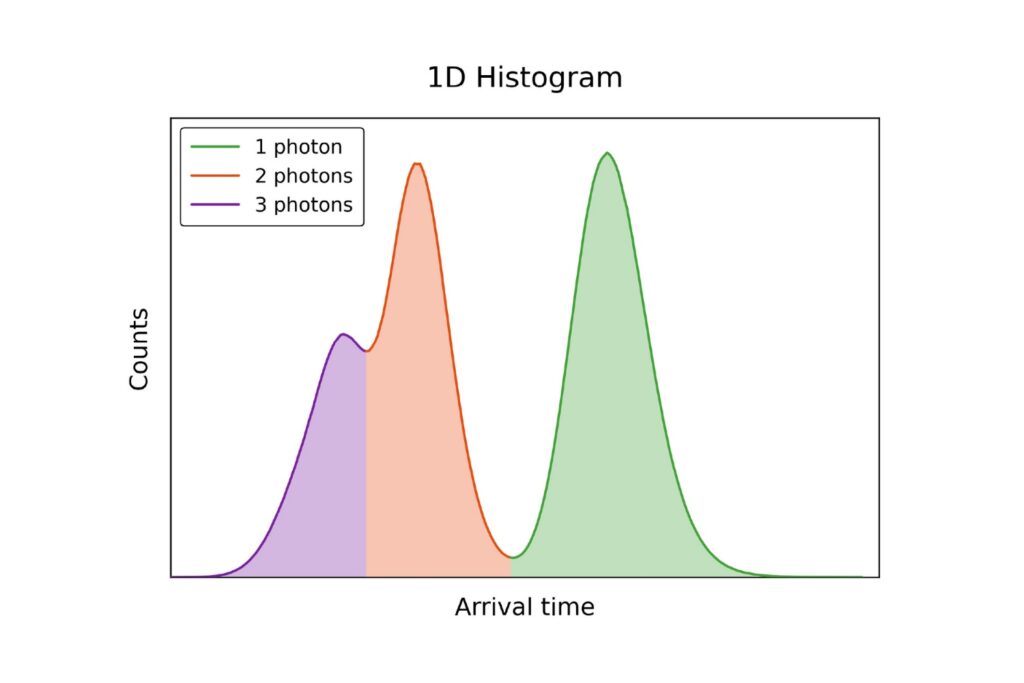
HydraHarp 500 is designed for the most advanced experiments in quantum optics and quantum photonics that demand both maximum timing accuracy and high data throughput, including multi-photon coincidence and correlation measurements such as g(2) antibunching, Hong–Ou–Mandel (HOM) interferometry, photon-number resolving (PNR) detection as well as quantum key distribution (QKD) and photonic quantum computing.

Specifications

HydraHarp 500 SHydraHarp 500 M
Number of detector channels (in addition to sync input)4 (Base model) | 5-8 (Base model + channel upgrades)4 (Base model) | 5-16 (Base model + channel upgrades)
Input voltage operating range (pulse peak into 50 Ohms)- 1200 mV to 1200 mV- 1200 mV to 1200 mV
Input voltage max. range (damage level)-2500 mV to 2500 mV-2500 mV to 2500 mV
Trigger methodEdge trigger: falling or rising edge (software adjustable) | CFD: falling edgeLevel trigger
HydraHarp 500 SHydraHarp 500 M
Minimum time bin width1 ps1 ps
Timing precision*3.5 ps RMS typ.3.5 ps RMS typ.
Timing precision / √2*2.5 ps RMS typ.2.5 ps RMS typ.
Dead time < 680 ps (edge trigger), < 6.8 ns (CFD)< 680 ps (edge trigger), < 6.8 ns (CFD)
Differential non-linearity< 5 % peak, < 1 % RMS (over full measurement range)< 5 % peak, < 1 % RMS (over full measurement range)
Maximum sync rate (periodic pulse train)1200 MHz (edge trigger), 140 MHz (CFD)1200 MHz (edge trigger), 140 MHz (CFD)
HydraHarp 500 SHydraHarp 500 M
Count depth32 bit (4 294 967 296 counts)32 bit (4 294 967 296 counts)
Maximum number of time bins131072131072
HydraHarp 500 SHydraHarp 500 M
Peak count rate per input channel1.25 Gcps for burst durations up to 2048 events1.25 Gcps for burst durations up to 2048 events
Sustained count rate per input channel**80 Mcps80 Mcps
Total sustained count rate, sum over all input channels**85 Mcps85 Mcps
HydraHarp 500 SHydraHarp 500 M
PeriodProgrammable, 0.1 µs - 1.678 s (0.596 Hz - 10 MHz)Programmable, 0.1 µs - 1.678 s (0.596 Hz - 10 MHz)
HydraHarp 500 SHydraHarp 500 M
Number44
HydraHarp 500 SHydraHarp 500 M
Ref. IN10 MHz 200 … 1500 mV p.p. 50 Ohm; AC coupled10 MHz 200 … 1500 mV p.p. 50 Ohm; AC coupled
Ref. OUTDefault: 10 MHz White Rabbit mode: 31.25 MHz 250 mV p.p 50 Ohm; AC coupledDefault: 10 MHz White Rabbit mode: 31.25 MHz 250 mV p.p 50 Ohm; AC coupled
PPS IN1 s, LVTTL1 s, LVTTL
White Rabbit interfaceConnector for SFP moduleConnector for SFP module

* In order to determine the timing precision it is necessary to repeatedly measure a time difference and to calculate the standard deviation (RMS error) of these measurements. This is done by splitting an electrical signal from a pulse generator and feeding the two signals each to a separate input channel. The differences of the measured pulse arrival times are calculated along with the corresponding standard deviation. This latter value is the RMS jitter which we use to specify the timing precision. However, calculating such a time difference requires two time measurements. Therefore, following from error propagation laws, the single channel RMS error is obtained by dividing the previously calculated standard deviation by √(2). We also specify this single channel RMS error here for comparison with other products.

** Sustained throughput depends on configuration and performance of host PC.

Technical Documentation and Data

Technical Downloads

Datasheet HydraHarp 500

Provides detailed specifications of this high-resolution TCSPC and time-tagging module designed for fast, precise photon counting

Technical Note: TCSPC

Explaining the principles of time-correlated single photon counting (TCSPC), including photon statistics, detectors, timing electronics, and applications.

Highlight Features

Fast

Highest data throughput up to 85 Mcps via USB 3.0 and < 680 ps dead time

Precise

1 ps resolution and few-picosecond stability for accurate timing

Flexible

Configurable channels, CFD and level/edge triggering & White Rabbit synchronization

Flexible Control and Software Integration

HydraHarp 500 offers versatile software and control options to ensure seamless integration into any experimental workflow. From an intuitive graphical user interface to high-performance Python APIs and fully programmable libraries, the system adapts easily to both rapid measurements and advanced, custom-built applications.

UniHarp software interface displaying time resolved histogram measurement data

UniHarp: intuitive control and advanced measurement modes

HydraHarp 500 is fully compatible with UniHarp, PicoQuant’s modern and intuitive graphical user interface for TCSPC and time tagging. UniHarp provides seamless access to advanced measurement modes such as time trace, histogram, raw data, unfold, and correlation analysis including FCS and g², enabling efficient data acquisition and real-time experiment monitoring.

Visit
snAPI Python interface for controlling PicoQuant Time Tagging & TCSPC electronics.

snAPI: fast and flexible Python integration

For users who require programmatic control, HydraHarp 500 supports snAPI, a high-performance Python interface built on a robust C++ core. snAPI enables fast device configuration, real-time data access, and direct handling of unfolded data or PTU files, allowing researchers to implement custom algorithms and automated analysis pipelines.

Visit
Custom programming with Python and Matlab for HydraHarp 500 workflows

Fully programmable for custom workflows

For maximum flexibility, the HydraHarp 500 offers a comprehensive programming library supporting C, C#, LabVIEW, Matlab, and Python. This enables full integration into custom experimental environments and synchronized measurement systems. Provided demo code and well-documented functions ensure a fast and straightforward start for advanced users.

Product Highlights

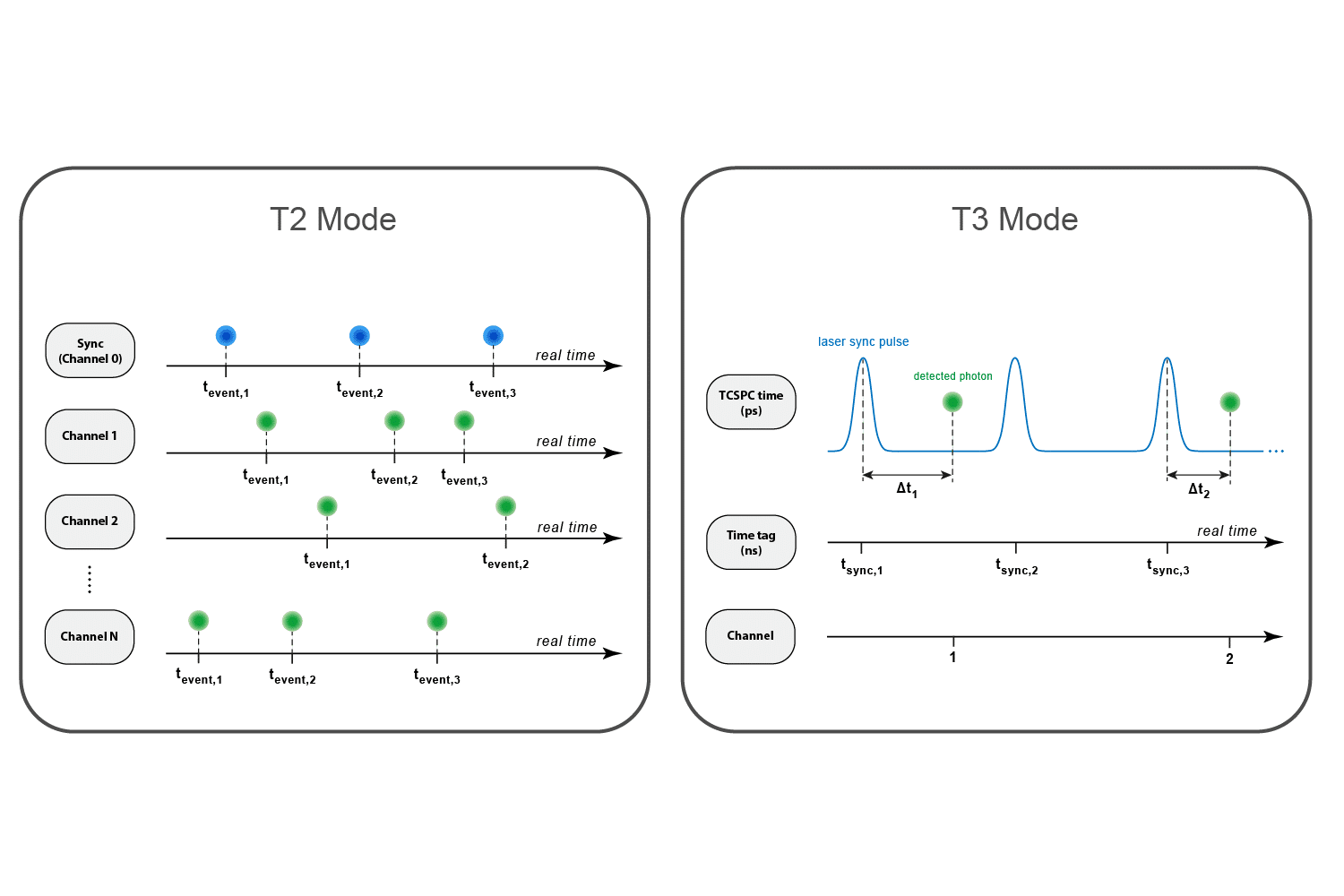
HydraHarp 500 combines advanced time-tagging capabilities with flexible trigger configurations to support a wide range of time-resolved photon experiments.

Diagram illustrating T2 and T3 time tagging architectures used in TCSPC systems to record photon arrival times.

Time-Tagged Time-Resolved (TTTR) Mode

PicoQuant‘s revolutionary TTTR mode records every detected photon as an individual time-tag event without early data reduction, preserving the full timing information of the experiment. This enables advanced analyses such as photon burst detection, detailed fluorescence dynamics, FCS, g2 correlation and high speed FLIM with unlimited image size. TTTR is also widely used in single molecule spectroscopy, time interval analysis and quantum optics. A dedicated blog article will provide a deeper introduction to TTTR, its modes and its application range.

Comparison of level trigger and constant fraction discriminator timing detection

Flexible Trigger Methods

In order to support the widest possible variety of single photon detectors, the PicoHarp 330 provides different input circuitry. For optimal timing with e.g. Single-Photon Avanlanche Diodes (SPADs) the inputs can be configured as level triggers while for best performance with Hybrid Photodetectors (HPD), Photomultiplier Tubes (PMTs), Micro Channel Plates (MCPs) or Superconducting Nanowire Single-Photon Detectors (SNSPDs) at high count rates they can be configured as Constant Fraction Discriminators (CFD). This way the overall system IRF may be tuned to become narrower. The same could not be achieved with a simple level trigger (comparator). Particularly with PMTs and MCPs, constant fraction discrimination is very important as their pulse amplitudes vary significantly.

Continuous hardware histogramming in Conti Mode for time-resolved TCSPC data acquisition

Continuous Hardware Histogramming

Conti-Mode is PicoQuant’s hardware-based continuous histogramming workflow for high-speed, uninterrupted acquisition of time-resolved data. Instead of capturing a single histogram at a time, the instrument generates consecutive, gapless histogram blocks automatically, each combining precise timing metadata with full histogram content and channel sums. This makes Conti-Mode ideal for real-time monitoring, long measurement series, process control, and applications such as fluorescence lifetime flow cytometry where continuous streaming and instant evaluation of histogram data are essential.”

Relevant for Your Research​

Matching Applications & Methods​

Switcher A&M
Schematic illustration of quantum key distribution showing single photons exchanged between Alice and Bob while eavesdropping by Eve introduces detectable disturbances.
Quantum Optics
Schematic of quantum sensing using a nitrogen-vacancy center in diamond for optical readout of magnetic field interactions
Materials Science | Quantum Optics
In-Depth Scientific Resources

Scientific Resources

Access in-depth application notes and scientific posters with detailed methods, measurement data, and real-world use cases.

Poster: High-Precision Time Tagging for Scalable Photonic Quantum Experiments

Poster on high-precision time tagging for scalable photonic quantum experiments using SNSPD arrays and multichannel TCSPC systems.

Download

Request your file

Please fill out the form below to receive the requested file. After submitting your details, the file will be sent to you by email.

* Required

Expert Q&A

How does HydraHarp 500 enable high-speed, high-precision photon counting for quantum optics and materials science? In this expert Q&A, we discuss its key features, applications, and what makes it a powerful tool for demanding photon counting experiments.
Expand Your System

Complete your setup

Combine compatible components to build a complete system tailored to your experimental requirements and measurement workflows.
Universal Time-Tagging Data Acquisition Software
Run complex experiments faster with intuitive workflows
Gain immediate experimental feedback via real-time visualization
Set up complex measurements without scripting
Compare live results directly with previously recorded data
Clean measurement data using built-in filtering tools
Hybrid Photomultiplier Detector Assembly
Wide dynamic range
Best timing precision for shortest lifetimes
No dead time and negligible afterpulsing
High count rate perfomance
Large, easy-to-align active area
Reliable UV–NIR coverage
High-End Picosecond Diode Laser Driver
Higher pulse stability
Faster experiment setup
Cleaner timing performance
Greater operational flexibility
Improved long-term reproducibility
Reliable synchronization
Learn, Connect, and Exchange

Meet PicoQuant at Scientific Events

Info Request

Explore Similar Products

Customer also Bought

Explore alternative products within this category to compare specifications, performance, and configurations for your application.

Fiber Amplified Picosecond Laser Diode Heads
Higher excitation power
Cleaner time-domain measurements
More flexible experiment design
Reliable performance at high repetition rates
Stable output for quantitative workflows
Precise timing in synchronized setups
High Power NIR to IR Picosecond Laser
High quality data
Enhanced resolution
Reduced photobleaching
Reliable timing stability
Consistent performance over long experiments
Easy integration & operation
Cooled Single Photon Detector Array
Super-resolution with confocal microscopes
Higher photon collection efficiency
Reduced background and detector noise
Faster acquisition through parallelization
Improved signal-to-noise ratio
Scalable multi-channel TCSPC workflows

Info Request

Contact us

Please fill out the form below to request more information about our products and services. You may also use it to ask for pricing, availability, technical specifications, or any other details relevant to your inquiry. Our team will be happy to review your request and get in touch with you. If additional information is needed to process your inquiry, we will let you know.

* Required

Contact us

Please fill out the form below to request more information and prices about our product. Our team will be happy to review your request and get in touch with you. If additional information is needed to process your inquiry, we will let you know.

* Required