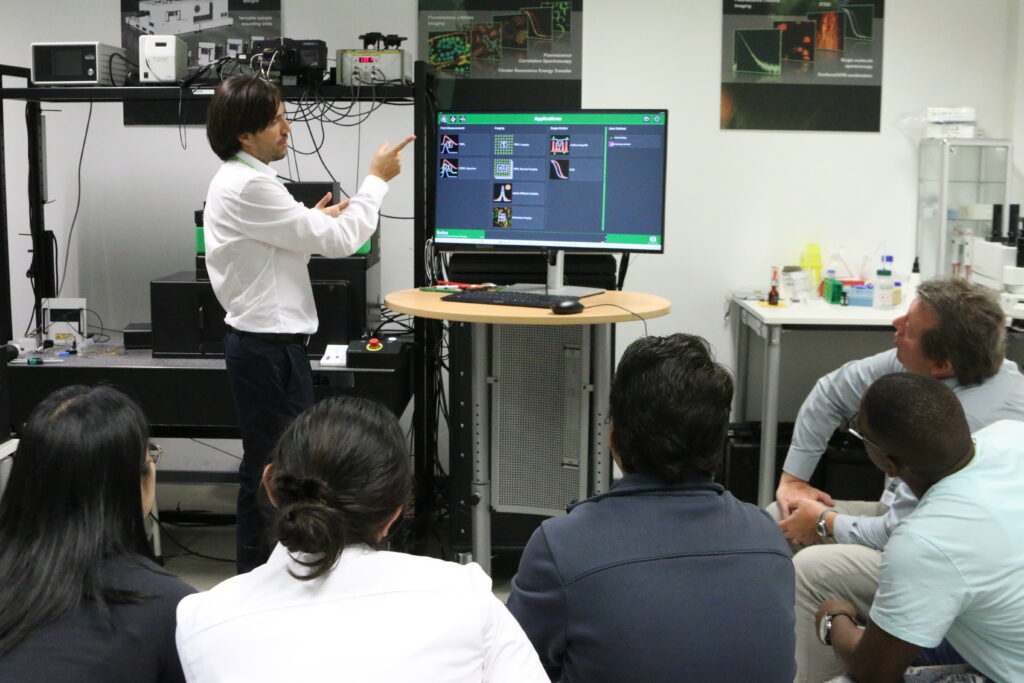
Complete confocal fluorescence microscope that empowers researchers to advance quantitative functional imaging from individual molecules to cells and tissues.

Modular, customizable, time-resolved confocal microscope with single-molecule sensitivity for life and materials science.

Compact FLIM and FCS upgrade kit that adds advanced functional imaging and correlation analysis to existing laser scanning microscopes.

Designed for flexible, sensitive, and precise steady-state and time-resolved spectroscopy across the UV to NIR range and time scales from picoseconds to milliseconds.

Modular lifetime spectrometer designed for flexible fluorescence and photoluminescence measurements in both materials and life science research.

Add spectral and time-resolved photoluminescence to your setup through flexible microscope–spectrometer coupling options.

Get the most out of superconducting nanowire detectors in large-scale quantum communication and computing experiments requiring precise multichannel timing.

Boost your time-resolved experiments with a flexible, high-precision time tagging and TCSPC unit for materials science and quantum sensing.

Scale your photonic quantum computing and detector characterization setups while maintaining performance, flexibility, and high data throughput.

Compact 3-color picosecond laser delivering flexible ns to ms excitation with cost-effective multicolor performance and straightforward operation.

Smart picosecond laser diode heads covering UV-A to NIR, providing the right combination of power, pulse width, and diode type for any time-resolved technique.

VisUV provides clean short pulses and stable timing across key UV and visible wavelengths, including deep UV lines as well as 488 nm and 532 nm.

Enhance your single-photon counting experiments with wide dynamic range and excellent timing precision in the UV and visible even at the highest count rates.

Capture even the weakest signals over large areas with maximum dynamic range and enhanced low-light sensitivity in a compact detector design.

Unlock spatially resolved single-photon detection with a 23-pixel SPAD array, combining low dark counts and precise time tagging for advanced experiments.

Advanced FLIM analysis software for fast, accurate interpretation of lifetime imaging data.

Intuitive, free software solution for real-time, high-precision photon data acquisition, visualization, and initial data analysis.

Advanced software for time-resolved fluorescence acquisition and analysis.

An imaging technique that uses fluorescence lifetimes to generate image contrast.

Investigating how proteins dynamically explore multiple conformational states that control biological function.

Investigating how biomolecules separate into dynamic liquid phases to organize cellular space and regulate biological function.

A time-resolved technique that measures photoluminescence lifetimes to reveal excited-state dynamics in materials.

Studying exciton dynamics, charge carrier processes, and structural properties through optical and time-resolved characterization methods.

Investigating charge-carrier lifetimes and recombination dynamics to enable precise optical characterization of material quality and device performance.

A quantum optical signature revealed by time-resolved photon correlation analysis to identify single-photon emission in materials and nanostructures.

The transmission of information using individual photons, using quantum effects to ensure absolute security.

Quantifying photons per detection event enables direct access to photon-number statistics, providing insight into quantum and statistical properties of light.

An optical technique that analyzes light emission under electrical excitation to reveal electronic properties of electroluminescent materials.

Monitoring environmental signals and trace compounds to understand dynamic changes in natural and engineered environments.

A photon timing technique that measures single-photon arrival times to resolve ultrafast dynamics in fluorescence, materials research, and quantum optics.
Time-correlated single photon counting (TCSPC) is a time-resolved measurement technique that determines the arrival time of individual photons relative to a periodic excitation signal. By repeating this measurement over many excitation cycles and accumulating the recorded time differences in a histogram, TCSPC reconstructs the temporal decay of optical emission with typical time resolutions in the picosecond range. The method is widely used for fluorescence lifetime measurements, carrier recombination studies in semiconductors, and photon correlation experiments for the characterization of non-classical light.
In TCSPC a pulsed excitation source illuminates the sample, emitted photons are detected by a single-photon detector, and their arrival times are recorded relative to the laser sync pulse. Accumulation over many events forms a histogram that reveals temporal dynamics such as fluorescence decay.Time-Correlated Single Photon Counting (TCSPC) measures the time delay between a periodic excitation pulse and the detection of an emitted photon. A pulsed excitation source (e.g. a laser) excites the sample. Each excitation pulse provides a precise temporal reference signal (laser sync). When the sample emits a photon that is detected by a single-photon detector, this event is registered as a stop signal. The TCSPC electronics then determines the time difference between the excitation pulse and the detected photon (Δt₁, Δt₂, …) with picosecond precision. Each measured time interval is assigned to a corresponding time bin in a histogram. Over many excitation cycles, these individual photon events accumulate to form the characteristic decay curve. Each detected photon contributes a count to its respective time channel. The resulting histogram represents the temporal distribution of photon arrival times and corresponds to the convolution of the sample’s fluorescence decay with the instrument response function (IRF). The IRF accounts for the finite timing resolution of the excitation source, detector, and timing electronics.
A key limitation in TCSPC arises from the finite dead time of the timing electronics. After registering a photon, the system is temporarily unable to detect or process additional photons. As a result, if multiple photons arrive within the same excitation cycle, only the first one is recorded, while subsequent photons are lost. This effect leads to pile-up distortion: early-arriving photons are more likely to be detected, whereas later photons within the same cycle are increasingly suppressed.
Consequently, the measured histogram becomes biased toward shorter arrival times and no longer accurately represents the true decay. To minimize pile-up, TCSPC operates in the single-photon regime. The probability of detecting a photon per excitation cycle is therefore kept low (typically well below 5%). Under these conditions, the likelihood of multiple photons occurring within the same cycle is negligible, ensuring that the recorded photon arrival times are statistically representative of the underlying decay process.
Modern TCSPC systems, such as those based on advanced time-to-digital converter (TDC) architectures, enable high count rates, precise timing, and efficient handling of photon events, forming the basis for accurate time-resolved measurements.
Beyond classical decay histogramming, modern TCSPC systems provide multiple data acquisition modes that preserve additional temporal information and enable more complex analyses.
Histogram Mode
In histogram mode, each measured start–stop interval is assigned to a discrete time bin. Over many excitation cycles, the accumulated counts form a decay curve representing the temporal evolution of the emission process. This mode is commonly used for fluorescence lifetime measurements (FLIM) and other time-resolved spectroscopy experiments such as time-resolved photoluminescence (TRPL) where the primary goal is to extract decay parameters.
Time-Tagged Time-Resolved (TTTR)
In time-tagged time-resolved (TTTR) mode, individual photon events are recorded sequentially rather than immediately accumulated into a histogram. Each photon is stored with its microtime (arrival time relative to the excitation pulse) and a macrotime stamp that references the overall experimental timeline. This approach preserves the full photon stream and allows flexible post-processing, including lifetime analysis, correlation analysis, and image reconstruction from scanning microscopy data. Read more about TTTR in our blog article.
TCSPC provides the photon timing foundation for a wide range of time-resolved spectroscopy and microscopy techniques. Historically, the primary goal of TCSPC was the determination of fluorescence lifetimes upon pulsed optical excitation. This objective remains central today and continues to shape instrument design. However, modern implementations extend this concept by enabling more comprehensive extraction of information from detected photons. By delivering picosecond-resolved arrival time information for individual photons, it enables quantitative lifetime measurements and correlation-based analyses down to the single-molecule level.
In life science research, TCSPC underpins methods such as fluorescence lifetime imaging microscopy (FLIM) and Förster resonance energy transfer (FRET). It also provides the precise timing information required for fluorescence correlation spectroscopy (FCS) and related techniques. Together, these approaches offer insight into molecular interactions, conformational dynamics, and environmental changes with high temporal sensitivity.
In materials science, TCSPC is widely used to investigate carrier recombination dynamics in semiconductors, nanomaterials, polymers, and optoelectronic structures. Time-resolved photoluminescence (TRPL) measurements reveal charge carrier lifetimes, trap states, and non-radiative recombination pathways that critically determine material performance.
In quantum optics, precise photon timing enables antibunching experiments, photon correlation analysis, and the characterization of single emitters and quantum light sources. By recording photon arrival times across multiple detection channels, TCSPC systems support coincidence detection and correlation measurements relevant to quantum communication, computing and sensing.

PicoQuant has defined the technological evolution of time-correlated single photon counting for decades. From compact PCIe boards for system integration to high-throughput multichannel platforms for quantum photonics, PicoQuant TCSPC electronics set the benchmark for picosecond timing, ultrashort dead time, and scalable architecture.
All current platforms are based on fully digital time-to-digital converter designs engineered for deterministic timing, high sustained count rates, and precise dead-time control. Resolutions down to 1 ps, timing jitter in the few-picosecond range, and dead times below 650 ps enable reliable single-photon detection even in demanding high-rate environments.
With independent timing channels, multi-stop capability, and advanced time-tagged time-resolved acquisition, PicoQuant electronics support applications ranging from fluorescence lifetime imaging and semiconductor carrier dynamics to multi-photon coincidence detection and large-scale quantum communication experiments.
High channel scalability, integrated White Rabbit synchronization, on-board event filtering, and programmable FPGA interfaces allow seamless expansion from laboratory setups to distributed quantum networks. Combined with flexible software environments and high-performance APIs, PicoQuant systems are designed not only to measure photons, but to control, process, and analyze them with maximum precision.
When ultimate timing performance and architectural flexibility are required, PicoQuant TCSPC electronics provide the reference standard for photon counting and time tagging.

HydraHarp 500 delivers picosecond timing precision, ultrashort dead time, and a fully digital multichannel architecture for demanding quantum photonics experiments. It unlocks the full performance of superconducting nanowire detectors in large-scale quantum communication and quantum computing setups requiring synchronized, high-accuracy timing across many input channels.

PicoHarp 330 combines 1 ps base resolution, few-picosecond timing jitter, and sub-700 ps dead time in a compact platform. It is optimized for time-resolved photoluminescence, material science, and quantum sensing applications requiring flexible triggering, TTTR acquisition, and precise photon timing across multiple input channels.

MultiHarp 160 scales time tagging to large detector arrays with up to 64 synchronized channels and ultrashort dead time. Designed for multiplexed quantum photonics and multipixel detector characterization, it delivers high-throughput TTTR acquisition, FPGA-based real-time processing, and White Rabbit synchronization for deterministic picosecond timing.

MultiHarp 150 is a versatile multichannel TCSPC and time-tagging platform for reliable high-throughput photon counting. With picosecond timing resolution, ultrashort dead time, flexible channel configurations, and integrated White Rabbit synchronization, it supports spectroscopy, correlation measurements, and scalable time-resolved experiments across materials science, quantum optics, life science, and metrology.

TimeHarp 260 is a compact PCIe-based TCSPC and time-tagging board designed for seamless system integration, OEM solutions, and education. Based on custom TDC architecture, it delivers picosecond timing, high sustained count rates, multi-stop capability, and long-range measurement modes for lifetime analysis and correlation experiments.
This tech note describes White Rabbit–based synchronization of multiple TCSPC devices, enabling sub-50 ps timing accuracy over long fiber networks.
Use the form below to submit your inquiry. Select the appropriate department to ensure it reaches the right team. Our experts will be happy to review your request and get in touch with you.
* Required
Please fill out the form below to request more information about our products and services. You may also use it to ask for pricing, availability, technical specifications, or any other details relevant to your inquiry. Our team will be happy to review your request and get in touch with you. If additional information is needed to process your inquiry, we will let you know.
* Required