Complete confocal fluorescence microscope that empowers researchers to advance quantitative functional imaging from individual molecules to cells and tissues.

Modular, customizable, time-resolved confocal microscope with single-molecule sensitivity for life and materials science.

Compact FLIM and FCS upgrade kit that adds advanced functional imaging and correlation analysis to existing laser scanning microscopes.

Designed for flexible, sensitive, and precise steady-state and time-resolved spectroscopy across the UV to NIR range and time scales from picoseconds to milliseconds.

Modular lifetime spectrometer designed for flexible fluorescence and photoluminescence measurements in both materials and life science research.

Add spectral and time-resolved photoluminescence to your setup through flexible microscope–spectrometer coupling options.

Get the most out of superconducting nanowire detectors in large-scale quantum communication and computing experiments requiring precise multichannel timing.

Boost your time-resolved experiments with a flexible, high-precision time tagging and TCSPC unit for materials science and quantum sensing.

Scale your photonic quantum computing and detector characterization setups while maintaining performance, flexibility, and high data throughput.

Compact 3-color picosecond laser delivering flexible ns to ms excitation with cost-effective multicolor performance and straightforward operation.

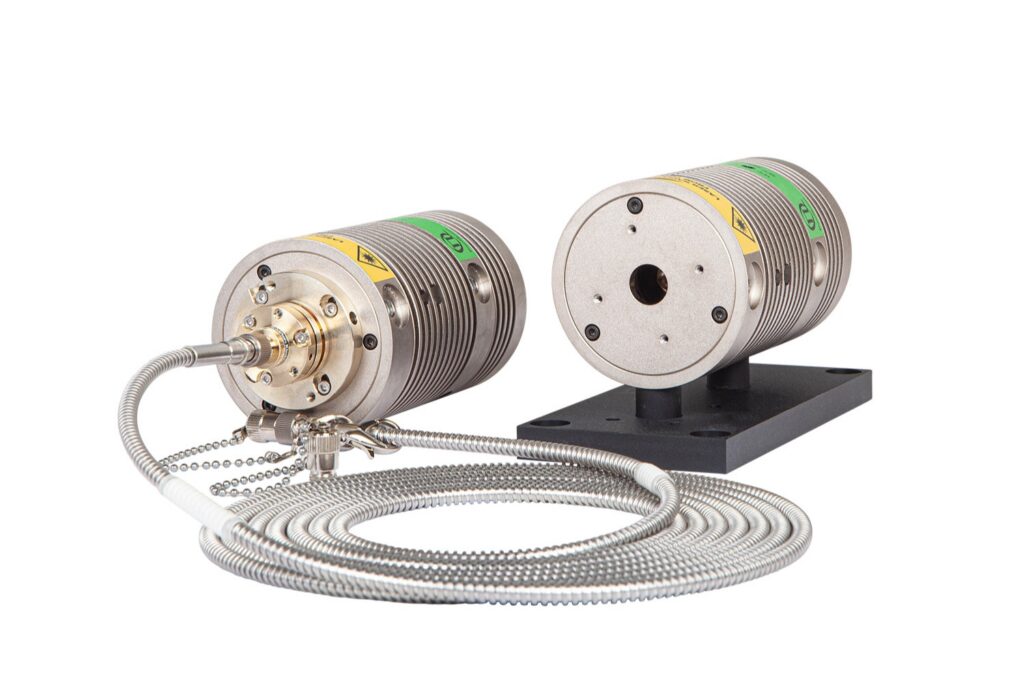
Smart picosecond laser diode heads covering UV-A to NIR, providing the right combination of power, pulse width, and diode type for any time-resolved technique.

VisUV provides clean short pulses and stable timing across key UV and visible wavelengths, including deep UV lines as well as 488 nm and 532 nm.

Enhance your single-photon counting experiments with wide dynamic range and excellent timing precision in the UV and visible even at the highest count rates.

Capture even the weakest signals over large areas with maximum dynamic range and enhanced low-light sensitivity in a compact detector design.

Unlock spatially resolved single-photon detection with a 23-pixel SPAD array, combining low dark counts and precise time tagging for advanced experiments.

Advanced FLIM analysis software for fast, accurate interpretation of lifetime imaging data.

Intuitive, free software solution for real-time, high-precision photon data acquisition, visualization, and initial data analysis.

Advanced software for time-resolved fluorescence acquisition and analysis.

An imaging technique that uses fluorescence lifetimes to generate image contrast.

Investigating how proteins dynamically explore multiple conformational states that control biological function.

Investigating how biomolecules separate into dynamic liquid phases to organize cellular space and regulate biological function.

A time-resolved technique that measures photoluminescence lifetimes to reveal excited-state dynamics in materials.

Studying exciton dynamics, charge carrier processes, and structural properties through optical and time-resolved characterization methods.

Investigating charge-carrier lifetimes and recombination dynamics to enable precise optical characterization of material quality and device performance.

A quantum optical signature revealed by time-resolved photon correlation analysis to identify single-photon emission in materials and nanostructures.

The transmission of information using individual photons, using quantum effects to ensure absolute security.

Quantifying photons per detection event enables direct access to photon-number statistics, providing insight into quantum and statistical properties of light.

An optical technique that analyzes light emission under electrical excitation to reveal electronic properties of electroluminescent materials.

Monitoring environmental signals and trace compounds to understand dynamic changes in natural and engineered environments.

A photon timing technique that measures single-photon arrival times to resolve ultrafast dynamics in fluorescence, materials research, and quantum optics.
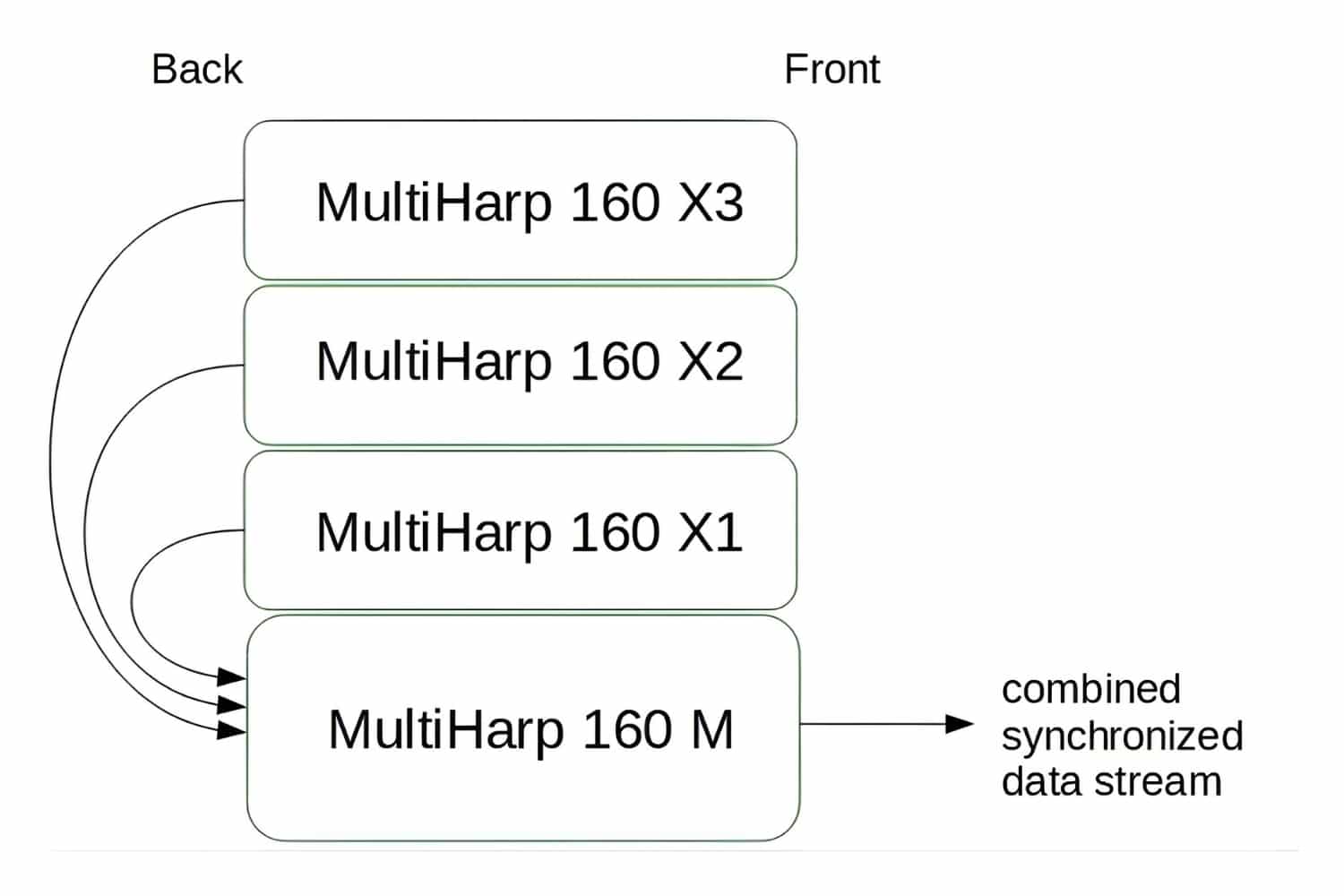
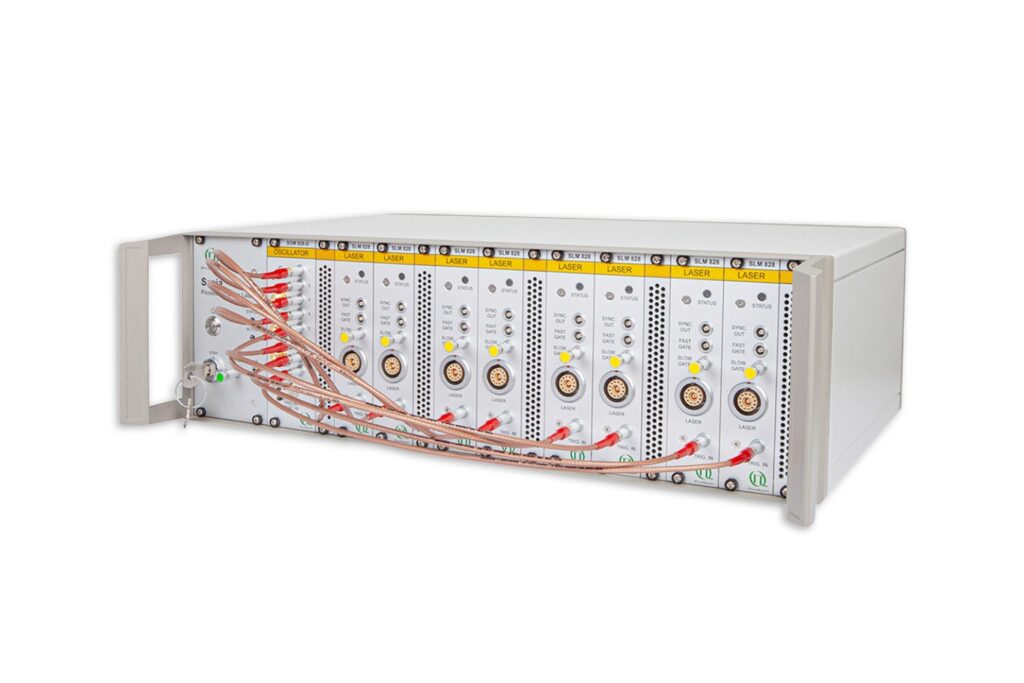
MultiHarp 160 has been developed to set new time tagging standards in scalability and interfacability. Its modular architecture supports up to 65 fully synchronized input channels with a record-breaking dead time of 650 ps. Equipped with flexible on-board event filters and its pioneering external FPGA interface, real-time custom programming and data throughput overcoming the USB limitation are facilitated. An integrated White Rabbit interface provides ps-precise synchronization across multiple devices and distributed setups without the need for additional hardware and sacrificing channels.
MultiHarp 160 addresses multiplexed applications in photonic quantum computing, including linear optical quantum computing (LOQC), boson sampling, and other multi-photon experiments that rely on precise coincidence detection across large numbers of channels. At the same time, its high channel density and precise timing make it ideally suited for the characterization and analysis of single-photon avalanche diode (SPAD) detector and superconducting nanowire single-photon detector (SNSPD) arrays.
| Number of detector channels (in addition to Sync input) | 16 (main unit), 32 (main unit + first extension unit), 48 (main unit + first and second extension unit), 64 (main unit + first, second, and third extension unit) |
| Input voltage operating range (pulse peak into 50 Ohms) | - 1200 mV to 1200 mV |
| Input voltage max. range (damage level) | ± 2500 mV |
| Trigger method | Falling or rising edge, software adjustable |
| Minimum time bin width | 5 ps |
| Timing precision | < 28 ps RMS |
| Timing precision / √2* | < 20 ps RMS |
| Dead time | < 650 ps (can be increased via software up to 160 ns in steps of 1 ns) |
| Differential non-linearity | < 5 % peak to peak, < 1 % RMS (over full measurement range) |
| Max sync rate (periodic pulse train) | 1.2 GHz |
| Count depth | 32 bit (4 294 967 295 counts) |
| Maximum number of time bins | 65 536 |
| Peak count rate per input channel | 1.5 Gcps for burst duration of 2048 events |
| Total sustained count rate, sum over all input channels** | 80 Mcps via USB 3.0 interface |
| Period | Programmable, 0.1 µs to 1.678 s (0.596 Hz to 10 MHz) |
| Number | 4 |
| Ref IN | 10 MHz, 200 … 1500 mV p.p., 50 Ohm; AC coupled |
| Ref OUT | Default: 10 MHz, White Rabbit mode: 31.25 MHz, 1400 mV p.p., 50 Ohm; AC coupled |
| PPS IN | 1 s, LVTTL |
| White Rabbit interface | Connector for SFP module |
* In order to determine the timing precision it is necessary to repeatedly measure a time difference and to calculate the standard deviation (RMS error) of these measurements. This is done by splitting an electrical signal from a pulse generator and feeding the two signals each to a separate input channel. The differences of the measured pulse arrival times are calculated along with the corresponding standard deviation. This latter value is the RMS jitter which we use to specify the timing precision. However, calculating such a time difference requires two time measurements. Therefore, following from error propagation laws, the single channel RMS error is obtained by dividing the previously calculated standard deviation by √(2). We also specify this single channel RMS error here for comparison with other products.
** Sustained throughput depends on configuration and performance of host PC.
All Information given here is reliable to our best knowledge. However, no responsibility is assumed for possible inaccuracies or omissions. Specifications and external appearances are subject to change without notice.
Provides detailed specifications of this multichannel TCSPC and time-tagging module designed for fast; precise photon-counting applications
This technical note describes White Rabbit-based synchronization of multiple TCSPC devices over long fiber networks
Key technologies that define the performance, scalability, and flexibility of MultiHarp 160.

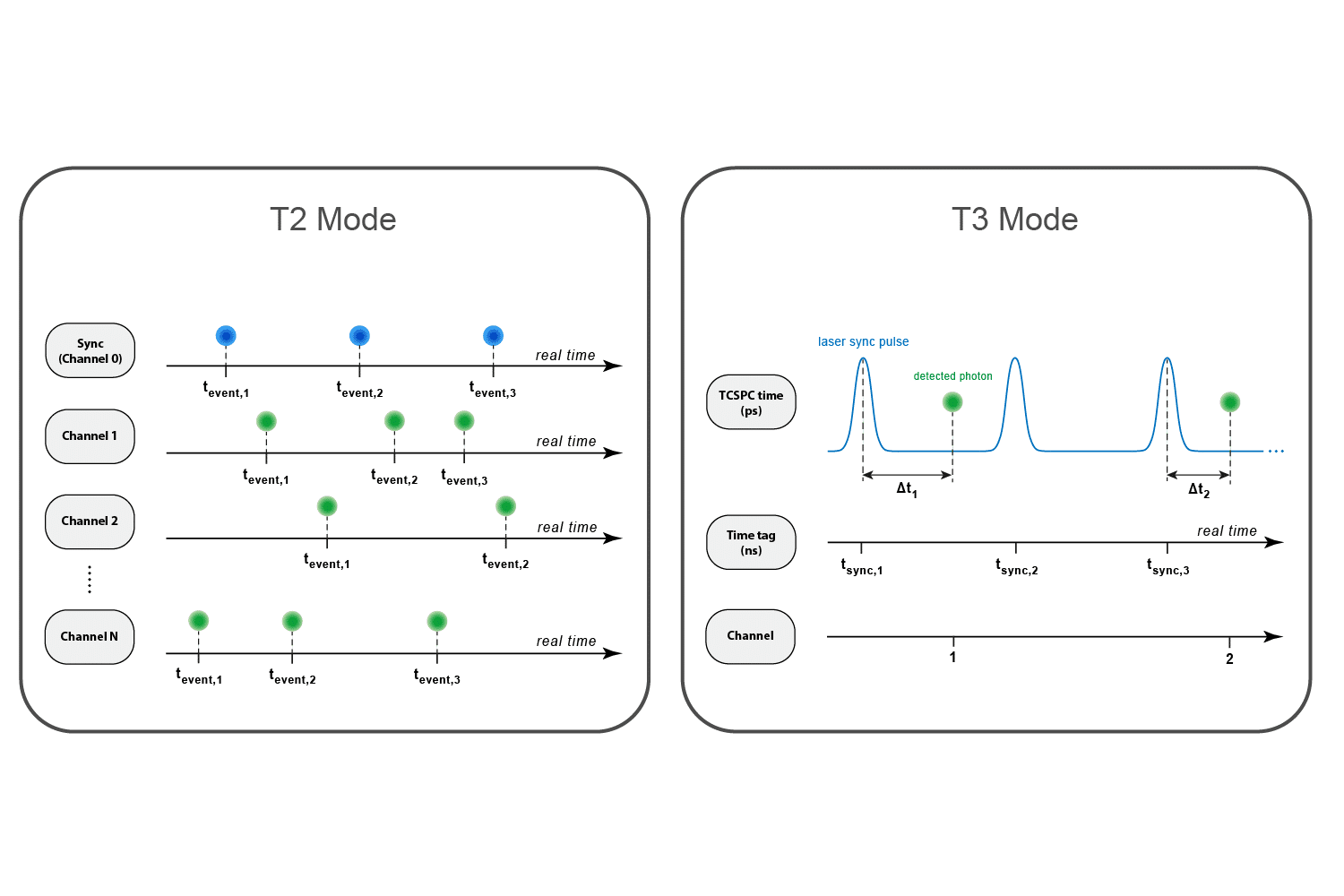
Time-Tagged Time-Resolved (TTTR) acquisition records every detected photon as an individual time-tagged event, preserving the complete temporal structure of the experiment. In quantum optics and detector characterization, TTTR is the native data model for coincidence analysis, photon statistics, and time-interval measurements across many channels.
MultiHarp 160 supports TTTR operation in both T2 and T3 modes, enabling flexible timing analysis depending on the experimental requirements. High sustained count rates, compact data formats, and hardware-level filtering help keep even long measurements manageable. Beyond quantum applications, TTTR also enables advanced analyses such as FCS, fluorescence dynamics, and burst detection. A dedicated blog article provides a deeper introduction to TTTR, its modes, and application range.

MultiHarp 160 features native White Rabbit support with fully integrated nodes for deterministic, Ethernet-based timing networks. This hardware-level integration enables sub-nanosecond accuracy and stable synchronization over large distances. By embedding the timing infrastructure directly inside the instrument, MultiHarp 160 enables highly reliable, long-distance synchronization without sacrificing input channels and is ideally suited for advanced distributed experiments and modern timing architectures.

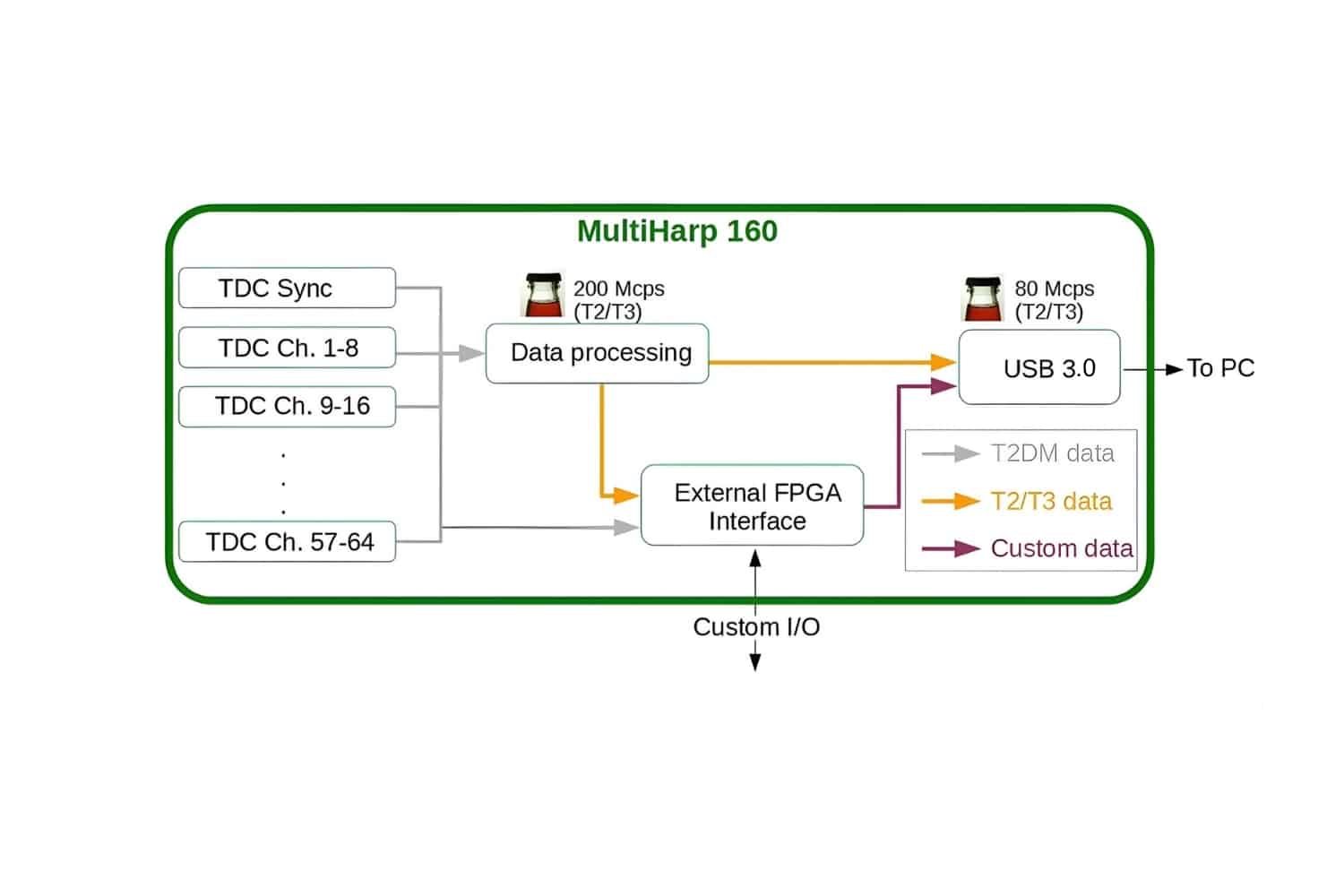
As quantum experiments scale in channel count and photon rate, data throughput quickly becomes the dominant limitation. While individual detector channels can operate at very high rates, conventional interfaces constrain how much information can be transferred to a computer in real time. MultiHarp 160 addresses this challenge through onboard processing, flexible data reduction, and a dedicated external FPGA interface. By enabling low-latency access to time tags and custom real-time processing beyond USB bandwidth limits, it allows researchers to adapt data handling precisely to their experimental requirements.

Quantum experiments rarely stay confined to a single box: Detectors multiply, setups stretch across optical tables, and sometimes even across buildings or kilometers of fiber. As complexity grows, timing electronics becomes the first thing to slip: channels saturate, data floods, clocks drift. The MultiHarp 160 is designed for this reality. It scales with your experiment, maintains picosecond timing at high rates, and uses White Rabbit to keep multiple devices synchronized with picosecond precision and sub-nanosecond accuracy over long distances. When your research surpasses conventional electronics, the MultiHarp 160 keeps everything aligned.
MultiHarp 160 includes easy-to-use, ready-to-run software for fast setup, live monitoring, and data visualization. At the same time, comprehensive programming interfaces support custom automation and experiment control across multiple languages and workflows.

UniHarp is PicoQuant’s integrated data acquisition software for MultiHarp systems, designed to give researchers a fast and intuitive start into time-resolved measurements. It offers real-time control of all key timing parameters, clear visual feedback through live histograms and time traces, and seamless access to correlation tools such as g2 and FCS. With a clean interface, structured parameter settings, and flexible data export, UniHarp supports both quick exploratory measurements and routine workflows. In combination with its built-in manipulators, UniHarp can also process photon time tags in real time, enabling coincidence filtering, heralded detection, and other experiment-specific data transformations directly during acquisition. It provides a consistent, modern environment for operating MultiHarp devices without additional setup effort.

For automated measurements and custom data pipelines, snAPI provides direct Python access to all MultiHarp configuration and acquisition functions. Its lightweight interface integrates smoothly into scientific codebases, enabling scripted scans, real-time processing, and experiment-specific timing logic. In combination with snAPI’s measurement classes and manipulators, photon data streams can be filtered, conditioned, and transformed in real time to implement coincidence logic, heralding schemes, or other experiment-specific workflows. Whether you need rapid prototyping or fully automated routines, snAPI offers the flexibility to adapt your workflow without overhead.
Poster on high-precision time tagging for scalable photonic quantum experiments using SNSPD arrays and multichannel TCSPC systems.
Poster on QuPAD: a massively parallel 64-channel single-photon detection system using SNSPD arrays and MultiHarp 160 for high-bandwidth quantum experiments.
Please fill out the form below to receive the requested file. After submitting your details, the file will be sent to you by email.
* Required
Please fill out the form below to request more information. You may also use it to inquire about pricing, availability, technical specifications, or discuss your specific application. Our sales team will be happy to review your request and get in touch with you. If additional information is needed to process your inquiry, we will let you know.
* Required
Explore alternative products within this category to compare specifications, performance, and configurations for your application.
Please fill out the form below to request more information about our products and services. You may also use it to ask for pricing, availability, technical specifications, or any other details relevant to your inquiry. Our team will be happy to review your request and get in touch with you. If additional information is needed to process your inquiry, we will let you know.
* Required
Please fill out the form below to request more information and prices about our product. Our team will be happy to review your request and get in touch with you. If additional information is needed to process your inquiry, we will let you know.
* Required