The 5 Percent Rule in TCSPC
For decades, time-correlated single photon counting (TCSPC) operated under an the rule: never exceed a few percent of the excitation rate.
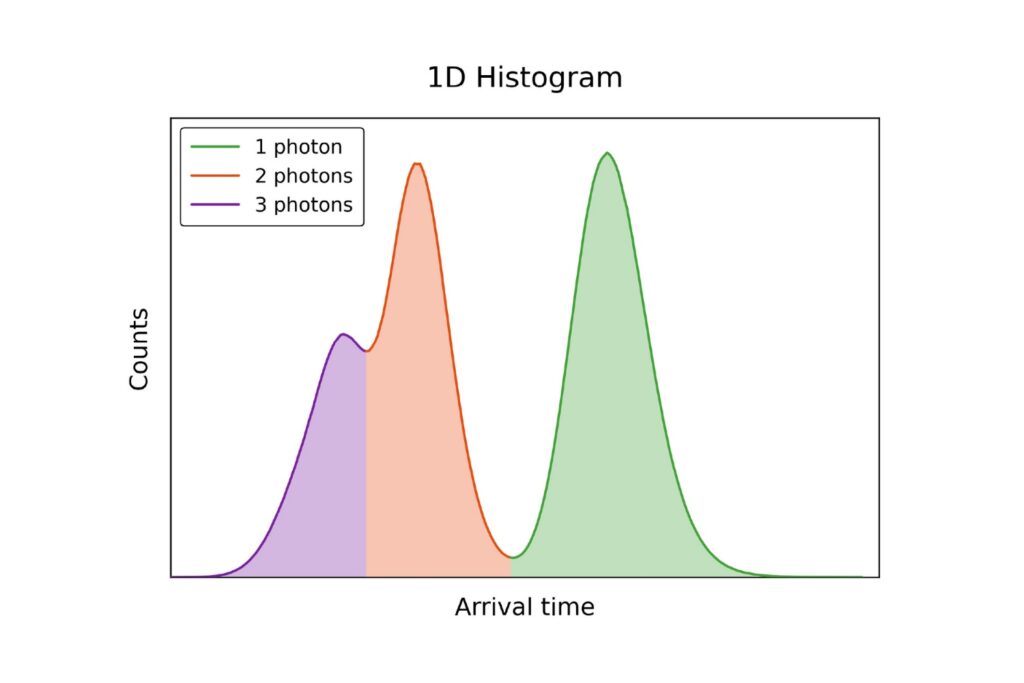
This limitation was not arbitrary. It emerged from the intrinsic statistics of photon detection and the finite dead time of detectors and timing electronics. When photon arrival rates increase, the probability that a second photon reaches the detector during processing of the first rises sharply. The consequence is pile-up distortion. Early photons are preferentially recorded, while later photons are systematically lost. The reconstructed decay no longer reflects the true emission dynamics of the sample.
To prevent this distortion, TCSPC systems were traditionally operated at count rates between one and five percent of the laser repetition frequency. This conservative regime ensured statistical fidelity but imposed a fundamental trade-off. Faster data acquisition required higher excitation intensity, yet higher intensity increased distortion.
The result was a methodological ceiling. TCSPC became synonymous with low-count-rate measurements, even though many modern applications in fluorescence imaging, quantum optics, and ranging demand much higher photon flux.
The question, therefore, was not how to operate safely below the limit. The question was whether the limit itself could be removed.
A Constraint-Free Framework for High-Rate TCSPC
In their publication, the group of Ivan Rech (Daniele et al., APL Photonics, 20251), introduced and experimentally validated a constraint-free approach to high-rate TCSPC. Instead of avoiding high photon flux, the authors demonstrated how the information lost through dead time can be reconstructed mathematically.
In conventional TCSPC, the recorded histogram reflects only those photons that were successfully registered. This measured distribution, rrec(t), deviates from the true distribution of photons impinging on the detector, rimp(t), because the system becomes temporarily inactive after each detection event.
The core innovation is the introduction of a time-dependent activity function, α(t). This function describes the probability that the detection system is active at a given time within the excitation period. Rather than assuming a fixed dead time correction or requiring prior knowledge of the decay shape, α(t) is reconstructed directly from the recorded timing information. Each excitation cycle contributes to a bin-wise estimate of whether the system was capable of detecting photons at that moment.
Dividing rrec(t) by α(t) yields an estimate of rimp(t) without imposing a model on the fluorescence decay. This removes the historical constraint that forced TCSPC operation to remain at only a few percent of the excitation rate.
Using this framework, Daniele et al. demonstrated operation at average photon numbers exceeding one photon per excitation period. In the reported experiments, count rates reached 121 % of the excitation frequency while maintaining stable lifetime estimation.

When Pile-Up Is Not the Only Distortion
After applying the α(t) correction, classical pile-up distortion was largely removed. Yet at the highest count rates, a residual deviation from the expected exponential decay was still observed. The source was not missed photons but corrupted timestamps.
Following each detection event, the hybrid photodetector output exhibits transient voltage ringing before returning to baseline. When a second photon arrives within this disturbed window, its leading edge is sampled from a shifted voltage level. Because the system relies on fixed-threshold discrimination, this baseline offset introduces a timing shift. Photons can therefore be registered slightly earlier or later than their true arrival time. This effect is rate-dependent and cannot be corrected by dead-time modeling alone.
To quantify this distortion, the authors used two synchronized laser sources with a controlled temporal delay. By mapping measured arrival times to true delays, they derived a correction function that compensates for the ringing-induced timing shift. Only after combining this hardware-specific correction with the α(t) reconstruction did the residual error fall below three percent at count rates exceeding one photon per excitation period.
System Architecture for High-Rate Distortion-Free TCSPC
The ability to operate beyond the traditional count-rate limit was not achieved through algorithmic innovation alone. It required a detection and timing architecture capable of preserving complete system state information at high photon flux.
Excitation was provided by PicoQuant’s Taiko PDL M1 picosecond laser driver coupled to an LDH-I diode laser head operating at 470 nm. The system delivered 80 ps pulses at a repetition rate of 20 MHz with stable synchronization to the timing electronics. This defined a precise temporal reference for each excitation cycle.
Photon detection was performed using the PMA Hybrid detector module based on hybrid photomultiplier technology. With a dead time of approximately 1.2 ns, negligible afterpulsing, and a clean electrical pulse response, the detector supported operation at photon rates that exceed the historical TCSPC limit.
Time acquisition was carried out using the MultiHarp 160 operating in time-tagging mode. Two synchronized input channels were used to capture both the falling edge corresponding to photon arrival and the rising edge marking the end of the detector dead time. This dual-edge acquisition provided explicit information about detector availability during each excitation period and enabled experimental reconstruction of the activity function α(t).
This architecture is essential to the constraint-free framework. Reconstruction of α(t) requires full access to time-resolved event streams and precise dead-time boundaries. Conventional histogramming electronics would not provide the necessary information.
High-rate TCSPC in this regime is therefore not merely a function of detector speed. It depends on the coherent interaction between stable picosecond excitation, fast hybrid detection, and high-throughput time-tagging electronics. Only as an integrated system does distortion-free measurement beyond the excitation rate become experimentally viable.

Instrumentation Used in This Study by PicoQuant
The constraint-free high-rate TCSPC implementation was realized using an integrated PicoQuant excitation, detection, and time-tagging architecture:
Taiko PDL M1 Picosecond Laser Driver
The Taiko PDL M1 provided stable picosecond excitation pulses at a repetition rate of 20 MHz. In combination with the LDH-I laser head, it delivered 80 ps pulses with precise synchronization to the timing electronics, ensuring a well-defined temporal reference for each excitation cycle.

LDH-I 470 nm Diode Laser Head
The LDH-I laser head generated pulsed excitation at 470 nm with clean temporal pulse profiles and stable output power. The short pulse width was essential for accurate reconstruction of the fluorescence decay without additional temporal broadening.

PMA Hybrid Detector Module
Photon detection was performed using a PMA Hybrid detector assembly based on hybrid photomultiplier technology. The detector provided single-photon sensitivity with negligible afterpulsing and an effective dead time of approximately 1.2 ns defined by the timing pulse threshold crossings. The clean electrical pulse response enabled reliable threshold-based edge discrimination at high count rates.

MultiHarp 160 Time-Tagging Unit
Time acquisition was carried out using a MultiHarp 160 operated in time-tagging mode. Dual-channel edge detection was used to record both photon arrival and detector reset events, enabling reconstruction of the detector activity function α(t). With picosecond timing resolution and high-throughput event streaming, the unit preserved full timing information required for distortion-free reconstruction beyond the excitation rate.

Conclusion
For decades, TCSPC was operated under a conservative count-rate limit to avoid distortion. Daniele et al. demonstrate that this limitation is not fundamental but architectural. By combining hybrid photodetection, time-tagged acquisition, and activity-based reconstruction with hardware-specific timing correction, distortion-free lifetime analysis becomes possible even beyond the excitation rate. High-rate TCSPC is therefore no longer restricted to low-flux regimes.
Explore how integrated excitation, detection, and time-tagging electronics can extend the quantitative limits of your TCSPC measurements.
1 Reference: P. Daniele, G. Fratta, I. Labanca, G. Acconcia, I. Rech. Breaking boundaries of hybrid photodetector: A novel approach for high-speed TCSPC with minimal distortion. APL Photonics 1 June 2025; 10 (6): 060803. https://doi.org/10.1063/5.0268205