The High Count Rate Challenge
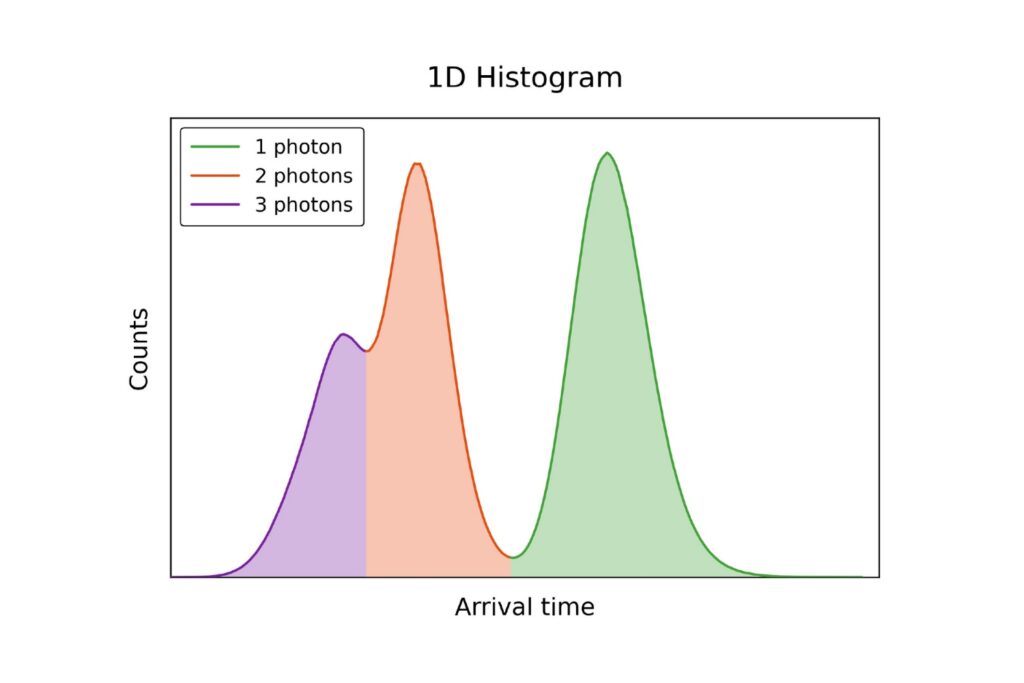
Photon number resolution (PNR) using superconducting nanowire single-photon detectors (SNSPDs) has attracted growing interest for quantum optical applications such as photonic quantum computing. In intrinsic SNSPD-based PNR, photon number information is encoded directly in the detector pulse shape and can be extracted from observables such as pulse timing and width.
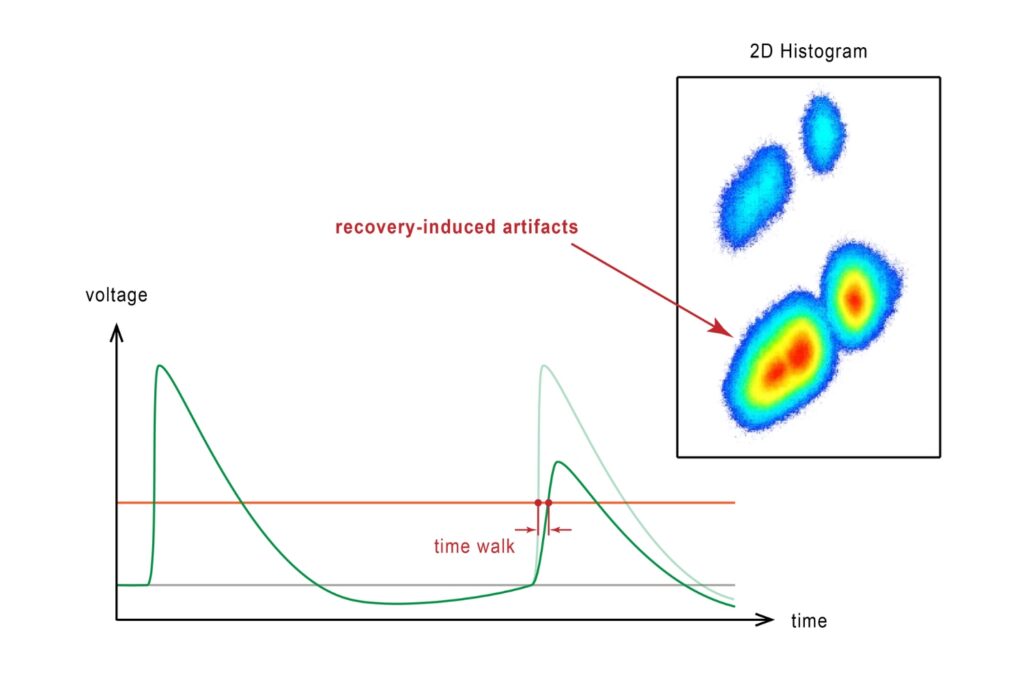
At low count rates, these pulse-shape differences can often be analyzed reliably using conventional timing techniques. However, operating SNSPDs at high repetition rates introduces an additional challenge: the detector may not fully recover between consecutive detection events. The resulting reduction in bias current modifies the detector response and leads to timing shifts, pulse-shape distortions, and duplicated photon number clusters in multidimensional timing histograms.
One possible solution is simply lowering the photon flux or repetition rate. In many modern experiments, however, this is undesirable or even impractical. High-throughput quantum photonics experiments increasingly demand both high timing precision and efficient handling of large event streams.
The Role of Time Tagging
In intrinsic SNSPD-based PNR, the detector output pulse contains significantly more information than a simple binary detection event. Depending on the number of simultaneously absorbed photons, the electrical response of the detector changes subtly in shape, width, and timing. Instead of digitizing the full waveform, this information can be extracted efficiently using high-resolution time tagging.

In our experiment, a femtosecond pulsed laser operating at a repetition rate of 20 MHz was attenuated to generate weak optical pulses with an average photon number of approximately two photons per pulse. The optical signal was detected using an SNSPD from Quantum Opus.
To access pulse-shape information, the detector signal was split into two timing channels of the HydraHarp 500 and analyzed relative to the laser synchronization signal. Multiple timing observables were extracted directly from the SNSPD pulses:
- leading-edge timing relative to the sync pulse
- trailing-edge timing relative to the sync pulse
- pulse width or time-over-threshold
This effectively transforms photon number discrimination into a multidimensional timing problem. Different photon numbers produce distinct combinations of rising-edge timing and pulse width, resulting in separable clusters in 2D histograms.
Importantly, this approach avoids the large data rates and computational overhead associated with continuous waveform digitization. Instead, only a small number of precisely timed events must be recorded for each detection pulse. Combined with efficient time-tagged time-resolved data acquisition such as the T3 mode, this enables scalable high-throughput PNR analysis while preserving picosecond timing precision.
Recovery-Induced Artifacts
At low repetition rates, the SNSPD typically returns close to its equilibrium state before the arrival of the next optical pulse. Under these conditions, pulses corresponding to different photon numbers form well-separated and stable clusters in 2D histograms. At higher count rates, however, the situation changes significantly. The recovery time of the detector becomes comparable to the laser repetition period, meaning that consecutive detection events frequently occur before the detector has fully recovered its bias current. As a result, the detector operates in different recovery states depending on its recent detection history.
These partially recovered states modify the electrical response of the SNSPD in several ways. Both the leading- and trailing-edge timing shift relative to the synchronization signal, while the pulse decay becomes particularly sensitive to the reduced bias current. As a result, the measured timing observables no longer depend solely on photon number, but also on the instantaneous recovery state of the detector.

When the detector is fully recovered, the pulse exhibits its intrinsic shape and timing behavior. Incompletely recovered pulses, however, show modified amplitudes, altered slew rates, and shifted threshold-crossing times. Since both leading- and trailing-edge time tags are affected, recovery effects propagate directly into the multidimensional timing observables used for PNR analysis.
Recovery-Corrected Analysis
The recovery-induced pulse distortions become clearly visible in 2D histograms of trailing-edge versus leading-edge arrival times relative to the excitation sync signal. Distinct photon-number-dependent clusters can be identified, but instead of a single set of clusters, two separated groups appear.

The weaker clusters correspond to pulses generated when the detector is fully recovered, while the brighter, displaced clusters originate from incompletely recovered detector states. Within each group, the clusters exhibit a pronounced diagonal correlation due to the coupled shift of rising- and falling-edge timing.
To separate intrinsic photon number information from recovery-induced distortions and ultimately enable robust temporal gating for photon number discrimination, the data can be transformed using a sequence of simple coordinate transformations. First, the timing representation is converted into time-over-threshold space by combining the leading- and trailing-edge timing information. By this, the data are projected onto the principal cluster direction to align the photon-number-dependent bands. Next, a linear scaling can be applied to one coordinate axis to compensate for the different timing spreads and align the cluster structure along a common direction. Finally, the displaced clusters originating from incompletely recovered detector states can be selected and shifted, allowing clusters corresponding to identical photon numbers to overlap.
PicoQuant’s Hardware and Software Implementation
The recovery-corrected PNR workflow presented here demonstrates how multidimensional time tagging can transform SNSPD pulse-shape analysis into an efficient and scalable high-throughput measurement technique. By combining leading-edge timing, trailing-edge timing, and time-over-threshold information, photon-number-dependent detector responses can be separated from recovery-induced artifacts.
The lightweight coordinate transformations used for recovery correction are computationally efficient and compatible with real-time processing. This enables robust photon number discrimination even under demanding high-count-rate operating conditions.
At PicoQuant, these workflows can be implemented using high-resolution time tagging platforms such as the HydraHarp 500 and PicoHarp 330 together with the UniHarp software environment. Interactive multidimensional histograms, coordinate transformations, and recovery-time corrections can be applied directly within the software workflow, while the snAPI Python interface enables integration into advanced analysis pipelines.

Further reading: A. Lehr et al., “High-resolution and high-throughput multichannel time tag streaming over USB”, Proc. SPIE 14019, Advanced Photon Counting Techniques XX, 140190E (2026). https://doi.org/10.1117/12.3096130
Explore how the HydraHarp 500 and PicoHarp 330 enable high-resolution time tagging workflows for advanced SNSPD-based photon number analysis.