Photon Number Resolution (PNR)

Reveal How Many Photons are Present in Each Optical Event

Quantifying photons per detection event enables direct access to photon-number statistics, providing insight into quantum and statistical properties of light.
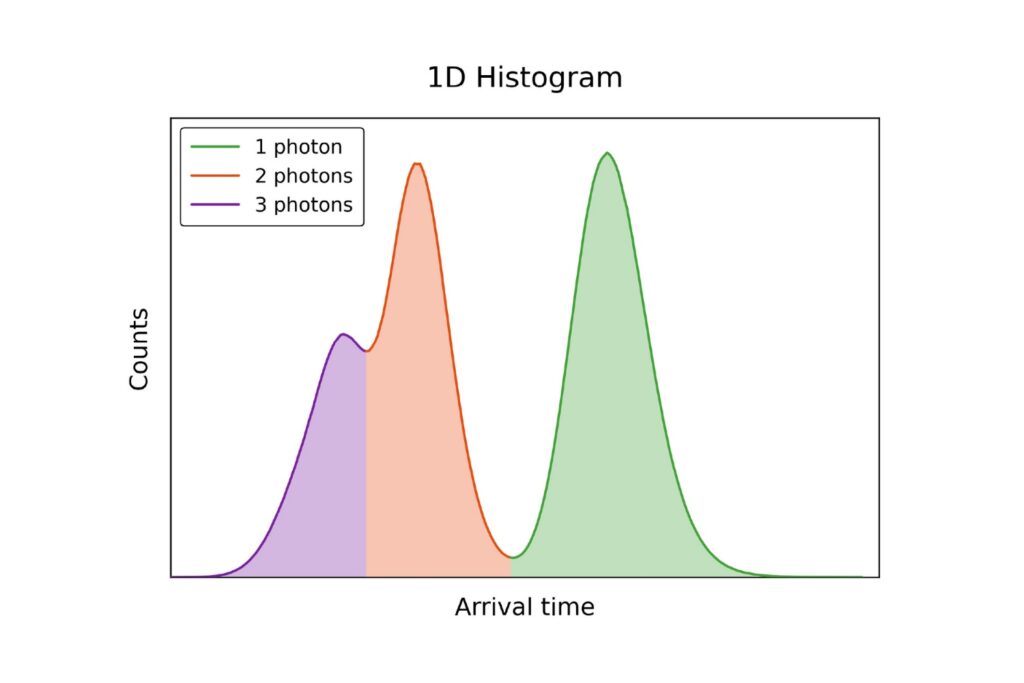
Detector response signals for one two and three photon events
Table of contents

Photon-Number-Resolved Detection for Advanced Quantum Measurements

What is Photon Number Resolution (PNR)?

Photon number resolution (PNR) is a measurement technique that determines the number of photons detected in a single optical event. It employs highly sensitive single-photon detectors in combination with signal-processing methods to distinguish between events involving one, two, or several photons. Unlike purely binary on/off detection schemes, PNR provides discrete photon-number statistics, offering insight into the probabilistic nature of light generation and quantum interactions. Depending on the experimental realization, PNR can be implemented using different approaches that extract photon-number information either directly from detector signals or through multi-channel detection strategies.

The method plays a key role in photonic quantum computing and quantum communication, enabling detailed studies of photon-number distributions, photon correlations, antibunching, and non-classical light sources.

How does PNR work?

PNR is realized by analyzing the detector response to individual photon events using high-precision timing electronics. By resolving variations in signal timing, shape, and spatial position or detection channel, information about the number of contributing photons can be extracted.

PNR Approaches

In practice, PNR can be realized using two main approaches: intrinsic PNR and multiplexed PNR. Intrinsic PNR relies on detectors whose response directly reflects the number of absorbed photons within a single detection event. The detector signal itself carries photon-number information, which can be extracted through detailed signal analysis. Multiplexed PNR, also referred to as pseudo-PNR, distributes incoming photons across multiple detection channels. The photon number is then inferred from the number of coincident detection events. This can be implemented using spatial multiplexing with detector arrays or temporal multiplexing by separating photon arrivals in time.

Detector Technologies for PNR

Different detector technologies enable PNR with distinct advantages and limitations.

  • Transition-Edge Sensors (TESs) provide true photon-number and energy resolution by measuring the deposited energy with high precision, but typically still exhibit longer recovery times, which limit their maximum count rates.
  • Superconducting Nanowire Single-Photon Detectors (SNSPDs) offer excellent timing performance and high count-rate capability. While not inherently energy-resolving, their pulse shapes can be analyzed to extract photon-number information, although the number of distinguishable photon levels is typically limited compared to TES-based systems.
  • SPAD and SiPM arrays enable multiplexed PNR by distributing photons across many channels. Their main advantage is room-temperature operation, while limitations include reduced detection efficiency and higher dark count rates compared to superconducting detectors.

The choice of detector depends on the required balance between timing resolution, count rate, and photon-number discrimination capability.

Signal Analysis in Intrinsic PNR

In intrinsic PNR, photon-number information is extracted from the detailed temporal or amplitude characteristics of the detector signal. Using SNSPDs as an example, the absorption of multiple photons within the nanowire leads to a larger initial normal-conducting region and a faster redistribution of the bias current. As a result, the electrical response of the detector changes in a photon-number-dependent way, affecting both the onset and evolution of the output pulse.

Key observables include:

  • Slew rate (rising edge): The slope of the rising edge increases with photon number, as multiple absorbed photons lead to a faster formation and expansion of the resistive region. This results in a steeper signal onset, which can be evaluated using precise timing electronics to discriminate between different photon-number events.
  • Pulse width: Multi-photon events often produce broader electrical pulses, as the detector remains in a resistive state for a longer time. This is commonly quantified using the time-over-threshold (ToT), providing a robust parameter that is less sensitive to amplitude fluctuations.
  • Amplitude: The signal amplitude can increase with photon number due to stronger redistribution of the bias current. While this parameter can be affected by noise and readout bandwidth, it still provides useful complementary information when combined with timing-based observables.
  • Timing relative to a synchronization pulse: Under pulsed excitation, the effective detection timing can shift depending on photon number. Multi-photon absorption can lead to earlier trigger conditions, resulting in measurable timing differences relative to a sync signal. This is particularly efficient when using PicoQuant’s T3 mode, where photon arrival times are recorded relative to the excitation cycle, enabling compact data representation and high-throughput analysis of photon-number-dependent timing shifts.

By combining these observables, photon-number-dependent signatures can be separated more robustly than with a single parameter alone. In particular, correlating multiple signal features enables reliable photon-number discrimination even under high count-rate conditions.

Why use PNR?

Photon number resolution is particularly valuable in applications where the exact number of detected photons carries meaningful information. This includes the characterization of light sources, for example to distinguish true single-photon emission from multi-photon contributions, as well as quantum information protocols, such as photon-number-based encoding schemes or the verification of multi-photon states used in quantum communication and photonic quantum computing. In addition, PNR plays an important role in the calibration and performance evaluation of single-photon detectors, enabling a deeper understanding of detector response under varying signal conditions.

PNR Data & Analysis

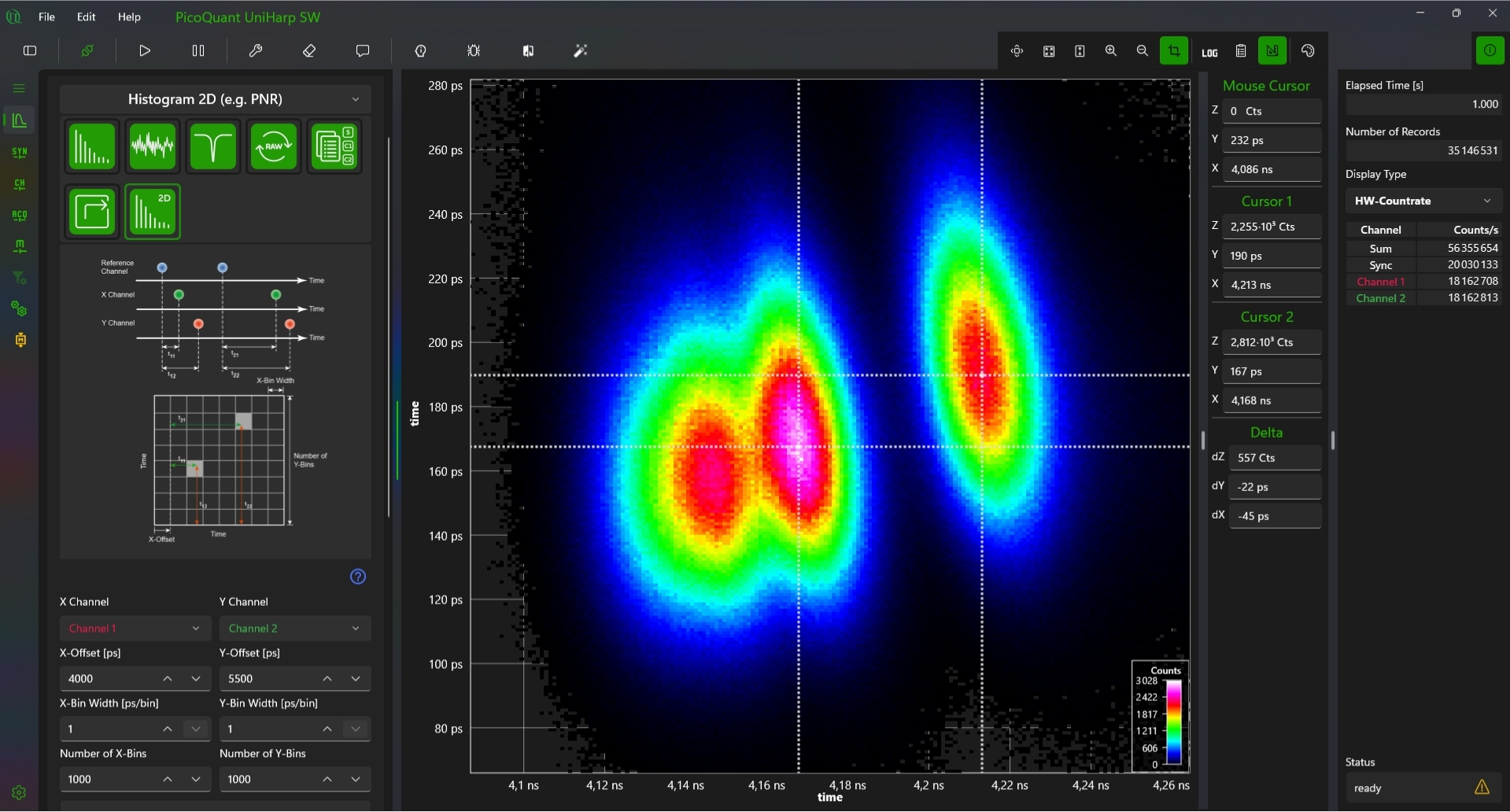
Photon-number-resolving measurements often rely on multi-dimensional representations of detector signals. A particularly powerful method is the use of two-dimensional histograms, where different timing parameters of the same pulse are analyzed simultaneously. For example, the arrival times of the rising and falling edges relative to a synchronization signal can be recorded and plotted against each other. This reveals distinct clusters corresponding to different photon numbers, allowing direct visual discrimination of one-, two-, and multi-photon events.

Such representations also expose systematic effects at high count rates. In particular, incomplete detector recovery can lead to shifted or duplicated clusters. By transforming the data, for example into a time-over-threshold representation, and applying appropriate corrections, these effects can be compensated, enabling robust photon-number classification even under demanding conditions.

These analysis methods allow efficient gating and classification of photon-number-dependent events and form the basis for real-time PNR evaluation.


Photon number resolution (PNR) analysis via UniHarp's measurement class 2D Histogram, showing photon-number-dependent clusters and enabling robust discrimination through multi-parameter timing analysis.

PicoQuant’s Software for PNR Analysis

PicoQuant’s time-tagging platforms provide dedicated tools for advanced photon-number-resolving  measurements and analysis. In UniHarp and snAPI, the measurement class 2D Histogram enables the simultaneous evaluation of multiple timing parameters, making it a powerful tool for real-time photon-number discrimination. It allows users to:

  • correlate rising and falling edge timing
  • visualize photon-number-dependent clusters
  • define gating regions for event classification

In addition, the software includes tools to correct recovery-time-related artifacts, which can occur at high count rates when detectors do not fully recover between events. These corrections improve the alignment and separation of photon-number clusters, enabling reliable analysis even in high-throughput scenarios. Together with time-tagged time-resolved acquisition (TTTR) in T3 mode, PicoQuant’s solutions enable efficient, high-resolution PNR measurements with scalable data processing and analysis capabilities.

HydraHarp 500 and PicoHarp 330 enable high-resolution time-tagging for photon number resolution experiments.

Instrumentation and performance requirements for PNR

Reliable photon number resolution requires precise single-photon detectors and high-performance data acquisition and processing capabilities. To accurately distinguish multi-photon events and extract meaningful photon-number statistics, several key performance aspects are critical:

  • Timing jitter: Ultra-low timing jitter is essential to resolve closely spaced photon events and perform accurate coincidence and correlation measurements.
  • Dead time: Minimal detector and system dead time is required to correctly identify multi-photon events, especially at high count rates.
  • Data throughput and event handling: High data transfer rates are necessary to process large photon streams in multiplexed and multi-channel PNR experiments. Efficient event filtering and selection further enable the isolation of relevant photon events within defined coincidence windows.
  • Programming interfaces and analysis tools: Flexible software frameworks and programming interfaces enable custom analysis workflows, real-time processing, and seamless integration into complex experimental setups.
Explore HydraHarp 500
Relevant for Your Research​

Matching Applications

Schematic illustration of quantum key distribution showing single photons exchanged between Alice and Bob while eavesdropping by Eve introduces detectable disturbances.
Quantum Optics
Coincidence correlation showing photon antibunching of NV centers in nanodiamonds
Materials Science | Quantum Optics

PicoQuant Instrumentation for PNR

Explore PicoQuant’s compatible components designed for PNR.

PicoQuant pulsed laser and LED sources

Laser Sources

Picosecond pulsed diode lasers provide controlled near-infrared excitation for time-resolved PNR measurements. Stable repetition rates and short pulse durations enable precise characterization of photon propagation in scattering tissue.

Visit
PicoQuant's hybrid and SPAD single-photon detectors

Single-Photon Counting Detectors

Single-photon sensitive detectors record weak transmitted or fluorescent signals with high timing precision. Low timing jitter and high sensitivity are essential for accurate extraction of absorption and scattering properties.

Visit
Overview image of PicoQuant Time Tagging and TCSPC units including HydraHarp 500, MultiHarp 150/160, PicoHarp 330, and TimeHarp 260.

Time Tagging & TCSPC Electronics

Time-Correlated Single Photon Counting (TCSPC) and time tagging electronics measure photon arrival times with picosecond resolution across multiple channels. This enables precise reconstruction of temporal point spread functions for quantitative tissue imaging.

Visit
Info Request

Info Request

Contact us

Please fill out the form below to request more information about our products and services. You may also use it to ask for pricing, availability, technical specifications, or any other details relevant to your inquiry. Our team will be happy to review your request and get in touch with you. If additional information is needed to process your inquiry, we will let you know.

* Required