Quantum Communication

Using Individual Photons and Quantum Effects

The transmission of information using individual photons, using quantum effects to ensure absolute security.
Schematic illustration of quantum key distribution showing single photons exchanged between Alice and Bob while eavesdropping by Eve introduces detectable disturbances.
Table of contents

Advancing Quantum Communication with High-Precision Photon Detection

What is Quantum Communication?

Quantum communication refers to the transfer of information using quantum states, typically using single or entangled photons in discrete variable implementations. By exploiting principles such as superposition and entanglement, it enables ultra-secure data exchange. Because quantum states cannot be measured or copied without disturbance, any interception attempt is fundamentally detectable, which makes the communication inherently secure.

Why Study Quantum Communication?

Quantum communication is a foundational step toward building secure information networks in the quantum age. It offers physical protection against eavesdropping while deepening our understanding of quantum effects like entanglement and measurement. Research in this field drives advances in Quantum Key Distribution (QKD), encryption methods beyond classical limits, and the future quantum internet.

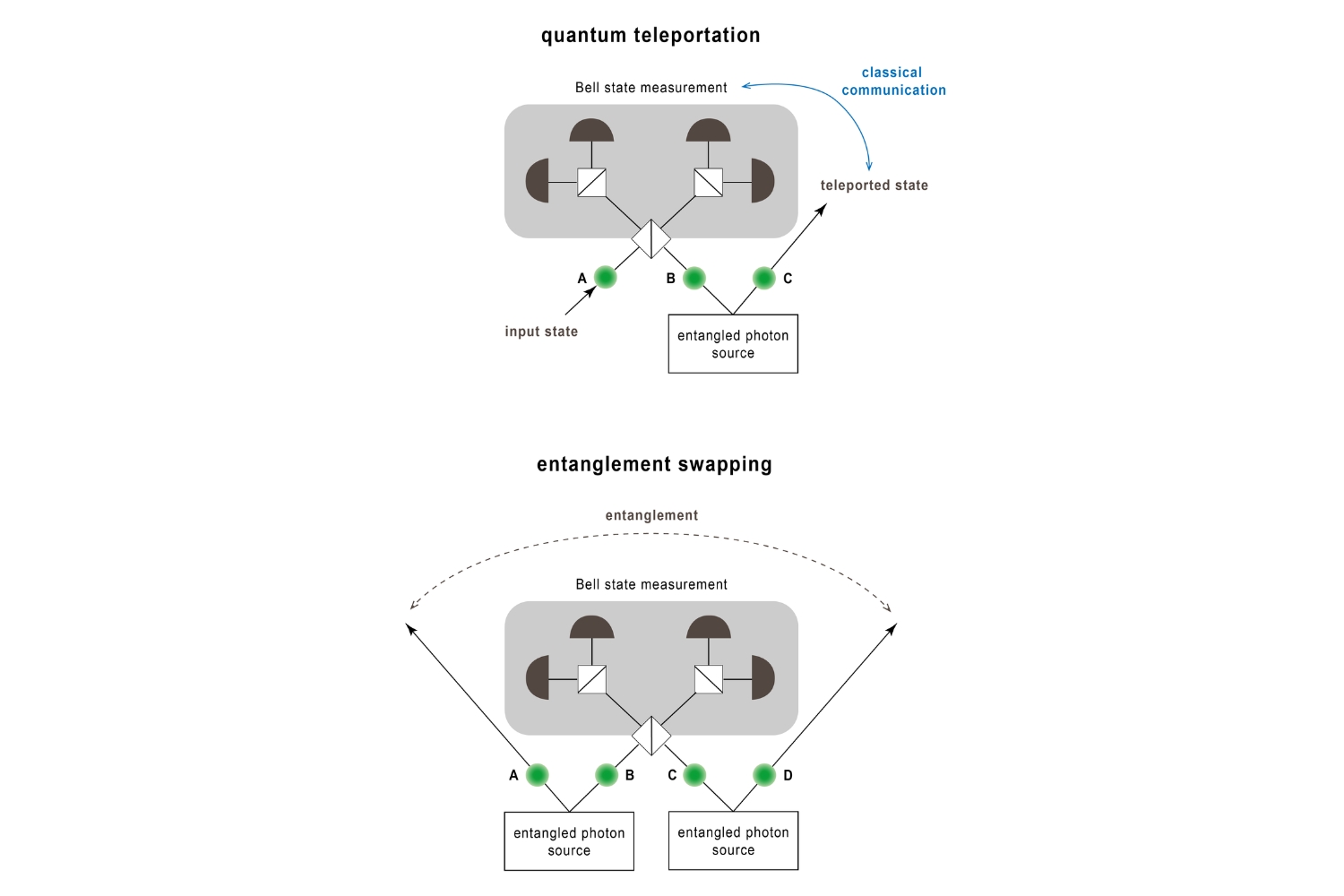
Quantum teleportation (top) and entanglement swapping (bottom) schemes. In both configurations, entangled photon pairs are generated and jointly measured via a Bell-state measurement. In quantum teleportation, the state of an input photon (A) is transferred to a distant photon (C) using an entangled pair and classical communication of the measurement outcome. In entanglement swapping, a Bell state measurement performed on photons (B and C) from two independent entangled sources projects the remaining photons (A and D) into an entangled state. Each single-photon detector in the Bell-state measurement setup is connected to a time tagger, enabling precise time-correlated detection and identification of coincidence events required for the respective protocols.

Key Principles of Quantum Communication

Quantum Superposition

Quantum superposition allows particles to exist in multiple states simultaneously. This enables qubits to encode information beyond classical binary states, providing the basis for enhanced information processing and communication protocols.

Quantum Entanglement

Quantum entanglement links two or more particles such that their states remain correlated, even across large distances. By performing joint measurements, entanglement can be extended to previously independent particles, forming the foundation for scalable quantum networks and long-distance quantum communication.

Quantum Teleportation

Quantum teleportation transfers the state of a particle to a distant photon using an entangled pair and a Bell-state measurement. The measurement outcome is transmitted via a classical communication channel, allowing the receiver to reconstruct the original quantum state. This process enables quantum state transfer without physically sending the particle itself and is a key building block for future quantum networks.

Entanglement swapping

Entanglement swapping can be understood as a special case of quantum teleportation. Instead of transferring an arbitrary input state, the protocol effectively “teleports” one part of an entangled pair onto another photon. A Bell-state measurement on two photons from independent entangled pairs projects the remaining photons into an entangled state, even though they have never directly interacted. This mechanism is essential for extending entanglement across large distances in quantum networks.

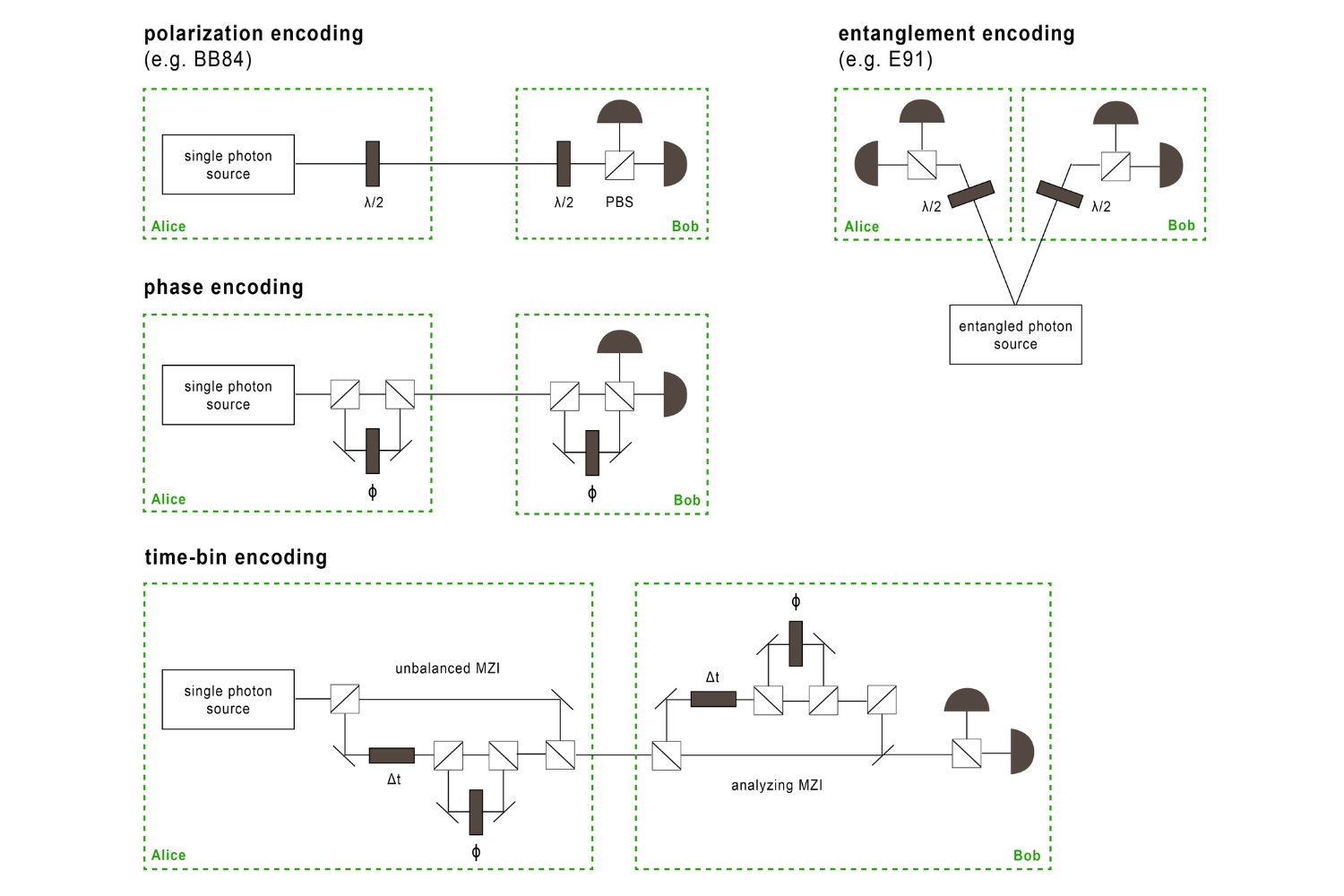
Overview of quantum key distribution (QKD) encoding schemes. Different approaches for encoding quantum information are illustrated, including polarization encoding (e.g. BB84) using λ/2-waveplates and polarizing beam splitters (PBS), phase encoding based on interferometric phase shifts (ϕ), and time-bin encoding using an unbalanced Mach-Zehnder interferometer (MZI) at Alice and an analyzing MZI at Bob with a defined delay (Δt). In entanglement encoding (e.g. E91), an entangled photon source distributes correlated photons to Alice and Bob. In all schemes, quantum states are prepared by Alice and measured by Bob, where each single-photon detector is connected to a time tagger channel, enabling precise timing and correlation of detection events for secure key generation.

Quantum Key Distribution (QKD) and Quantum Cryptography

Quantum Key Distribution (QKD) is a central application of quantum communication, enabling two parties (commonly referred to as Alice and Bob) to generate shared, secure encryption keys using single photons.

QKD protocols rely on encoding information into quantum states of light, as illustrated in the figure. In polarization encoding (e.g. BB84), information is carried by the polarization state of single photons. In phase encoding, relative phase shifts in interferometric setups are used to encode the key. Time-bin encoding employs unbalanced interferometers to define early and late photon arrival times, offering robustness for fiber-based transmission. In entanglement-based protocols (e.g. E91), correlated photon pairs are distributed between Alice and Bob, enabling secure key generation through measurement correlations.

The security of all QKD schemes is fundamentally guaranteed by the laws of quantum mechanics. Any attempt to intercept or measure the transmitted quantum states introduces detectable disturbances. By comparing a subset of their measurement results, Alice and Bob can identify the presence of an eavesdropper and ensure that only secure keys are retained. This physics-based security makes QKD a key technology for future secure communication networks.

PicoQuant Time Tagging and TCSPC electronics for high-precision photon timing applications.

PicoQuant’s Time Tagger for Quantum Communication

PicoQuant provides advanced instrumentation designed to meet the demanding requirements of quantum communication and quantum key distribution experiments. Our technology enables precise timing, scalable data acquisition, and reliable synchronization for single-photon and entanglement-based protocols.

Key Advantages Include:

  • Support for Advanced Encoding Protocols: High timing precision enables reliable time-bin, polarization, and entanglement-based encoding schemes.
  • Remote and Multi-Device Synchronization: Precise synchronization across distributed nodes is enabled through technologies such as White Rabbit, allowing sub-nanosecond alignment for coincidence detection in scalable quantum communication networks.
  • High-Speed Data Transfer: High-bandwidth USB interfaces and external FPGA interfaces enable real-time access to large time-tag data streams, supporting highest count rates and advanced post-processing in quantum communication experiments.
  • Minimal Dead Time: The shortest dead times on the market minimize data loss and enable higher data transfer rates, even in demanding high-count-rate QKD setups.
  • Low Timing Jitter and Photon Number Resolution (PNR): Ultra-low timing jitter is essential for fully exploiting superconducting nanowire single-photon detectors (SNSPDs). High timing resolution preserves temporal correlations and enables PNR in quantum communication experiments.


Explore Time Taggers

Selected Time Taggers for Quantum Communication

These time-tagging & TCSPC electronics address different experimental requirements in quantum communication and quantum key distribution.

HydraHarp 500 multichannel TCSPC and time tagging unit front view

HydraHarp 500

HydraHarp 500 is best suited for large-scale quantum communication and quantum computing experiments using superconducting nanowire detectors. It delivers picosecond timing precision, ultra-short dead time, scalable multichannel architectures, and White Rabbit synchronization for highest-performance photon-correlation and QKD measurements.

Visit
MultiHarp 160 multichannel time tagging and TCSPC unit with extension modules

MultiHarp 160

MultiHarp 160 scales quantum communication and multipixel detector experiments with up to 65 synchronized channels, ultra-short dead time, and high-throughput time tagging. Integrated White Rabbit synchronization and an external FPGA interface enable precise, flexible, and distributed quantum network measurements.

Visit
LDH-I Series smart picosecond diode laser head with integrated cooling, compatible with the Taiko PDL M1 driver for calibrated excitation in time-resolved spectroscopy.

Pulsed Diode Lasers for Quantum Communication

PicoQuant’s picosecond pulsed diode lasers support quantum communication experiments in fiber-based networks, covering key telecom wavelength bands such as the O band (1260–1360 nm) and C band (1530–1565 nm).

Visit
PDM Series SPAD single-photon avalanche diode detector module by MPD

Single-Photon Detectors for QKD Experiments

For fiber-based quantum key distribution, PicoQuant distributes InGaAs single-photon avalanche detectors from MPD, optimized for telecom wavelengths. These detectors complement high-resolution time-tagging electronics and enable reliable single-photon detection in QKD and quantum communication experiments.

Visit
Relevant for Your Research​

Matching Methods

Schematic of multi-channel photon coincidence showing three-fold correlated events
Materials Science | Quantum Optics
Schematic comparison of antibunched, bunched and coherent photon emission statistics
Life Science | Materials Science | Quantum Optics
In-Depth Scientific Resources

Premium Resources

Access in-depth application notes and scientific posters with detailed methods, measurement data, and real-world use cases.

Poster: High-Precision Time Tagging for Scalable Photonic Quantum Experiments

Poster on high-precision time tagging for scalable photonic quantum experiments using SNSPD arrays and multichannel TCSPC systems.

Poster: QuPAD – High Bandwidth Photon Detection

Poster on QuPAD: a massively parallel 64-channel single-photon detection system using SNSPD arrays and MultiHarp 160 for high-bandwidth quantum experiments.

Download

Request your file

Please fill out the form below to receive the requested file. After submitting your details, the file will be sent to you by email.

* Required

Info Request

Info Request

Contact us

Please fill out the form below to request more information about our products and services. You may also use it to ask for pricing, availability, technical specifications, or any other details relevant to your inquiry. Our team will be happy to review your request and get in touch with you. If additional information is needed to process your inquiry, we will let you know.

* Required

Contact us

Please fill out the form below to request more information and prices about our product. Our team will be happy to review your request and get in touch with you. If additional information is needed to process your inquiry, we will let you know.

* Required