Complete confocal fluorescence microscope that empowers researchers to advance quantitative functional imaging from individual molecules to cells and tissues.

Modular, customizable, time-resolved confocal microscope with single-molecule sensitivity for life and materials science.

Compact FLIM and FCS upgrade kit that adds advanced functional imaging and correlation analysis to existing laser scanning microscopes.

Designed for flexible, sensitive, and precise steady-state and time-resolved spectroscopy across the UV to NIR range and time scales from picoseconds to milliseconds.

Modular lifetime spectrometer designed for flexible fluorescence and photoluminescence measurements in both materials and life science research.

Add spectral and time-resolved photoluminescence to your setup through flexible microscope–spectrometer coupling options.

Get the most out of superconducting nanowire detectors in large-scale quantum communication and computing experiments requiring precise multichannel timing.

Boost your time-resolved experiments with a flexible, high-precision time tagging and TCSPC unit for materials science and quantum sensing.

Scale your photonic quantum computing and detector characterization setups while maintaining performance, flexibility, and high data throughput.

Compact 3-color picosecond laser delivering flexible ns to ms excitation with cost-effective multicolor performance and straightforward operation.

Smart picosecond laser diode heads covering UV-A to NIR, providing the right combination of power, pulse width, and diode type for any time-resolved technique.

VisUV provides clean short pulses and stable timing across key UV and visible wavelengths, including deep UV lines as well as 488 nm and 532 nm.

Enhance your single-photon counting experiments with wide dynamic range and excellent timing precision in the UV and visible even at the highest count rates.

Capture even the weakest signals over large areas with maximum dynamic range and enhanced low-light sensitivity in a compact detector design.

Unlock spatially resolved single-photon detection with a 23-pixel SPAD array, combining low dark counts and precise time tagging for advanced experiments.

Advanced FLIM analysis software for fast, accurate interpretation of lifetime imaging data.

Intuitive, free software solution for real-time, high-precision photon data acquisition, visualization, and initial data analysis.

Advanced software for time-resolved fluorescence acquisition and analysis.

An imaging technique that uses fluorescence lifetimes to generate image contrast.

Investigating how proteins dynamically explore multiple conformational states that control biological function.

Investigating how biomolecules separate into dynamic liquid phases to organize cellular space and regulate biological function.

A time-resolved technique that measures photoluminescence lifetimes to reveal excited-state dynamics in materials.

Studying exciton dynamics, charge carrier processes, and structural properties through optical and time-resolved characterization methods.

Investigating charge-carrier lifetimes and recombination dynamics to enable precise optical characterization of material quality and device performance.

A quantum optical signature revealed by time-resolved photon correlation analysis to identify single-photon emission in materials and nanostructures.

The transmission of information using individual photons, using quantum effects to ensure absolute security.

Quantifying photons per detection event enables direct access to photon-number statistics, providing insight into quantum and statistical properties of light.

An optical technique that analyzes light emission under electrical excitation to reveal electronic properties of electroluminescent materials.

Monitoring environmental signals and trace compounds to understand dynamic changes in natural and engineered environments.

A photon timing technique that measures single-photon arrival times to resolve ultrafast dynamics in fluorescence, materials research, and quantum optics.
| Large, L | 1 slot for oscillator module, 8 slots for laser driver modules |
| Small, S | 1 slot for oscillator module, 2 slots for laser driver modules |
| Power supply | 115/230 VAC, 50/60 Hz, max. 350 Watts |
| Dimension | Large, L: 464 × 310 × 140 mm (w × d × h) small, S: 250 × 310 × 140 mm (w × d × h) |
| Outputs | 8 trigger (NIM), 1 synchronization (NIM), 1 auxiliary |
| Inputs | 1 external trigger, 1 auxiliary (TTL) |
| Operation mode | rotary, programmed sequence of one channel must be completed before next channel is activated; adjacent channels can be grouped; multiple channels can be either combined or delayed (SOM 828-D only) |
| Oscillator type | crystal locked |
| Base frequencies | 80, 64, 50 MHz (selectable) |
| Repetition frequency | User-selectable, derived from the selected master frequency or an external trigger source by division through any integer factor between 1 and 65 536 (SOM 828-D) |
| Jitter | Typ. 3-5 ps |
| Timing | synchronous to repetition frequency, timing position stepwise adjustable within the limits of the repetition frequency, step size equals base oscillator period |
| Masking | synchronization pulses can be inhibited (masked), mask size selec- table in integer steps from 0 to 255, stepsize equals repetition period |
| Amplitude | +500 mV into 50 Ohms (SOM 828); +1.5 V into 50 Ohms (SOM 828-D) |
| Timing | at start of complete trigger sequence |
| Amplitude | +500 mV into 50 Ohms |
| Amplitude | -5 to +5 V (maximum limits) |
| Trigger level | -1.2 to +1.2 V |
| Frequency range | up to 40 MHz |
| External synchronization | 6.25 to 85 MHz (SOM 828-D only) |
| Burst length | Up to 16.7 million pulses |
| Operation mode | 1 synchronization (NIM), laser head connector |
| Repetition frequency of internal oscillator | 80, 40, 20, 10, 5 or 2.5 MHz (user-selectable) |
| Jitter | Typ. 3-5 ps |
| Outputs | 1 synchronization (NIM), laser head connector |
| Inputs | 1 trigger (NIM), 2 gating (TTL) |
| Slow gate | Transition time 500 Ohms Connector type: 4-pin LEMO socket - 00.304 series Example of connector: FGG.00.304.CLA |
| Fast gate | Transition time typ. 10 ns (pulsed only) Internal impedance: 50 Ohms Connector type: 1-pin LEMO Socket - 00.250 Series Example of connector: FFA.00.250.NTA |
| Operating system | Windows 11 |
| PC interface | USB 2.0 |
All Information given here is reliable to our best knowledge. However, no responsibility is assumed for possible inaccuracies or omissions. Specifications and external appearances are subject to change without notice.
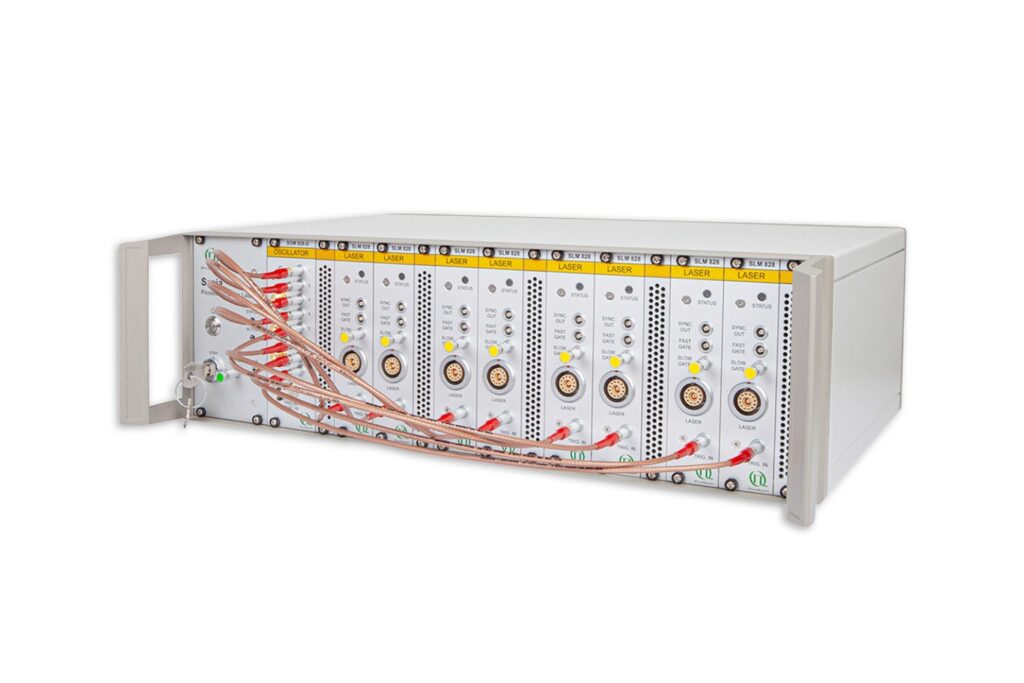
Shown here in a 2-channel configuration, the modular Sepia PDL 828 can scale to drive up to 8 laser or LED heads.Sepia PDL 828 is a highly flexible multichannel driver designed for precise control of picosecond lasers and pulsed LEDs across a broad spectral range (266 – 1990 nm). Its modular architecture supports up to 8 independently addressable heads, enabling parallel excitation, complex pulse sequences, and rapid wavelength switching. A powerful oscillator module provides fine timing control, user-defined burst patterns, and picosecond-level delays, while the dedicated software and API allow seamless integration into automated measurement workflows. With intuitive USB operation and stand-alone capability, Sepia PDL 828 offers a robust platform for demanding multi-wavelength experiments in modern scientific research. A five-year limited warranty underscores its long-term reliability.
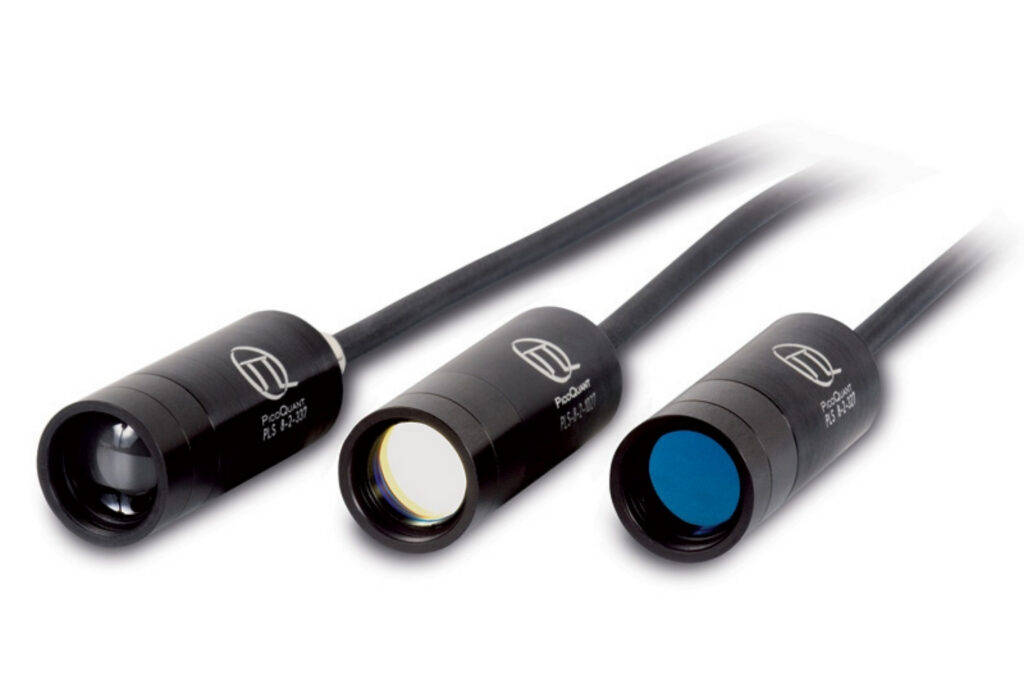
Sepia PDL 828 operating with LDH laser heads and compatible with LDH, LDH-FA, and PLS Series light sources for flexible multi-wavelength excitation.Sepia PDL 828 is fully compatible with PicoQuant’s LDH, LDH-FA and PLS Series, supporting picosecond pulsed diode lasers and sub-nanosecond LEDs across a wide spectral range. Laser heads can be exchanged easily, enabling fast adaptation to different experimental requirements.
Read–Write–Read burst sequence generated by the Sepia PDL 828 and the SOM 828-D oscillator module, enabling controlled population and probing of hidden states in time-resolved photoluminescence experiments. Demonstrated here for trapped carrier dynamics in a CsPbBr₃ microplate. Image courtesy of Ivan Scheblykin, Lund University, Sweden.Advanced burst control enables tailored excitation schemes for materials with long-lived or hidden non-radiative states, where conventional repetition rates fail to capture relevant dynamics. Using the burst mode of the Sepia PDL 828, complex pulse sequences such as the Read–Write–Read approach can be implemented. These sequences are generated and precisely timed by the SOM 828-D oscillator module, which provides programmable delays and reliable synchronization across channels. A controlled burst of write pulses prepares a quasi steady state, followed by delayed readout pulses to probe carrier trapping and relaxation dynamics in time-resolved photoluminescence experiments.
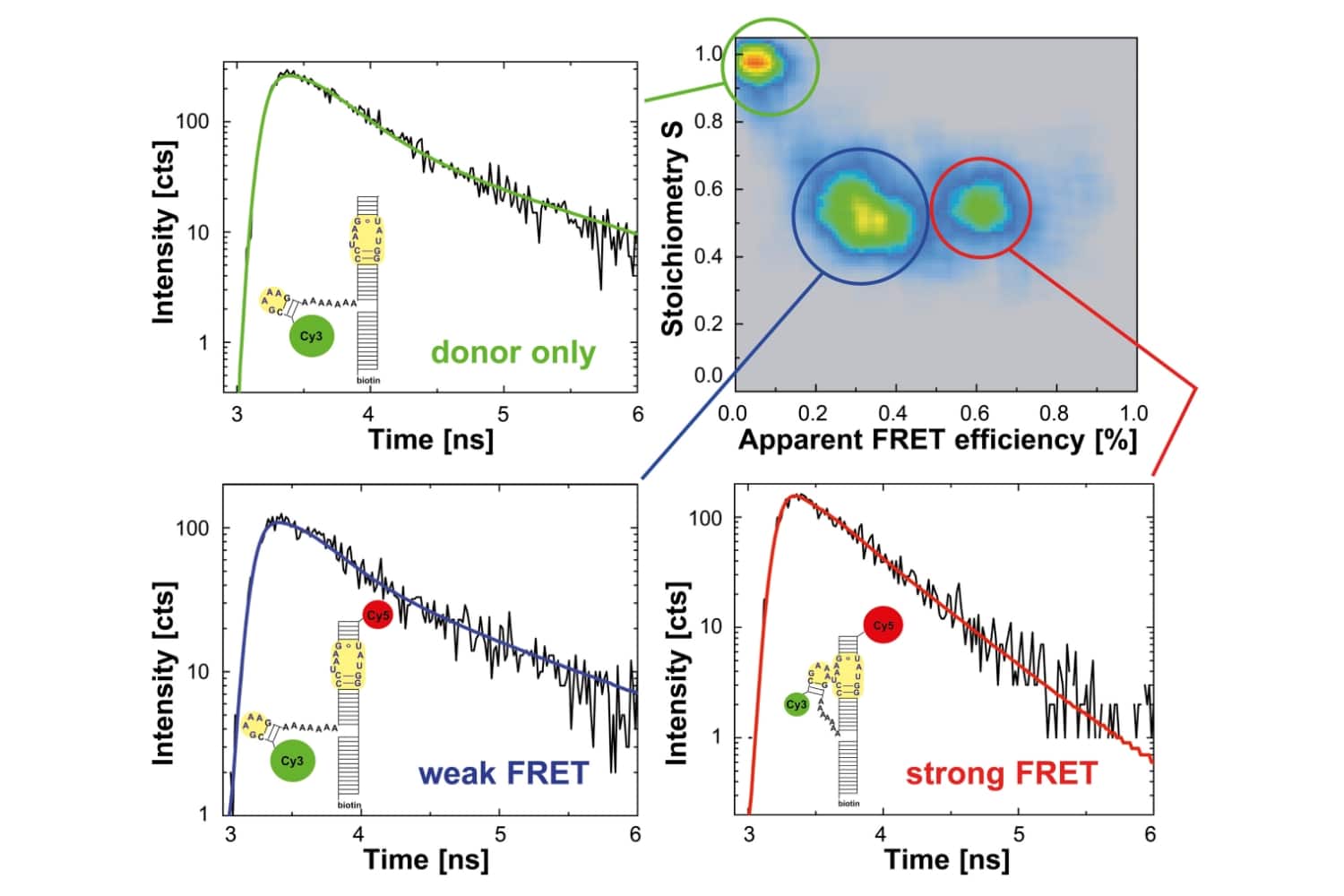
Single-molecule FRET analysis of freely diffusing RNA using pulsed interleaved excitation (PIE). The experiment probes interactions between a GAAA tetraloop motif (Cy3 donor) and its receptor region (Cy5 acceptor). A 2D plot of FRET efficiency versus stoichiometry reveals distinct molecular subpopulations for further analysis. Data courtesy of Julie Fiore and David Nesbitt, University of Colorado Boulder, USA.In Pulsed-Interleaved Excitation (PIE) two laser pulses are used sequentially to excite donor (D) and acceptor (A) molecules independently. The resulting fluorescence emission patterns can be used to discriminate between molecules showing Förster Resonance Energy Transfer (FRET) and molecules that don’t as well as indicate the absence of A.
FRET analysis of freely diffusing RNA. The experiment aimed at localizing interactions between specific elements of RNA secondary structure, in this case a GAAA tetraloop motif (Cy3 label, green) and its corresponding receptor region (Cy5 label, red). Using PIE, it was possible to calculate a 2D plot of FRET efficiency versus stoichiometry, that enables easy identification of subpopulations for further FRET evaluation.
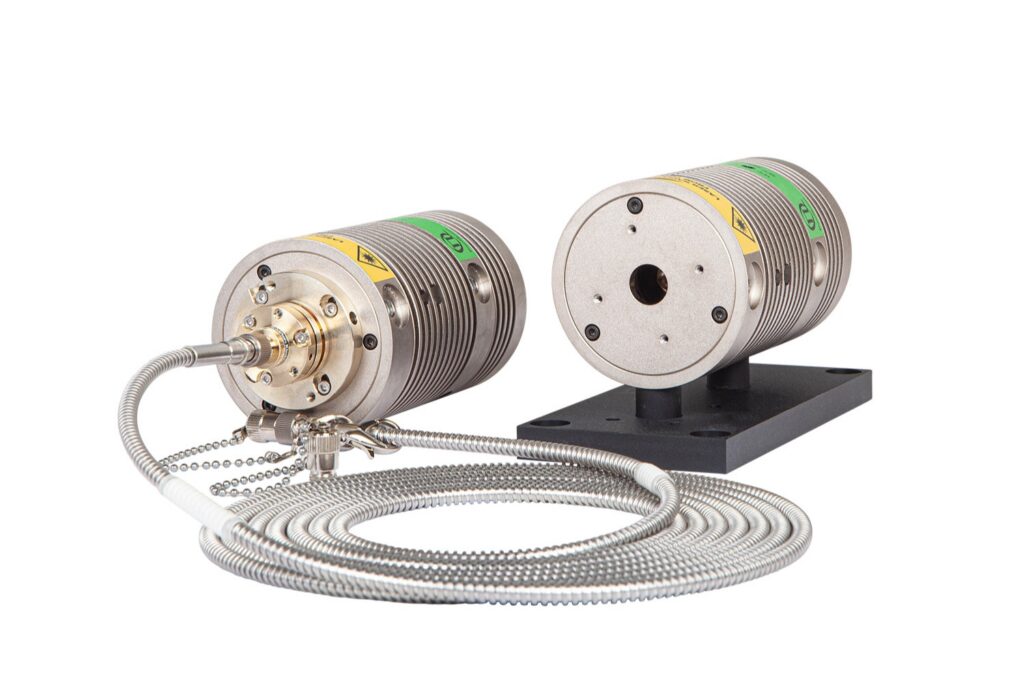
Laser Combining Unit (LCU) integrating multiple picosecond laser heads for fiber-coupled excitation.The Laser Combining Unit allows you to merge the output of up to five compatible laser heads into a single polarization maintaining single mode fiber.
Features, specifications and applications of a multichannel picosecond diode laser driver for up to 8 laser heads
Coveres measurement principles, instrumentation, TCSPC detection, and applications in materials and life sciences
Combine compatible components to build a complete system tailored to your experimental requirements and measurement workflows.
Please fill out the form below to request more information. You may also use it to inquire about pricing, availability, technical specifications, or discuss your specific application. Our sales team will be happy to review your request and get in touch with you. If additional information is needed to process your inquiry, we will let you know.
* Required
Explore alternative products within this category to compare specifications, performance, and configurations for your application.
Please fill out the form below to request more information about our products and services. You may also use it to ask for pricing, availability, technical specifications, or any other details relevant to your inquiry. Our team will be happy to review your request and get in touch with you. If additional information is needed to process your inquiry, we will let you know.
* Required
Please fill out the form below to request more information and prices about our product. Our team will be happy to review your request and get in touch with you. If additional information is needed to process your inquiry, we will let you know.
* Required