Timing Is an Architectural Question
In modern multi-wavelength experiments, the challenge is no longer the availability of laser sources. It is the ability to structure them in time. Sequential excitation, grouped pulses, defined pauses, burst mode operation, and synchronization with detection electronics are not peripheral functions. They determine how an experiment behaves.
When timing is assembled from chained triggers and loosely coupled devices, reproducibility becomes fragile. When timing is designed as a closed architecture, excitation patterns and burst mode sequences remain deterministic and scalable. This distinction defines whether a setup is merely functional or structurally controlled.
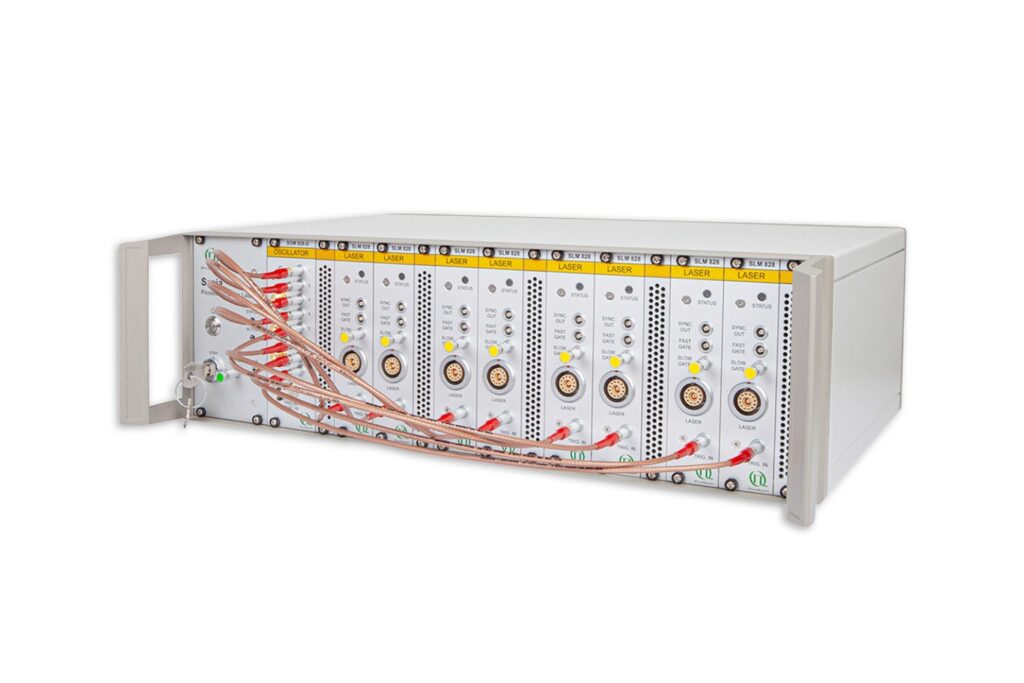
Within the Sepia PDL 828 multichannel laser driver, this architectural layer is implemented in the Sequencer Oscillator Module, the SOM 828-D.
Deterministic Sequencing and Burst Mode Control
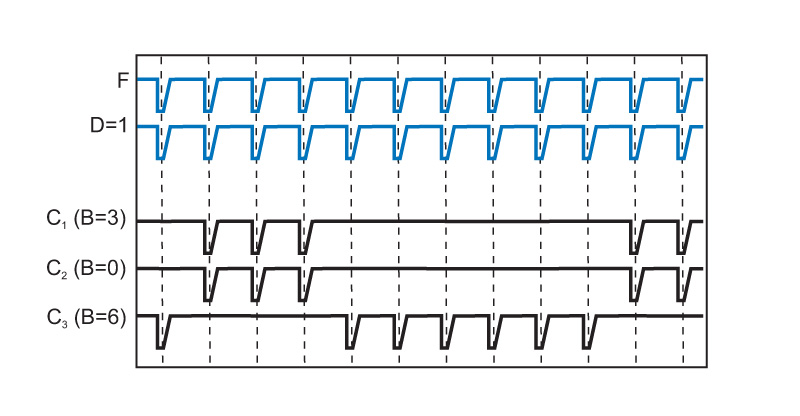
The SOM 828-D operates on a rotary sequencing principle. Eight individually addressable burst channels progress in a fixed cycle. Once the sequence reaches the last channel, it restarts from the first. The order is deterministic and remains constant from period to period.
Channels can operate independently, be grouped with adjacent channels, or be freely combined for simultaneous activation in burst mode. Even when a channel output is disabled, it remains part of the programmed cycle. This allows intentional time gaps without breaking the structural logic of the sequence.

Burst Mode as an Experimental Tool
Each burst channel can emit between one and 16,772,215 pulses before the sequence advances. Programmable burst mode control allows burst lengths to define preparation phases, stable excitation windows, or controlled transitions between channels.
In Sepia PDL 828, burst mode control is not simply a way to generate multiple pulses. It defines how long a channel dominates the timing cycle and how channels interact within one closed period. Grouping channels by assigning zero-length bursts to adjacent channels enables simultaneous emission without external switching hardware.
Within this architecture, burst mode transforms the laser driver from a pulse source into a programmable excitation platform.
Scalable Repetition Control and Synchronization
The timing structure of the SOM 828-D is derived from internal crystal oscillators with base frequencies of 80, 64, or 50 MHz. Integer frequency division allows repetition rates to be scaled from the megahertz regime down to below one kilohertz, ensuring that burst mode sequences remain embedded within a stable timing framework. The same divider logic remains active when an external trigger signal is used. This ensures that externally defined repetition rates are integrated into the same deterministic architecture.
Configurable Synchronization Signals
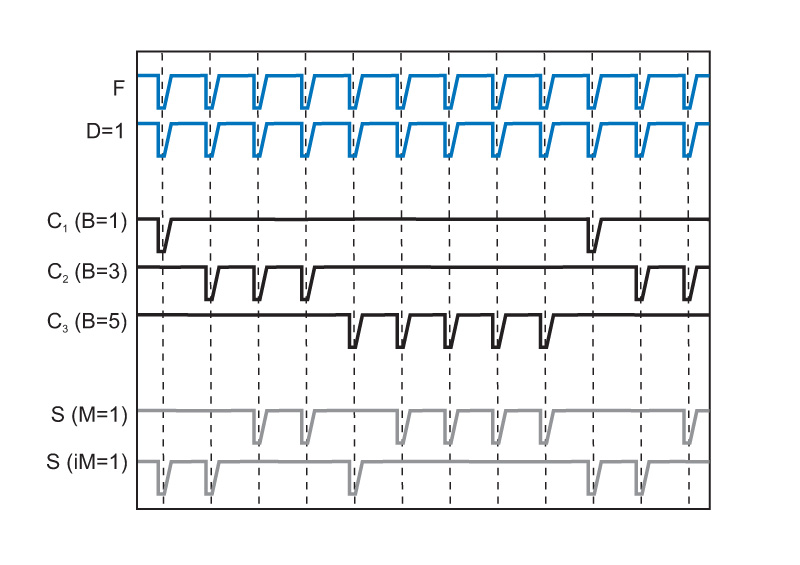
Synchronization is implemented as a configurable timing layer. Each channel can generate its own sync signal during burst mode operation. At reduced repetition rates, the synchronization pulse can be shifted within the clock period in discrete steps defined by the base oscillator. Additional masking options allow defined numbers of synchronization pulses to be suppressed or inverted.
This makes the sync output adaptable to complex detection schemes such as TCSPC systems while preserving the integrity of burst mode timing control.
From Oscillator to System Core
In Sepia PDL 828, the SOM 828-D is not an accessory module. It is the logical core that structures how up to eight laser or LED heads operate in time and in burst mode.
Deterministic rotary sequencing, programmable burst mode control, scalable repetition control, and configurable synchronization together form a coherent excitation architecture. For advanced multi-wavelength experiments, this architectural burst mode control is often more decisive than the laser sources themselves.
Understanding how burst mode and timing are structured is therefore essential when evaluating a multichannel laser driver. The Sepia PDL 828 provides this structure at the oscillator level, where experimental logic is defined.
Explore the Sepia PDL 828 laser driver and evaluate how programmable burst mode control can support your experimental design.