Temperature-Dependent Timing Jitter in CMOS SPADs Revealed by TCSPC
Photon timing precision lies at the heart of many modern optical measurement techniques. Techniques such as LiDAR rely on the ability to determine the arrival time of individual photons with high accuracy. Even small uncertainties in photon arrival time can limit distance resolution, lifetime determination, or key transmission rates in quantum systems.
This uncertainty is commonly described as timing jitter, the statistical variation in the detected arrival time of photons. Timing jitter is often attributed primarily to electronic noise or detector response characteristics. In reality, the origin of timing jitter can be deeply connected to the internal physics of the detector itself.
A recent study by Wu et al., Sensors (2025)1, investigated how temperature, photon wavelength, and device structure influence timing jitter in CMOS single-photon avalanche diodes (SPAD). By using time-correlated single photon counting (TCSPC) measurements, the researchers were able to directly observe how carrier transport inside the detector contributes to the measured timing distribution.
Investigating the Origin of Timing Jitter
To investigate the physical origin of timing jitter, the researchers compared two CMOS SPAD devices with different internal electric field distributions created by modified doping profiles.
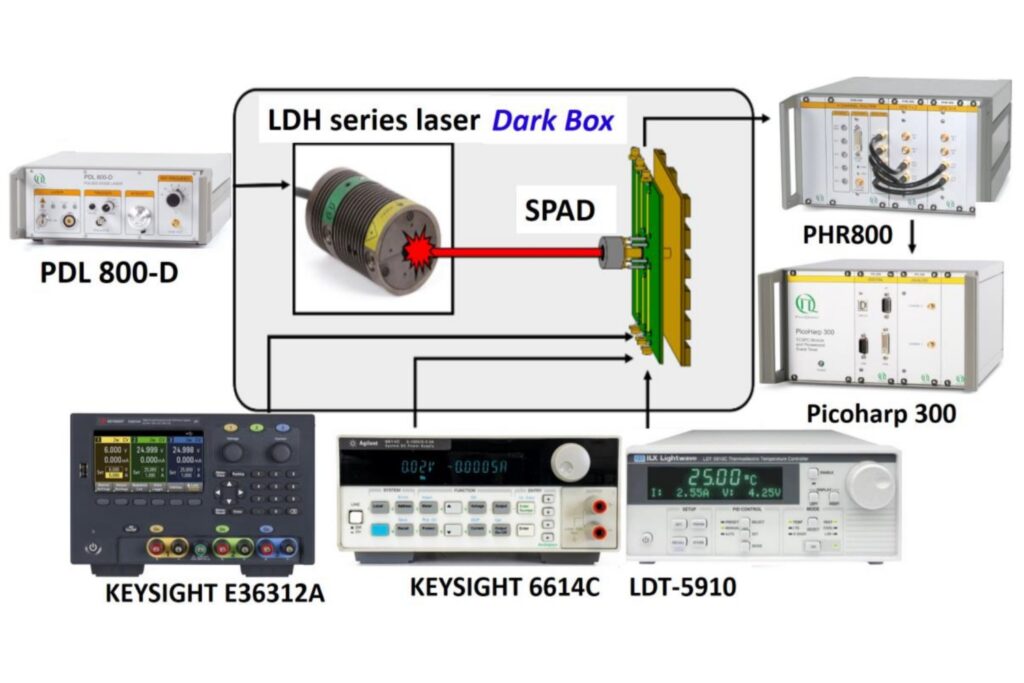
Timing measurements were performed using time-correlated single photon counting (TCSPC). In this method, the arrival time of individual photons is recorded relative to an excitation pulse, producing a statistical timing histogram.
Picosecond laser excitation was used at three wavelengths:
- 405 nm
- 780 nm
- 905 nm
These wavelengths probe different absorption depths in silicon. Short wavelengths generate carriers near the surface, while longer wavelengths penetrate deeper into the detector structure.
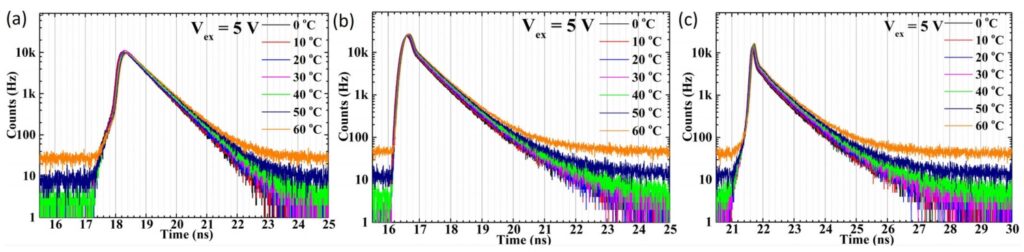
Detector timing performance was evaluated using the width of the TCSPC histogram, typically described by the FWHM of the main peak and the broader FWTM tail.
Strong Temperature Dependence in the First SPAD Design
The two SPAD designs showed markedly different timing behavior.
The first device exhibited strong temperature-dependent timing jitter, particularly under 405 nm excitation. At this wavelength, photons are absorbed near the detector surface, and carriers must diffuse through weak-field regions before reaching the avalanche region. This diffusion process broadens the timing distribution and produces long histogram tails.
The second SPAD structure incorporated modified doping layers that strengthened the internal electric field. As a result, carriers were more rapidly driven toward the avalanche region, significantly reducing diffusion effects. The detector maintained a timing resolution of about 150 ps FWHM with minimal temperature dependence.
Improved Timing Stability in the Second SPAD Structure
The measurements show that carrier diffusion inside the semiconductor is the dominant source of temperature-dependent timing jitter.
When photons are absorbed outside the high-field avalanche region, the generated carriers must travel through the device before triggering the avalanche process. The time required for this transport depends on carrier mobility, diffusion coefficients, electric field distribution, and temperature.
TCSPC timing histograms make these processes directly visible, revealing how device structure and carrier transport determine detector timing performance.
Instrumentation Used in This Study by PicoQuant
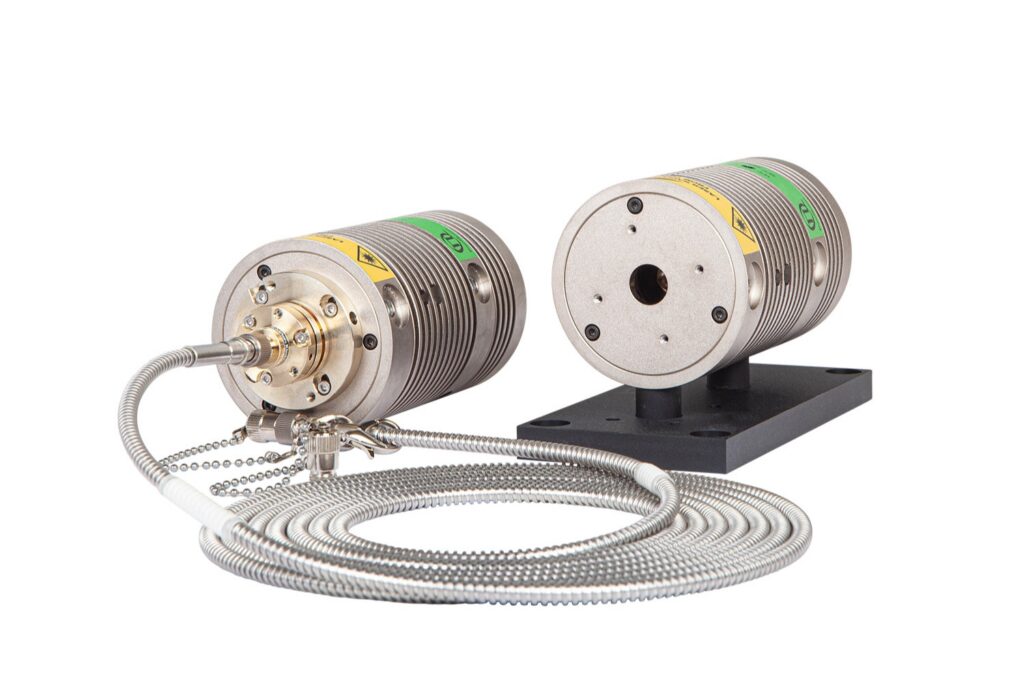
LDH Series Picosecond Diode Lasers
The study employed picosecond pulsed diode lasers from the LDH series at excitation wavelengths of 405 nm, 780 nm, and 905 nm.
Key characteristics include:
- Higher excitation precision
- Faster data acquisition
- Improved signal quality
- Greater flexibility
- More reliable long-term performance
- Consistent output
- Seamless system integration
- Robust synchronization
PicoHarp 330: Precise and Versatile Time Tagging & TCSPC Unit
Photon arrival times were recorded using PicoHarp 300, the predecessor of the current PicoHarp 330 time tagging & TCSPC unit, which provides picosecond-resolution photon timing for applications such as detector characterization, fluorescence lifetime measurements, and time-of-flight experiments.
Key features are:
- Exceptional timing precision
- Flexible trigger options
- Upgradable channel configuration
- High throughput via USB
- Smart on-board event filters

Bringing TCSPC Timing Analysis into Your Own Experiments
The results highlight that timing jitter in SPAD detectors is not solely determined by electronics but also by carrier transport inside the device structure.
Investigating these effects requires precise control over both excitation and photon timing electronics. Picosecond pulsed lasers combined with TCSPC instrumentation allow researchers to directly observe timing distributions and carrier transport effects inside photon detectors.
If you are investigating SPAD timing performance, fluorescence lifetimes, or photon arrival statistics in your own experiments, TCSPC provides a direct way to visualize these effects with picosecond precision.
Explore PicoQuant’s TCSPC solutions such as PicoHarp 330 and the LDH Series picosecond diode lasers, which are widely used for detector characterization and photon timing experiments.
1 Reference: Jau-Yang Wu, Yu-Wei Lu, Meng-Hsuan Liu, Tien-Ning Chang and Chun-Hsien Liu. An Analysis of Temperature-Dependent Timing Jitter Factors in the Structural Design of Complementary Metal-Oxide-Semiconductor Single-Photon Avalanche Detectors. Sensors 2025, 25, 391. https://doi.org/10.3390/s25020391