Quantum Sensing

Extract Information from Quantum Signals Using Time-Resolved and Correlated Detection

Quantum sensing probes physical quantities using quantum systems and light, extracting information from photon timing, correlations, and statistics even at very low signal levels.
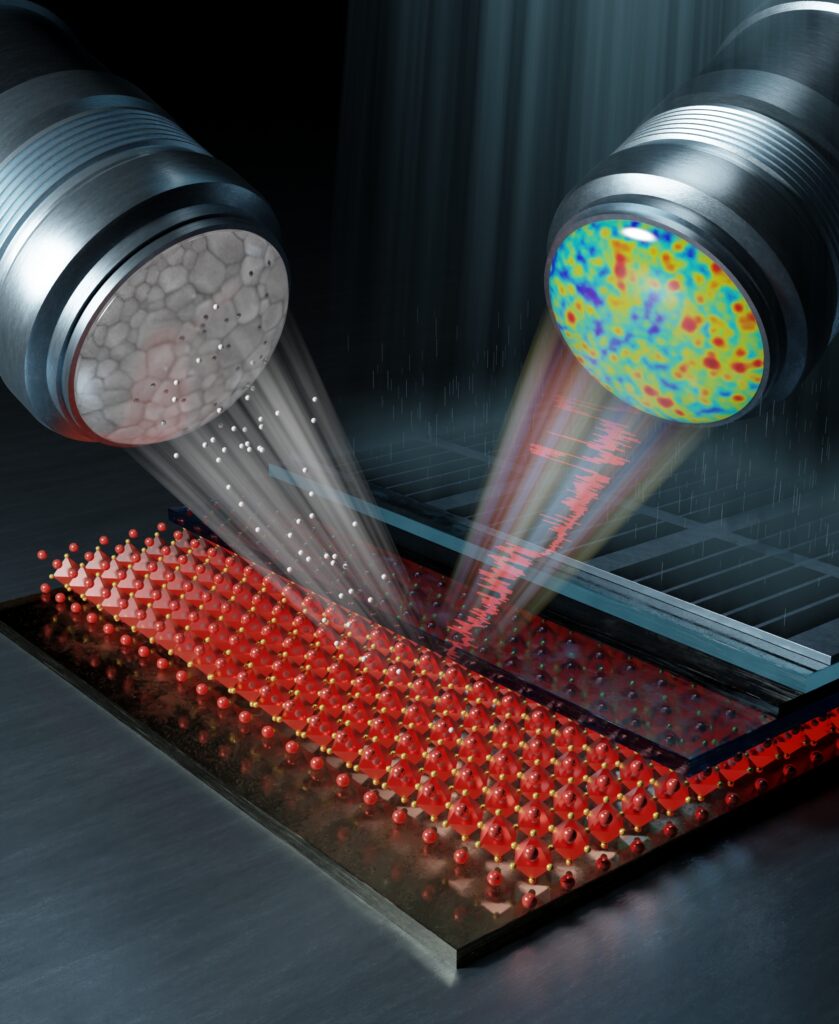
Schematic of quantum sensing using a nitrogen-vacancy center in diamond for optical readout of magnetic field interactions
Table of contents

Enhancing Measurement Sensitivity through Quantum Sensing

What is Quantum Sensing?

Quantum sensing uses quantum systems, such as photons, atoms, or spins, to measure physical quantities by analyzing how these systems interact with their environment or how their signals are detected. Unlike classical sensing approaches, it often operates in regimes where signals are extremely weak, requiring the detection and analysis of individual quantum events.

Different physical platforms can be used for quantum sensing, including atomic systems, solid-state defects such as nitrogen-vacancy (NV) centers, and photonic systems. In photonic quantum sensing, information is encoded in properties of light such as arrival time, phase, or photon statistics, and is extracted through precise time-resolved and correlation-based detection.

Quantum sensing encompasses a broad range of techniques and applications. While quantum metrology focuses on achieving ultimate measurement precision and quantum imaging extends these concepts to spatially resolved measurements, quantum sensing serves as the overarching framework for extracting physical information from quantum signals in practical scenarios.

Quantum Sensing Modalities

Quantum sensing encompasses a range of applications where physical information is extracted from quantum systems and quantum light. Depending on how the signal interacts with the environment and how it is detected, different sensing modalities can be realized.

Fluorescence Sensing

Fluorescence-based quantum sensing directly uses emitted photons as the sensing signal. Here, the information is encoded in the properties of the emitted light itself, such as its intensity, timing, or statistical distribution, which reflect interactions at the molecular or material level.

By analyzing photon arrival times and emission statistics, processes such as energy transfer, molecular interactions, and environmental changes can be studied. This approach is widely used in spectroscopy, material science, and life sciences, particularly in regimes where signals are weak and require single-photon sensitivity.

Spin-Based Quantum Sensing

Spin-based quantum sensing uses well-defined quantum states—such as electronic or atomic spins—as the actual sensing element. External perturbations, including magnetic or electric fields, temperature, or pressure, directly modify the spin state. This information is then transferred to the optical domain via spin–photon coupling, enabling optical initialization and readout.

The detected photons do not carry the primary sensing information themselves but act as a readout channel of the underlying spin dynamics, typically accessed through time-resolved detection and synchronized control sequences.

Nitrogen-Vacancy (NV) Centers

NV centers in diamond are widely used for nanoscale sensing. Their spin state can be optically initialized and read out, while microwave excitation enables optically detected magnetic resonance (ODMR). External fields shift the spin resonance, and these changes are mapped onto variations in the emitted fluorescence, allowing highly sensitive and spatially resolved measurements.

Atomic Quantum Sensors

Atomic systems, such as vapor cells or cold atom ensembles, exploit coherent spin dynamics of atomic states to sense external fields and forces. Optical probing converts changes in the atomic spin state into measurable signals, often requiring precise timing and synchronization with control sequences.

Quantum LiDAR

Quantum LiDAR uses single photons or correlated photon pairs to measure distances and object properties with high sensitivity. By precisely measuring photon arrival times, distance information can be extracted even under extremely low-light conditions.

Correlation-based detection schemes further enhance performance by suppressing background noise. By analyzing coincidences between emitted and detected photons, uncorrelated ambient light can be rejected, enabling robust operation in challenging environments such as long-range sensing or high-background scenarios.

Quantum Imaging

Quantum imaging extends quantum sensing to spatially resolved measurements, where both the position and timing of detected photons carry information. By exploiting correlations and quantum properties of light, imaging can be performed under low-light conditions or in regimes inaccessible to classical techniques.

Quantum Ghost Imaging (QGI)

Coincidence detection between a “bucket” detector, which collects light interacting with the object, and a spatially resolving reference detector enables image reconstruction. This correlation-based approach uses spatial correlations between photon pairs to reconstruct images, even though the imaging detector never directly observes the object.

Quantum Imaging with Undetected Photons (QIUP)

In QIUP, imaging is achieved using photons that are never directly detected. Within a nonlinear interferometer, photons interacting with the object transfer their spatial information to another beam via interference. This enables imaging in spectral ranges where detectors are inefficient or unavailable, such as mid-infrared, while detection is performed in a convenient, often visible wavelength range.


The distinction between different quantum sensing modalities is not always strict, as many approaches combine multiple physical principles and measurement techniques. For example, fluorescence sensing and spectroscopy both analyze emitted photons, while spin-based sensing often relies on spectroscopic methods such as ODMR. Similarly, correlation-based techniques and interferometric methods are frequently used across different sensing applications.

Why use Quantum Sensing?

Quantum sensing enables the detection and analysis of signals in regimes where classical approaches reach their limits. By leveraging single-photon detection and quantum systems, it provides access to information that is often hidden by noise or extremely low signal levels.

A key advantage is the ability to operate in the few-photon regime, where time-resolved detection and correlation analysis allow reliable signal extraction even under challenging conditions such as high background or low light.

In addition, quantum sensing provides access to multiple dimensions of information, including temporal dynamics, photon statistics, and phase. This enables more efficient use of each detected photon, improving sensitivity and measurement fidelity across a wide range of applications.

PicoQuant Time Tagging and TCSPC electronics for quantum sensing.

PicoQuant’s Time Tagger for Quantum Sensing

PicoQuant provides high-precision timing and photon-counting instrumentation for quantum sensing applications. Accurate time tagging enables the extraction of information from photon arrival times, correlations, and signal statistics, forming the basis for time-resolved, correlation-based, and interferometric sensing. Low timing jitter and flexible synchronization support reliable measurements even at low signal levels and in complex experimental environments.

Key advantages include:

  • Ultra-High Timing Resolution: Low timing jitter preserves temporal information and enables precise analysis of fast dynamics, phase-sensitive signals, and time-of-flight measurements.
  • Efficient Coincidence and Correlation Analysis: Hardware-accelerated coincidence detection and real-time correlation processing allow reliable extraction of signals from background noise and support advanced sensing schemes based on photon statistics.
  • Minimal Dead Time: Short system dead times reduce count losses and ensure accurate event detection, even at high photon rates and in multi-channel experiments.
  • Scalable Multi-Channel Architectures: Flexible channel configurations enable parallel detection and synchronization across multiple sensors, supporting imaging, array-based detection, and complex sensing setups.
  • High-Speed Data Interfaces: High-bandwidth connectivity, on-board event filtering, and FPGA-based extensions enable efficient handling of large data streams and support custom real-time analysis and adaptive sensing protocols.
Explore

Selected Time Taggers for Quantum Sensing

These time-tagging and TCSPC electronics address diverse experimental requirements in quantum sensing and quantum metrology.

PicoHarp 330 time tagging and TCSPC unit front view

PicoHarp 330

PicoHarp 330 is ideally suited for flexible quantum sensing and photon-counting experiments requiring high timing accuracy and versatile triggering. It delivers picosecond resolution, ultra-short dead time of 680 ps, and configurable multi-channel operation, enabling precise photon-correlation and time-resolved measurements across a wide range of quantum optics and material science applications.

Visit
PMA Hybrid Series hybrid photomultiplier detector assembly for single-photon counting and TCSPC measurements.

PMA Hybrid Series

PMA Hybrid Series detectors are ideally suited for high-sensitivity quantum sensing and time-resolved photon-counting experiments. They combine single-photon sensitivity with excellent timing performance, low noise, and negligible afterpulsing, enabling accurate correlation measurements and reliable detection of weak optical signals across the UV–NIR spectral range.

Visit
LDH-I Series smart picosecond diode laser head with integrated cooling, compatible with the Taiko PDL M1 driver for calibrated excitation in time-resolved spectroscopy.

Pulsed Diode Lasers for Quantum Sensing

PicoQuant’s picosecond pulsed diode lasers support quantum sensing experiments across a wide range of applications, from spectroscopy and fluorescence sensing to interferometric and time-of-flight measurements. Short pulse widths and stable repetition rates enable precise temporal control and synchronization, forming the basis for time-resolved detection, correlation analysis, and phase-sensitive measurements in photon-counting experiments.

Visit
Relevant for Your Research​

Matching Methods

TCSPC start-stop timing scheme showing photon arrival time differences relative to excitation pulses
Life Science | Materials Science | Metrology | Quantum Optics
Schematic of multi-channel photon coincidence showing three-fold correlated events
Materials Science | Quantum Optics
Schematic comparison of antibunched, bunched and coherent photon emission statistics
Life Science | Materials Science | Quantum Optics
Info Request

Info Request

Contact us

Please fill out the form below to request more information about our products and services. You may also use it to ask for pricing, availability, technical specifications, or any other details relevant to your inquiry. Our team will be happy to review your request and get in touch with you. If additional information is needed to process your inquiry, we will let you know.

* Required

Contact us

Please fill out the form below to request more information and prices about our product. Our team will be happy to review your request and get in touch with you. If additional information is needed to process your inquiry, we will let you know.

* Required