Hong-Ou-Mandel (HOM) Interferometry

Measure Photon Indistinguishability Through Two-Photon Interference

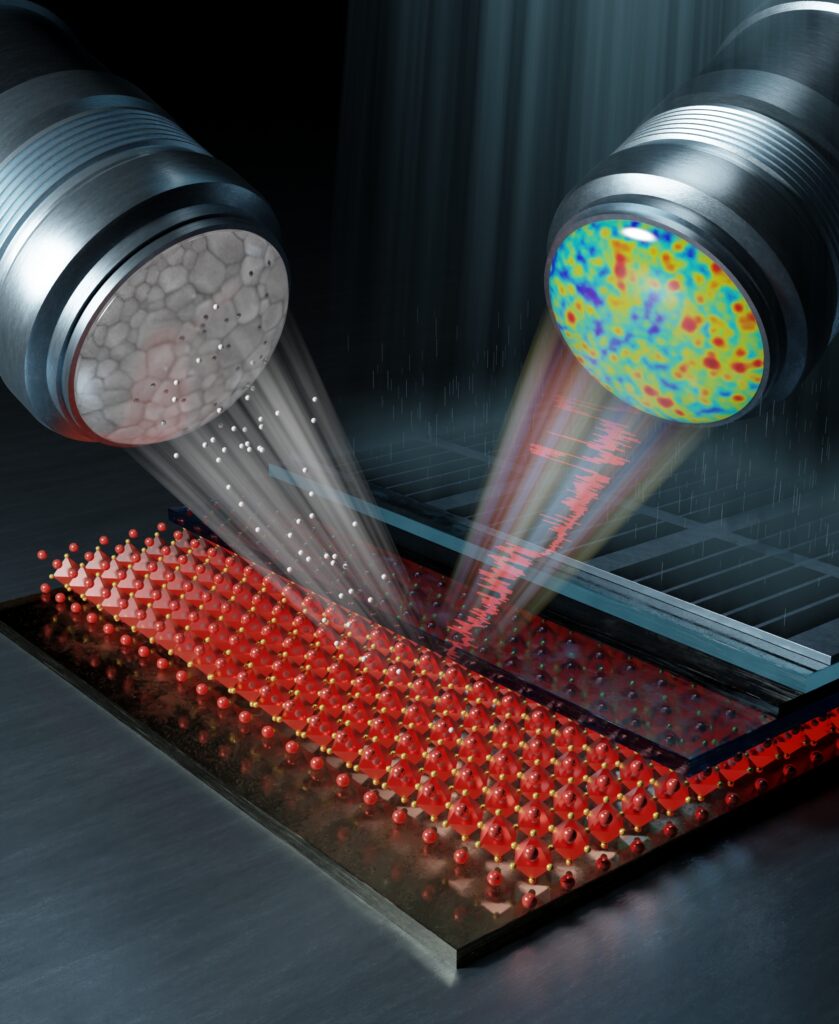
Two photons interfere at a beam splitter, revealing their indistinguishability through a reduction in coincidence counts at zero delay.
Two-photon interference at beam splitter showing suppressed coincidence events
Table of contents

Photon Indistinguishability and Interference Effects

What is HOM Interferometry?

The Hong–Ou–Mandel (HOM) effect is a two-photon interference phenomenon in which two identical photons entering a beam splitter simultaneously always exit together through the same output port. This behavior arises from quantum interference and leads to a suppression of simultaneous detections at two separate detectors.

This effect relies on photon indistinguishability, meaning the photons must be identical in all relevant degrees of freedom, such as arrival time, wavelength, polarization, and spatial mode. If the photons are distinguishable, the interference is reduced or disappears, and coincidence events are observed.

HOM interferometry exploits this effect by measuring the coincidence rate as a function of relative delay between two photons. The resulting change in coincidence counts provides direct information about their indistinguishability and temporal overlap, making it a key tool for characterizing single-photon sources and photonic quantum systems.

Experimental setup and principle of Hong-Ou-Mandel interferometry. Two photons are combined at a beam splitter with a variable delay, and coincidence detection reveals the characteristic HOM dip as a function of delay.

How does HOM Interferometry work?

In a typical HOM interferometry experiment, photons are generated by a sample, such as a quantum emitter (e.g. quantum dots, color centers, or single atoms and molecules) or nonlinear optical processes like spontaneous parametric down-conversion (SPDC). Two photons from the same or synchronized sources are directed onto the input ports of a 50:50 beam splitter. One of the photon paths includes a variable delay line (Δx), which allows precise control of the relative arrival time between the photons. After the beam splitter, the two output ports are monitored by single-photon detectors. The detection events are recorded using time-tagging and time-correlated single-photon counting (TCSPC) electronics, enabling precise timing and correlation of photon arrivals.

The key observable is the rate of coincidence events between the detectors, defined as simultaneous detections within a given time window. Accurate coincidence detection requires high timing resolution, well-defined and adjustable coincidence windows, and precise synchronization, ensuring that only correlated photon events contribute while uncorrelated background is suppressed.

By scanning the delay Δx, the relative arrival time of the photons is varied. When the photons arrive at different times, they behave independently and coincidences are observed. As the delay approaches zero, the photons become indistinguishable and interfere, leading to a reduction in coincidence counts and the formation of the characteristic HOM dip. The depth of this dip quantifies the degree of photon indistinguishability, while its width reflects the coherence time or temporal overlap of the photons.

Methods and Applications enabled by HOM Interferometry

Single-Photon Source Characterization

HOM interferometry is a key method for single-photon source characterization, enabling the evaluation of photon indistinguishability from quantum emitters. By analyzing the visibility of the HOM dip, it provides direct information on the temporal and spectral overlap of emitted photons, which is essential for high-quality single-photon generation. In combination with antibunching measurements, which verify the single-photon nature of the source, HOM interferometry offers a comprehensive characterization by probing both photon statistics and indistinguishability.

Quantum Communication and Computing

Two-photon interference is a fundamental resource in quantum communication and photonic quantum computing, where quantum states are encoded in photons and processed using linear optical elements. HOM interferometry is used to verify photon indistinguishability, which is essential for reliable interference in photonic circuits and protocols. In photonic quantum computing, interference of indistinguishable photons enables operations in approaches such as linear optical quantum computing and boson sampling. In quantum communication, HOM-type measurements are used in Bell-state analysis and entanglement-based schemes, where coincidence detection reveals quantum correlations between photons.

Quantum Sensing

HOM interferometry can be applied in quantum sensing to extract temporal information with high sensitivity. By analyzing changes in coincidence rates as a function of delay, it enables precise determination of relative optical path differences and coherence properties. This approach is particularly useful in interferometric sensing schemes, where two-photon interference provides access to timing and phase information beyond classical intensity measurements, supporting applications such as delay estimation and characterization of optical signals.

Integration in Time-Resolved Optical Systems

This technique can be integrated into optical setups such as confocal microscopes and time-resolved measurement systems. It builds on existing single-photon detection and timing infrastructures, making it compatible with spectroscopy and fluorescence-based approaches. In time-resolved methods such as fluorescence lifetime imaging microscopy (FLIM), it provides complementary information by probing photon coherence and indistinguishability. Combined with lifetime measurements, this enables a more complete characterization of emission processes and light–matter interactions.

Why use HOM Interferometry?

HOM interferometry provides direct access to photon indistinguishability, a key parameter in many quantum optical applications. By relying on two-photon interference and coincidence detection, it enables sensitive characterization of temporal and spectral overlap that cannot be obtained from intensity-based measurements alone.

A major advantage is its operation at the single-photon level, making it well suited for experiments with weak signals and quantum light sources. As a correlation-based technique, it is robust against intensity fluctuations and provides reliable results even under low count rate conditions.

In addition, HOM interferometry complements other methods such as antibunching and time-resolved measurements by adding information on photon coherence and interference. This makes it an essential tool for a comprehensive characterization of photonic systems in quantum optics, quantum communication and computing, and beyond.

HOM Interferometry Data & Analysis

HOM interferometry measurements are based on recording coincidence events between two detection channels as a function of relative delay. By accumulating photon arrival times using time tagging electronics, coincidence histograms can be constructed, revealing the characteristic HOM dip.

From these measurements, key parameters can be extracted:

  • Dip depth: quantifies photon indistinguishability
  • Dip width: reflects coherence time and temporal overlap
  • Baseline level: indicates residual distinguishability and background contributions

Accurate analysis requires precise control of timing resolution, coincidence windows, and synchronization. High temporal resolution ensures correct identification of true coincidence events, while appropriate data processing separates correlated photon pairs from uncorrelated background.

Auto- and cross-correlation measurement for analyzing photon statistics, molecular dynamics, and quantum emitter properties.

PicoQuant’s Software for HOM Interferometry

PicoQuant’s software solutions provide flexible tools for coincidence-based analysis in HOM experiments. Time-tagged photon streams can be processed to extract coincidence events, construct delay-dependent histograms, and evaluate key parameters such as visibility and coherence time.

Live tracking of coincidence count rates in UniHarp enables real-time monitoring of interference conditions, while automation of delay scans can be implemented using scripting interfaces such as snAPI synchronize data acquisition with motorized stages. Combined with multi-channel correlation, coincidence filtering, and real-time processing, this allows efficient and scalable analysis of two-photon interference measurements.

Instrumentation suited for antibunching measurements, including PMA Hybrid Series, PDM Series and PicoHarp 330.

PicoQuant's Instrumentation for HOM Interferometry

Reliable HOM interferometry measurements require fast single-photon detectors with low timing jitter and low dark counts to accurately resolve coincidence events. Time tagging electronics with high temporal resolution are essential for precise coincidence detection and delay-dependent analysis. Stable pulsed or continuous-wave excitation sources and well-controlled optical delay lines are needed to ensure reproducible interference conditions. Multi-channel data throughput and precise timing synchronization are critical, especially for measurements at high count rates. Dedicated acquisition and analysis software is required to compute coincidence histograms, monitor interference in real time, and extract quantitative parameters such as visibility and coherence time.

Relevant for Your Research​

Matching Applications

Coincidence correlation showing photon antibunching of NV centers in nanodiamonds
Materials Science | Quantum Optics
Schematic of quantum sensing using a nitrogen-vacancy center in diamond for optical readout of magnetic field interactions
Materials Science | Quantum Optics

Related Products for HOM Interferometry

These products support Hong-Ou-Mandel interferometry by enabling precise photon timing, coincidence detection, and low-noise single-photon measurements required for two-photon interference experiments.

PicoHarp 330 time tagging and TCSPC unit front view

PicoHarp 330

PicoHarp 330 provides picosecond timing resolution for coincidence measurements in HOM experiments. Its time-tagging capabilities enable precise correlation of photon arrival times, making it well suited for delay-dependent interference analysis and characterization of photon indistinguishability.

Explore PicoHarp 330
PMA Hybrid Series hybrid photomultiplier detector assembly for single-photon counting and TCSPC measurements.

PMA Hybrid Series

PMA Hybrid Series combines high sensitivity, low timing jitter, and low dark counts for reliable single-photon detection. These detectors support accurate coincidence measurements in HOM interferometry, particularly when timing precision and stable count rates are required.

Explore PMA Hybrid Series
PDM Series SPAD single-photon avalanche diode detector module by MPD

PDM Series

PDM Series offers compact single-photon detection with high quantum efficiency and low noise. Its timing performance and detector stability make it suitable for HOM measurements requiring reproducible coincidence detection and efficient photon counting across different wavelength ranges.

Explore PDM Series
Info Request

Info Request

Contact us

Please fill out the form below to request more information about our products and services. You may also use it to ask for pricing, availability, technical specifications, or any other details relevant to your inquiry. Our team will be happy to review your request and get in touch with you. If additional information is needed to process your inquiry, we will let you know.

* Required