The Limits of Seeing Only the Spectrum
Photoluminescence (PL) spectroscopy is one of the most widely used characterization methods in materials science. Emission spectra can provide insight into bandgap energies, defect-related states, compositional variations, and optical quality. In semiconductors, nanomaterials, and perovskites alike, steady state PL has become a routine tool of material evaluation. Yet spectral information alone rarely tells the full physical picture.
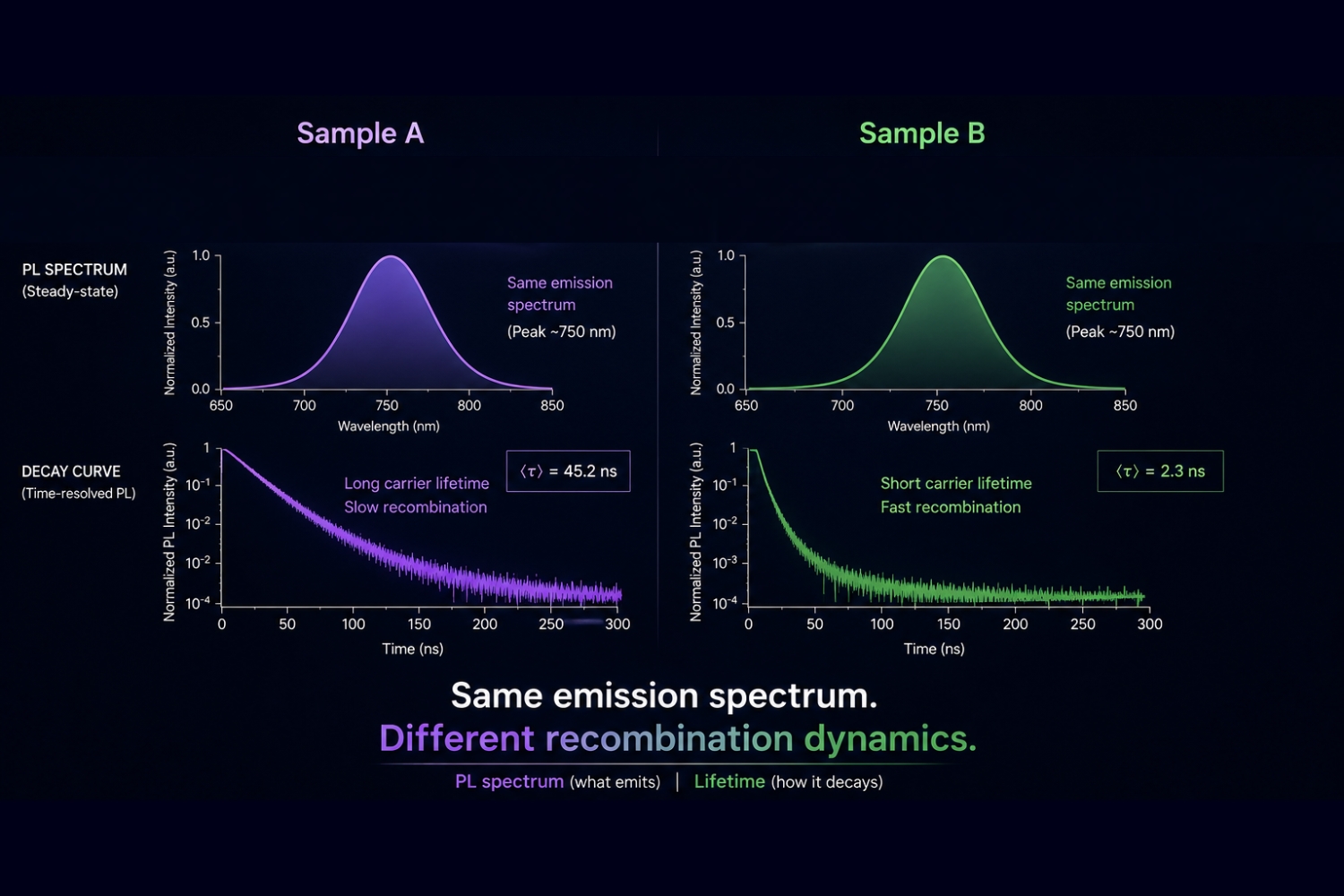
Two materials can exhibit nearly identical PL spectra while displaying substantially different recombination dynamics. The spectral position and emission profile may appear similar, even though the underlying carrier behavior following excitation differs significantly. One material may exhibit predominantly radiative recombination, whereas the other may be strongly affected by trap-assisted losses, carrier trapping, or non-radiative decay pathways that remain difficult to identify from steady-state measurements alone.
The spectrum shows what emits; carrier dynamics help explain why.
Why Emission Intensity Can Be Misleading
Steady-state PL provides a time-integrated view of photoluminescence and therefore reflects the combined outcome of multiple competing recombination processes.
A bright PL signal does not necessarily indicate efficient charge extraction, favorable carrier transport, or a low density of electronically active defects. Likewise, weak emission does not automatically imply poor material quality.
Excitation conditions, local morphology, surface states, interfaces, and defect populations can all influence the observed emission intensity. As a result, materials with substantially different microscopic properties may exhibit surprisingly similar photoluminescence characteristics.
These effects become especially relevant in material systems where local structure, interfaces, and defects strongly influence optical response, including:
- Perovskite thin films
- 2D materials
- Nanomaterials
- Quantum emitters
- Polycrystalline photovoltaic devices
- Heterostructures and multilayer systems
Recombination Dynamics Are Closely Linked to Device Performance
Carrier dynamics are a key factor influencing the performance of many optoelectronic devices.
In solar cells, carrier lifetime contributes to diffusion length and can influence charge extraction efficiency. In LEDs, recombination pathways affect internal quantum efficiency and emission stability. In quantum photonic systems, excited-state dynamics influence photon emission statistics and emitter behavior.
Many technologically relevant loss mechanisms arise from dynamic carrier processes that cannot be inferred from structural information alone. Trap assisted recombination is one example. Defect states may introduce additional recombination pathways that shorten carrier lifetimes without necessarily producing strong spectral signatures. Similarly, interfacial quenching can suppress device efficiency even when steady state emission spectra appear largely unchanged.
Structural characterization methods such as Raman spectroscopy remain essential for understanding composition, crystal structure, and material heterogeneity. However, these techniques provide information that is complementary to, rather than interchangeable with, measurements of carrier dynamics.
Why Temporal Information Matters
Time-resolved photoluminescence (TRPL) provide access to the temporal signatures of physical processes that are averaged over in steady-state characterization.
TRPL measurements can provide insight into:
- Non-radiative recombination processes
- Trap-mediated decay pathways
- Carrier trapping and detrapping
- Interfacial charge transfer
- Exciton diffusion behavior
- Spatially resolved variations in recombination dynamics
This temporal dimension becomes particularly important in materials where local variations strongly influence device behavior. For example, two spatial regions may emit at the same wavelength while exhibiting substantially different decay kinetics. One region may show long-lived emission consistent with comparatively efficient radiative recombination, whereas another may exhibit fast decay caused by defect-related quenching.
The situation becomes even more complex in materials systems where multiple recombination pathways coexist. Multi-exponential decay behavior, delayed emission, or excitation-dependent lifetimes can reflect the coexistence of multiple recombination channels and other complex excited-state processes.
From Steady State Characterization to Correlative Workflows
Modern materials characterization increasingly relies on combining complementary methods rather than depending on a single measurement modality.
Structural techniques provide information about crystallography, morphology, and material composition. Steady-state photoluminescence measurements reveal optical transitions and emission energies. Time-resolved measurements provide access to recombination kinetics and excited-state behavior. Together, these approaches create a more complete physical picture of the material system.
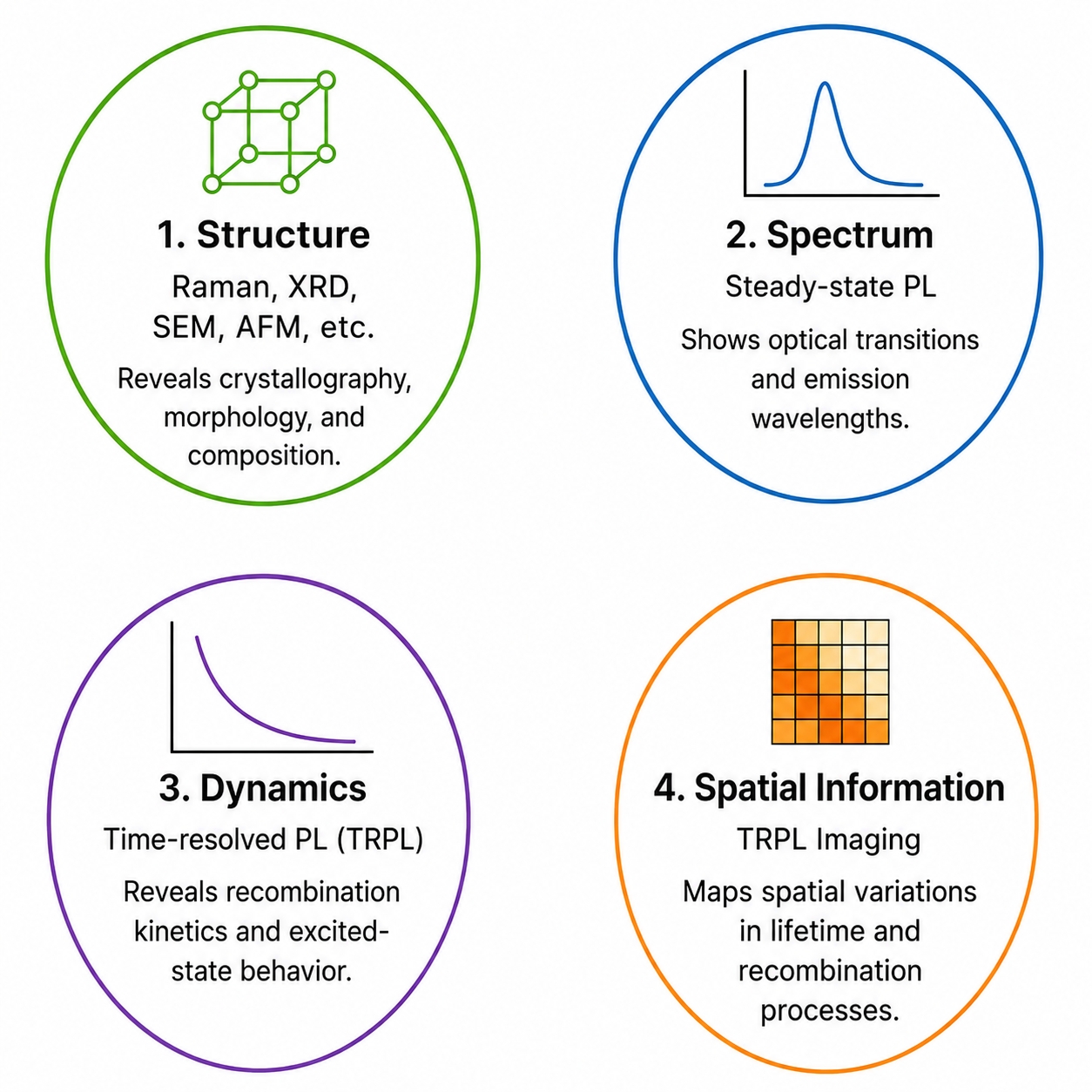
This becomes particularly important for spatially heterogeneous materials, where local defects, grain boundaries, strain distributions, and interfaces can lead to substantial variations in carrier dynamics across a sample. Capturing these variations requires not only spectral and temporal information, but also spatial resolution.
In this context, TRPL imaging extends conventional time-resolved photoluminescence by providing spatially resolved information about carrier dynamics. By combining spatial, spectral, and temporal information, it becomes possible to visualize how recombination behavior varies across complex material systems and to identify regions associated with enhanced non-radiative losses, efficient emission, or distinct recombination pathways.
Steady-state PL remains an essential characterization method, but understanding modern optoelectronic materials increasingly requires access to the dynamic processes that govern carrier behavior. Carrier lifetime measurements provide a direct connection between excited-state physics and device performance, helping researchers understand why materials with similar optical signatures can behave very differently in practical applications.
Systems such as Solira are designed around this concept, supporting spatially resolved and time-resolved photoluminescence measurements as part of modern materials characterization workflows rather than isolated measurements alone.

Also read Part 2: “Why Spatially Resolved TRPL Imaging Matters”