Your Questions Answered
Thank you to everyone who joined our recent webinar with Dr. Sudipta Seth from KU Leuven, hosted by Physics World, on In Situ and Operando Optical Microscopy and Spectroscopy: Investigating Perovskite Optoelectronic Devices at Work.
The session sparked many interesting questions about photoluminescence (PL) dynamics, defect behavior, and advanced optical characterization techniques of perovskites. Since we couldn’t address every question in detail during the live session, Sudipta kindly provided written answers.
If you missed the live session or would like to revisit the presentation, you can access the recording through Physics World.
In this three-part Q&A series, we’re sharing his insights with the broader scientific community.
Part 1: Understanding Photoluminescence Fluctuations and Functional Domains
In this first part, we explore what photoluminescence fluctuations can reveal about perovskite materials, from changes in trap density during self-healing to the interpretation of correlated regions in correlation clustering imaging (CLIM) maps.
Q1: During the self-healing process, how does the density of trap states change? Does the behavior of the trap states also change?
A: As self-healing proceeds, the photobleached spot gradually recovers its brightness and the characteristic PL fluctuation pattern returns. Using Monte Carlo simulations, we showed that reducing the metastable trap density from 12 × 10¹⁴ to 1.5 × 10¹⁴ reproduces the correlation and cluster behavior observed experimentally.
We cannot fully exclude the possibility that the behavior of the traps also changes. For example, the traps could become more efficient quenchers while their concentration remains the same. In that case, however, we would expect larger-amplitude PL fluctuations, which we did not observe. A decrease in trap density is therefore the most consistent explanation of our data, although a change in trap behavior cannot be completely ruled out.
Q2: What is the significance of the correlated regions observed in CLIM maps?
A: Highly correlated regions represent functional domains, meaning areas in which the photoluminescence intensity fluctuates in a synchronized manner.
Beyond PL Fluctuations: Explore Time-Resolved Photoluminescence Microscopy
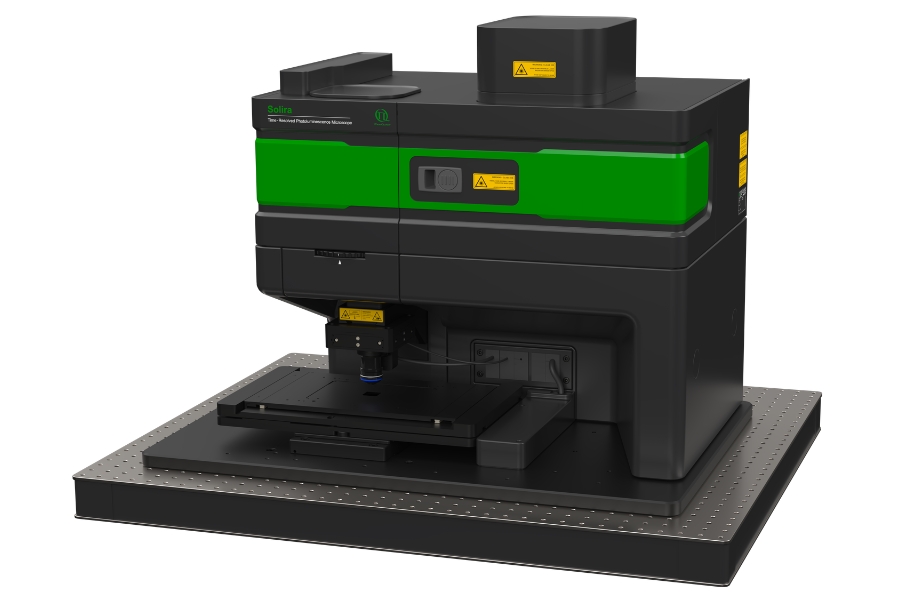
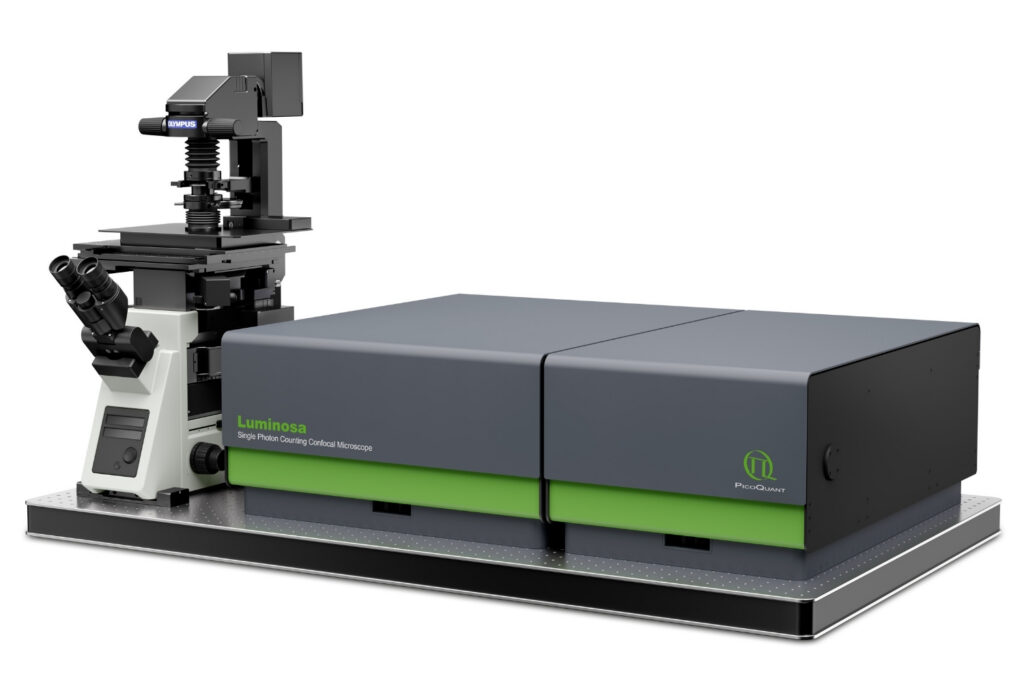
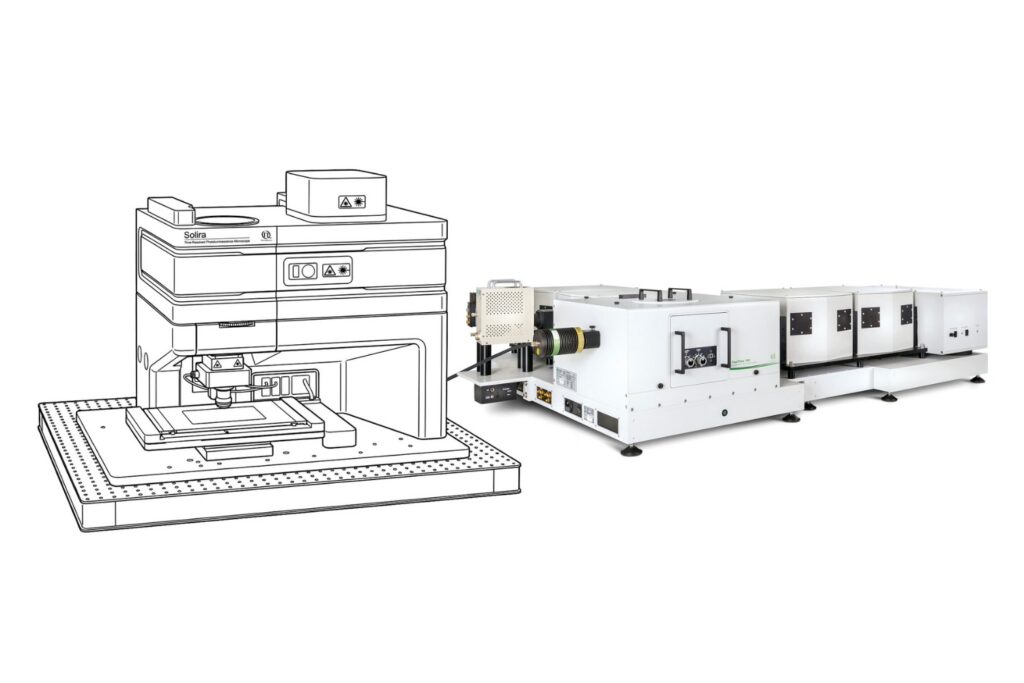
In a recent Physics World Weekly podcast, our Product Manager for Materials Science, Dr. Emilio Gutierrez-Partida, discusses how combining temporal, spatial, and spectral photoluminescence measurements can provide deeper insights into material properties. The conversation also explores our Solira time-resolved photoluminescence microscope.
Want to learn more about how photoluminescence can reveal the dynamics of advanced materials?
Q3: What is the effect of grain size on correlations in CLIM?
A: As long as the grains are comparable to or larger than the optical diffraction limit and behave independently, each grain appears as an individual cluster. If grains are fused and interact with each other, they form a larger functional domain, and a single cluster can include several grains.
In our measurements, the clusters correspond to individual grains in MAPI and FAPI films with large grains (≥ 500 nm). In contrast, for triple-cation films with smaller grains, a cluster often contains multiple grains.
Q4: How should the boundaries and relationships between clusters in a CLIM map be interpreted?
A: Pixels at the boundaries between two clusters generally exhibit the lowest correlations because their PL signals contain contributions from neighboring regions.
We generally impose a cleanup method that removes these pixels and do not assign them to any clusters. Each cluster in the map represents a distinct functional domain in the film. Where clusters share some degree of similarity, this is reflected in the silhouette score of the corresponding cluster map. Lower silhouette score generally stand for certain extent of communication between neighbors.
Further Reading and Webinar Resources
For those interested in exploring the research discussed during the webinar in greater detail, Sudipta has provided references to two scientific publications:
- In Operando Locally-Resolved Photophysics in Perovskite Solar Cells by Correlation Clustering Imaging – Advanced Materials (2025)
- Microscopic Intricacies of Self-Healing in Halide Perovskite–Charge-Transport-Layer Heterostructures – ACS Energy Lett. (2026)
You can also revisit the full presentation through the Physics World webinar recording.
Explore Carrier Dynamics at MRS Fall 2026
How do charge carriers move through a material, and what determines whether they recombine radiatively or non-radiatively? If you’d like to explore these questions further, join our free TRPL Masterclass, “Carriers Move. Carriers Recombine. How Do We Tell What Matters?”, at MRS Fall in Boston on December 1 or 2. Together with Dr. Emilio Gutierrez-Partida, you’ll discuss carrier diffusion, mobility, and how photoluminescence measurements can help reveal the processes governing material performance.
More Questions? Stay Tuned for Part 2!
In the next part of our Q&A series, we’ll take a closer look at the technical aspects of CLIM, including temporal and spatial resolution, pixel definitions, and how correlation clusters are established.
Don’t miss the next part – subscribe to our Newsletter to stay informed!