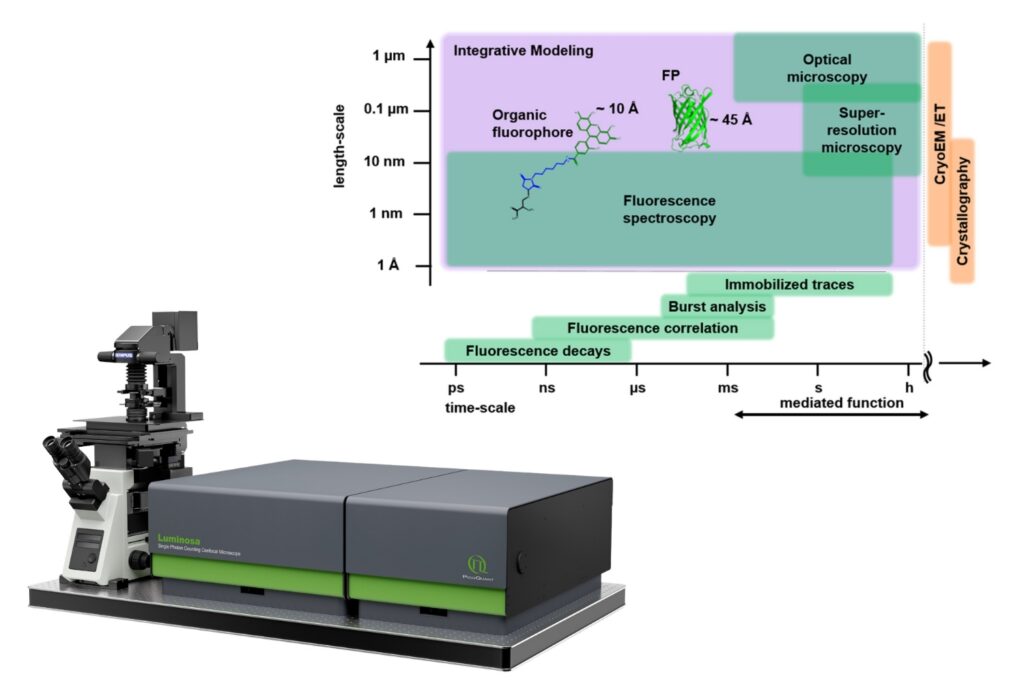
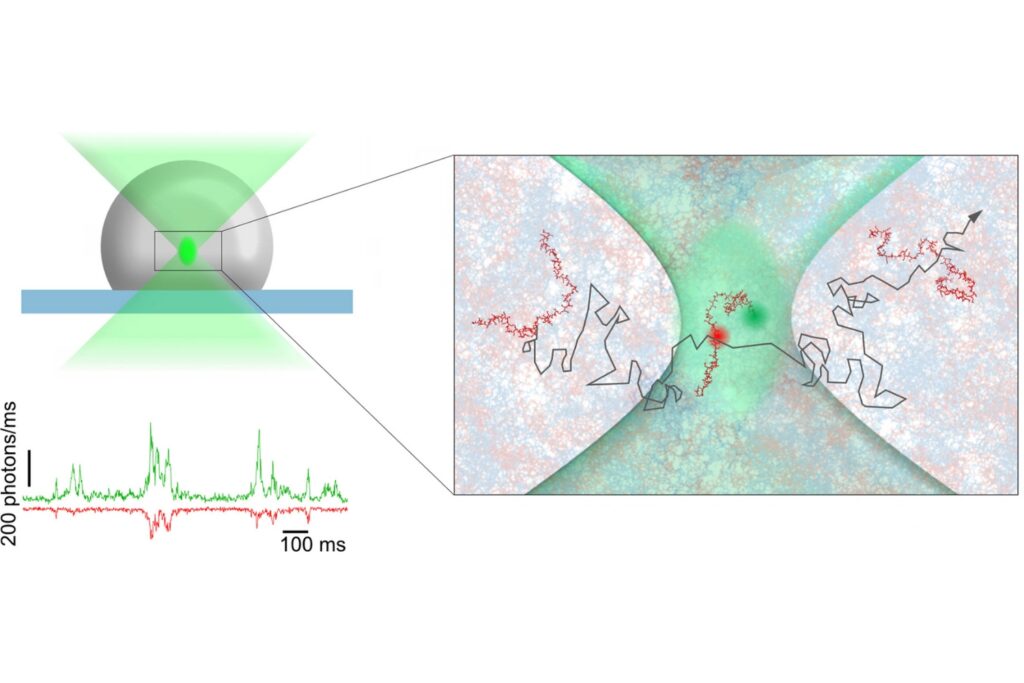
A material may appear uniform in one measurement and highly heterogeneous in another. Correlative characterization connects these different views before they lead to incomplete interpretations.
Modern optoelectronic materials are rarely uniform systems. Their behavior can be influenced by local composition, interfaces, grain boundaries, defects, strain, layer structure, and processing history. These factors affect not only how strongly a sample emits, but also where the emission originates, how it evolves after excitation, and which electronic states contribute to it. A single measurement can provide an important part of this information. It may not, however, explain why a material performs well, why it degrades, or why two apparently similar samples behave differently.
The central challenge is therefore not simply to collect more data. It is to connect complementary information dimensions in a way that reduces ambiguity.
One Sample Can Contain More Than One Answer
An observed photoluminescence signal is the combined result of several processes. Light is absorbed, excited states are formed, charge carriers may migrate or become trapped, and recombination eventually produces either emitted photons or nonradiative losses. Different physical mechanisms can therefore produce similar experimental observations. A reduction in photoluminescence intensity, for example, may result from increased nonradiative recombination. It may also reflect lower absorption, reduced emitter concentration, altered layer thickness, charge extraction, or changes in the optical collection conditions. An emission spectrum may reveal the wavelengths involved, but not necessarily the underlying kinetics.
A more complete characterization asks three connected questions:
- Where does emission occur?
- How does the emission evolve over time?
- Which spectral contributions dominate the observed behavior?
Each question describes a different dimension of the same material.
Spatial Information: Where Behavior Changes
Spatially resolved measurements show whether photophysical behavior is distributed uniformly across a sample or concentrated in specific regions.
This distinction matters for materials containing grain boundaries, patterned structures, interfaces, local defects, compositional domains, or multilayer architectures. An averaged point measurement may combine all these contributions into a single intensity value or decay curve, so that local variations can disappear within the average.
Photoluminescence imaging can identify bright and dark regions, patterned areas, and variations in emission intensity. Spatially resolved TRPL imaging adds a temporal dimension to these maps by showing whether different locations also exhibit different decay kinetics. A region with reduced emission intensity and a shorter decay time may be consistent with increased local quenching. A region with lower intensity but unchanged decay behavior may require a different explanation, such as reduced absorption or a lower concentration of emissive material. Neither interpretation should be made from intensity alone.

Spatial lifetime variations can also reveal the influence of interfaces, processing damage, surface passivation, phase segregation, or local electric fields. In structured semiconductor devices, they can help relate fabrication steps to changes in local recombination behavior. Carrier diffusion measurements extend this analysis beyond the point of excitation. By observing how photogenerated carriers spread and recombine, researchers can investigate transport length scales, trapping, and spatially varying loss mechanisms.
Temporal Information: How Excited States Evolve
Time-resolved photoluminescence investigates how the emission changes after optical excitation. The resulting decay kinetics provide information about recombination, trapping, energy transfer, diffusion, quenching, and other excited-state processes. Two materials can show similar PL spectra while exhibiting fundamentally different recombination dynamics. One sample may be dominated by rapid trapping or nonradiative loss, while another may retain excited carriers for longer periods. Both could still emit within a similar spectral range. A steady-state spectrum alone would not reveal this difference.

Decay times must also be interpreted carefully. A shorter decay is not automatically evidence of inferior material quality. It can result from increased nonradiative recombination, but it may also indicate faster radiative recombination, efficient charge extraction, or energy transfer to another state or layer. The interpretation depends on the sample architecture, excitation conditions, emission intensity, spectral range, and supporting measurements.
Similarly, a long decay component may represent long-lived radiative states, trapped carriers, delayed emission, or a distribution of recombination environments. TRPL constrains the possible explanations, but it does not assign every decay component to a unique physical mechanism on its own. This is where correlation with spatial and spectrally resolved data becomes essential.
Spectrally Resolved Information: Which Emission Channels Dominate
A photoluminescence spectrum shows which wavelengths are emitted and may reveal multiple peaks, broad emission bands, spectral shifts, or defect-related contributions. Conventional TRPL measurements often collect decay dynamics within an integrated or selected emission range. This provides an effective decay response for the detected photons. When several emission channels overlap within that range, the measured decay may contain contributions from states with different kinetics.
Spectrally resolved workflows address this limitation by analyzing emission as a function of both wavelength and time. Time-resolved emission spectroscopy (TRES) records how the emission spectrum evolves after excitation. It can reveal whether different wavelengths decay at different rates, whether an emission band shifts over time, or whether delayed components become more prominent after faster processes have decayed. While conventional TRPL can reveal integrated recombination dynamics, spectrally resolved workflows such as TRES help identify whether different emission channels exhibit distinct decay behavior.
This distinction is relevant across several material classes. In multilayer semiconductors, separate spectral bands may originate from different layers or interfaces. In quantum wells, individual transitions can exhibit different carrier capture and recombination kinetics. In nanomaterials and two-dimensional materials, excitons, trions, localized emitters, and defect-related states may contribute within overlapping spectral regions. In LEDs and other emissive devices, spectrally resolved decay analysis can help determine whether changes in emission arise from the intended emissive state, a secondary recombination channel, or degradation-related defect emission.
TRES does not assign a spectral component automatically. Structural data, temperature-dependent measurements, excitation-power studies, or theoretical modeling may still be required. It does establish whether apparently overlapping emission features follow the same temporal behavior.
Why Correlation Improves Interpretation
Consider a sample containing a region with reduced photoluminescence intensity. A spatial map identifies where the change occurs. TRPL determines whether the local recombination kinetics are altered. TRES then examines whether the same spectral states remain dominant or whether a new emission contribution has appeared. The combined result is more informative than any individual measurement.
If the intensity and lifetime both decrease while the spectral shape remains stable, a faster local recombination pathway may be involved. If a new red-shifted band appears with a distinct decay time, localized or defect-related emission may be contributing. If different regions show comparable spectra but different lifetimes, the same optical transition may be governed by different local recombination environments. These observations still require scientific interpretation. Correlation does not eliminate the need for controls or complementary methods. It narrows the number of plausible explanations.
Correlative characterization becomes powerful when the resulting information layers are registered to the same sample regions, acquired under controlled conditions, and interpreted as parts of one physical system.
Connecting Spatial, Temporal, and Spectral Workflows with Solira
Solira, our new time-resolved photoluminescence microscope, supports this characterization logic by combining several photoluminescence workflows within one configurable microscope system. At selected points of interest, steady-state PL can first identify the relevant emission bands. TRPL can then measure the associated decay kinetics, while TRES resolves how those kinetics vary across the emission spectrum.
The resulting three-in-one approach connects:
- Spatial information, showing where emission, heterogeneity, interfaces, defects, or local variations occur.
- Temporal information, showing how excited carriers recombine, diffuse, become trapped, or are quenched.
- Spectral information, showing which wavelengths, emission bands, or material-specific channels contribute to these dynamics.

This three-in-one concept refers to three complementary information dimensions rather than only three measurement modes. Depending on the scientific question, Solira workflows can include:
- Steady-state PL
- TRPL point measurements
- TRPL imaging
- Time-resolved emission spectroscopy (TRES)
- Carrier diffusion imaging
- Hyperspectral imaging
- Excitation-power-, temperature-, or polarization-dependent measurements.
The practical value is not simply the number of available measurement modes. It is the ability to build an experimental sequence around a scientific question.
From More Measurements to Better Scientific Context
Modern materials research increasingly depends on connecting information rather than evaluating isolated signals. Spatial measurements establish where a process occurs. Time-resolved measurements show how it evolves. Spectrally resolved measurements identify which emission channels are involved.
These dimensions help determine whether similar spectra arise from different recombination pathways, whether local defects affect only emission intensity or also carrier dynamics, and whether individual layers or states contribute distinct temporal behavior. The objective is not to measure every possible parameter. It is to select complementary measurements that test the same physical hypothesis.
Solira supports this approach by bringing spatially resolved TRPL, TRES, carrier diffusion imaging, hyperspectral imaging, and complementary photoluminescence workflows into one configurable measurement platform. This allows spatial, temporal, and spectral information to be investigated within a consistent experimental workflow.
One sample can provide multiple insights when spatial, temporal, and spectrally resolved information are treated as connected parts of the same experiment.