Complete confocal fluorescence microscope that empowers researchers to advance quantitative functional imaging from individual molecules to cells and tissues.

Modular, customizable, time-resolved confocal microscope with single-molecule sensitivity for life and materials science.

Compact FLIM and FCS upgrade kit that adds advanced functional imaging and correlation analysis to existing laser scanning microscopes.

Designed for flexible, sensitive, and precise steady-state and time-resolved spectroscopy across the UV to NIR range and time scales from picoseconds to milliseconds.

Modular lifetime spectrometer designed for flexible fluorescence and photoluminescence measurements in both materials and life science research.

Add spectral and time-resolved photoluminescence to your setup through flexible microscope–spectrometer coupling options.

Get the most out of superconducting nanowire detectors in large-scale quantum communication and computing experiments requiring precise multichannel timing.

Boost your time-resolved experiments with a flexible, high-precision time tagging and TCSPC unit for materials science and quantum sensing.

Scale your photonic quantum computing and detector characterization setups while maintaining performance, flexibility, and high data throughput.

Compact 3-color picosecond laser delivering flexible ns to ms excitation with cost-effective multicolor performance and straightforward operation.

Smart picosecond laser diode heads covering UV-A to NIR, providing the right combination of power, pulse width, and diode type for any time-resolved technique.

VisUV provides clean short pulses and stable timing across key UV and visible wavelengths, including deep UV lines as well as 488 nm and 532 nm.

Enhance your single-photon counting experiments with wide dynamic range and excellent timing precision in the UV and visible even at the highest count rates.

Capture even the weakest signals over large areas with maximum dynamic range and enhanced low-light sensitivity in a compact detector design.

Unlock spatially resolved single-photon detection with a 23-pixel SPAD array, combining low dark counts and precise time tagging for advanced experiments.

Advanced FLIM analysis software for fast, accurate interpretation of lifetime imaging data.

Intuitive, free software solution for real-time, high-precision photon data acquisition, visualization, and initial data analysis.

Advanced software for time-resolved fluorescence acquisition and analysis.

An imaging technique that uses fluorescence lifetimes to generate image contrast.

Investigating how proteins dynamically explore multiple conformational states that control biological function.

Investigating how biomolecules separate into dynamic liquid phases to organize cellular space and regulate biological function.

A time-resolved technique that measures photoluminescence lifetimes to reveal excited-state dynamics in materials.

Studying exciton dynamics, charge carrier processes, and structural properties through optical and time-resolved characterization methods.

Investigating charge-carrier lifetimes and recombination dynamics to enable precise optical characterization of material quality and device performance.

A quantum optical signature revealed by time-resolved photon correlation analysis to identify single-photon emission in materials and nanostructures.

The transmission of information using individual photons, using quantum effects to ensure absolute security.

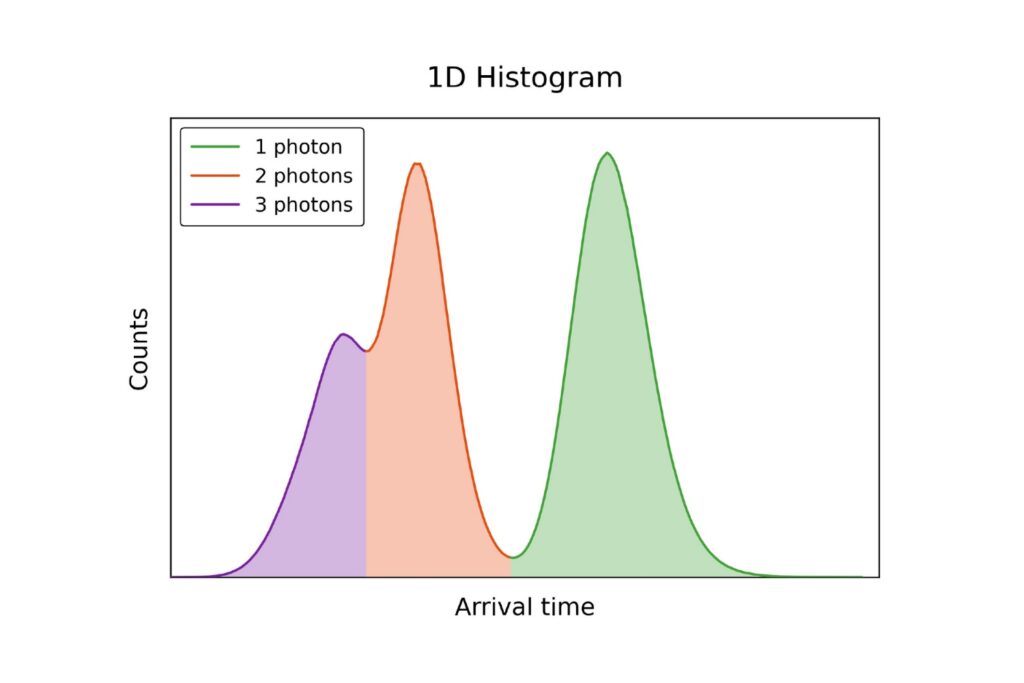
Quantifying photons per detection event enables direct access to photon-number statistics, providing insight into quantum and statistical properties of light.

An optical technique that analyzes light emission under electrical excitation to reveal electronic properties of electroluminescent materials.

Monitoring environmental signals and trace compounds to understand dynamic changes in natural and engineered environments.

A photon timing technique that measures single-photon arrival times to resolve ultrafast dynamics in fluorescence, materials research, and quantum optics.
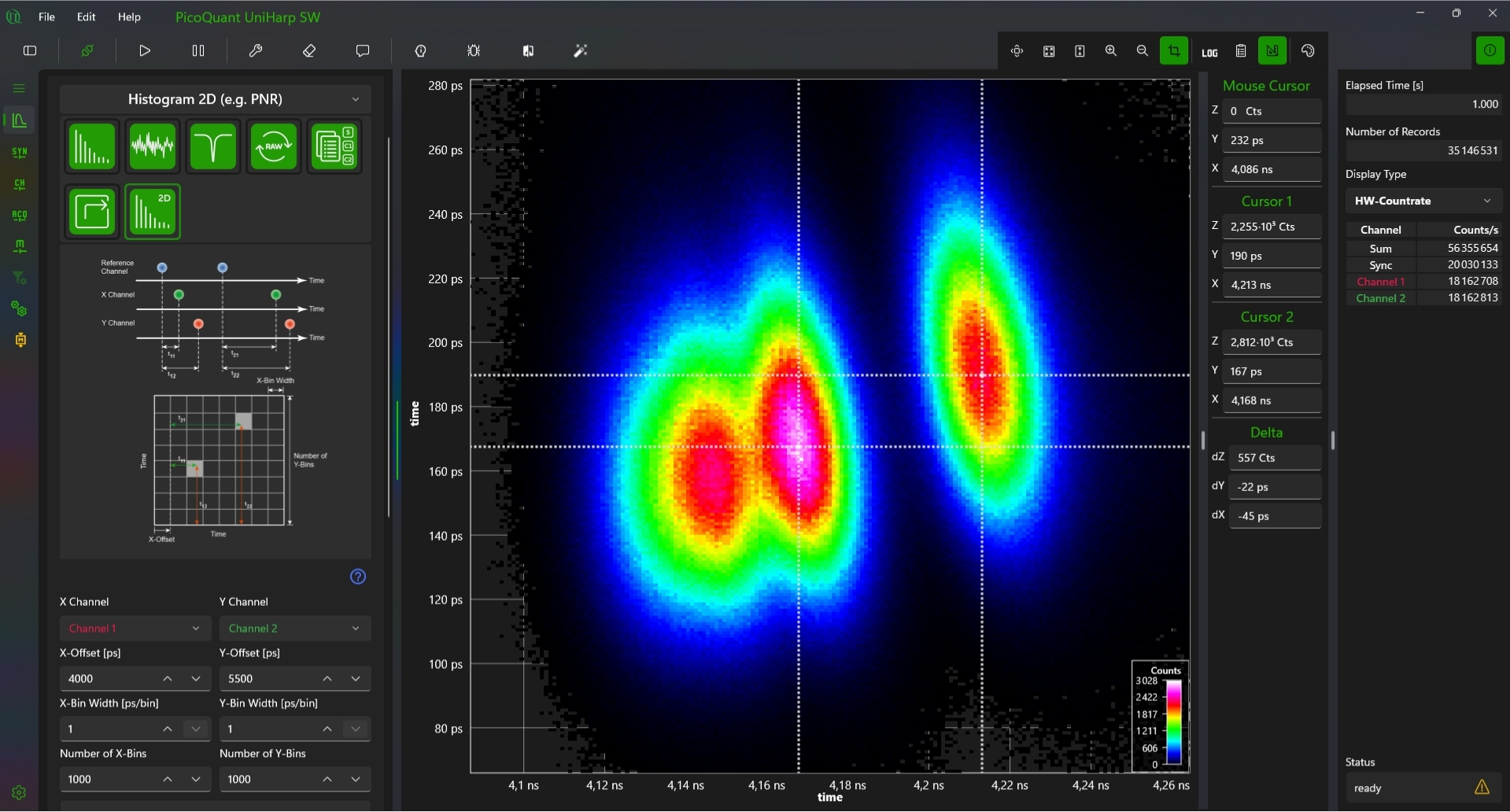
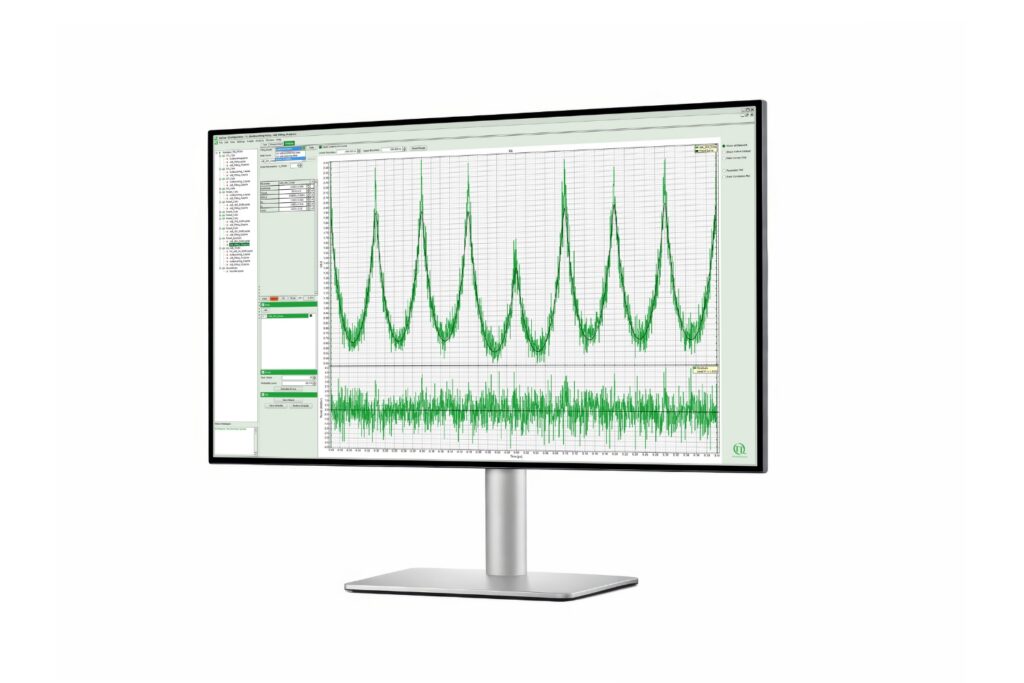
Screenshot from UniHarp software demonstrating the Histogram measurement class together with the Herald manipulator.UniHarp is a free and universal software solution for time-resolved photon data acquisition, bringing precision, flexibility, and simplicity together in a single environment. It unifies time-tagging and TCSPC data acquisition within an intuitive interface, offering real-time visualization and flexible data export for both quick inspection during alignment and rigorous post-processing in external environments. UniHarp supports all core measurement classes, including histogramming, time traces, correlation analysis, unfold, and raw acquisition, giving researchers complete flexibility to capture and study photon-arrival information with high temporal accuracy. UniHarp’s true strength lies in the combination of measurement classes with various manipulators that act as ‘virtual’ channels. It enables researchers to focus on scientific insight rather than technical overhead, supporting advanced work in quantum optics, photonics, materials science and life sciences.
It is fully compatible with all PicoQuant time tagging and TCSPC units.
UniHarp provides a series of measurement classes that cover the key workflows for working with time-resolved photon data. Histogram measurements analyze photon arrival times to study decay kinetics and excited-state lifetimes in experiments such as TRPL or FLIM. Time traces capture intensity fluctuations over time, enabling the investigation of slow dynamics such as molecular blinking or drift. Correlation analysis supports auto- and cross-correlation methods including FCS and g² measurements, while Unfold and RAW provide detailed access to photon timing information and complete time-tag streams.
A key strength of UniHarp is the seamless integration of these measurement classes with real-time manipulators, allowing photon streams to be filtered, combined, or transformed during acquisition to build flexible and application-specific measurement workflows.
PicoQuant Time Tagging and TCSPC electronics for high-precision photon timing applications.
Measurement classes define how the time-tagged photon event stream is converted into measurable quantities. Each event in the stream contains at least a timestamp and a channel identifier, representing when and where a photon was detected. A measurement class processes this stream using a specific algorithm to generate a particular representation of the data, such as count rates, time-delay distributions, or photon correlations. Different measurement classes therefore provide different perspectives on the same underlying photon detection events

The Histogram measurement class builds a distribution of photon arrival times relative to a reference signal, typically the sync signal of a pulsed excitation source. Each photon event is assigned to a time bin based on its arrival delay after the sync pulse.
The resulting histogram represents the temporal distribution of photon arrivals, commonly used in time-correlated single photon counting (TCSPC) experiments such as time-resolved photolumindescence (TRPL). It provides information such as fluorescence lifetimes or decay dynamics.

The Time Trace measurement class calculates the photon count rate as a function of time. Photon detection events are grouped into consecutive time bins of fixed duration. The number of photons detected within each bin is counted, producing a time-dependent trace of photon intensity.
This measurement is typically used to monitor temporal fluctuations in photon emission, such as blinking behavior of single emitters, fluorescence intensity changes, or detector stability over time.

The Correlation measurement class computes the temporal correlation between photon detection events. It evaluates the time differences between photons detected on one or more channels and accumulates them into correlation bins.
Depending on the analysis type, different algorithms are used. For example, g² correlations are typically computed using bins of constant width, whereas fluorescence correlation spectroscopy (FCS) calculations often employ a multi-tau algorithm, where bin widths increase pseudo-logarithmically to efficiently cover a wide range of time scales.
The resulting correlation function describes how likely photon events are to occur at a certain delay relative to one another. This allows the investigation of photon statistics and dynamic processes in the sample. Typical applications include photon antibunching measurements, FCS, and cross-correlation between detection channels.
The Unfold and Raw measurement classes provide direct access to time-tagged photon events. Unfold outputs individual detection events with their timestamps and channel information in a structured table format, enabling detailed inspection and custom analysis of photon sequences. Raw mode records the unprocessed TTTR data stream directly to a PTU file without intermediate processing or visualization, ensuring maximum recording performance and efficient storage for large datasets intended for offline analysis.
Manipulators operate directly on the photon event stream before it is processed by a measurement class. Each photon event consists of a timestamp and a channel identifier, and manipulators modify this stream by filtering, transforming, or generating new events based on temporal or logical conditions. Multiple manipulators can be combined sequentially to build complex processing pipelines. This allows users to implement experiment-specific logic such as coincidence detection, temporal filtering, channel merging, or timing corrections before the data is analyzed by a measurement class.

The “Coincidence” manipulator identifies photon events that occur within a defined time window across multiple input channels. When events from the selected channels are detected within this temporal window, they are considered a coincidence and can be written to a dedicated software channel or replace the original events. The manipulator also allows different coincidence counting modes and timestamp definitions, enabling flexible control over how coincident events are generated and represented in the data stream.
A common application is the detection of simultaneous photon events in multi-detector experiments. For example, in a two-detector photon correlation measurement, the coincidence manipulator can identify photon pairs detected within a few nanoseconds, allowing further analysis of photon statistics or quantum correlations.

The “Herald” manipulator filters photon events based on the detection of a herald photon on a specific input channel. For each photon event on selected gate channels, the manipulator opens a time gate after a configurable delay and checks whether a herald photon occurs within this gate interval. Depending on the configuration, events associated with herald detections can either be accepted or rejected, and the resulting events may be written to new software channels or overwrite the original ones.
This mechanism is commonly used in heralded photon experiments such as spontaneous parametric down conversion (SPDC), where the detection of one photon indicates the presence of another correlated photon. By filtering events based on the herald signal, the manipulator can significantly reduce background events and isolate the photon pairs of interest.

The “Merge” manipulator combines photon events from multiple input channels into a single software channel. When an event from one of the selected channels is detected, its channel identifier is replaced with the new merged channel while the timestamp remains unchanged. Events from channels that are not part of the configuration pass through the manipulator unaffected.
This functionality is useful when signals from several detectors should be treated as a single logical source. For example, events from multiple detectors monitoring the same optical path can be merged into one channel to simplify subsequent coincidence or correlation analysis.

The “Delay” manipulator shifts the timestamps of photon events from a selected channel by a fixed time offset. The configured delay is added to the timestamp of each event on that channel, while all other channels pass through unchanged. This allows precise correction of timing differences introduced by detectors, cables, or electronic components in the measurement setup.
An example application is the temporal alignment of signals from multiple detectors. If one detector introduces an additional delay due to longer cable paths or internal processing, the delay manipulator can compensate for this offset to ensure accurate coincidence or correlation measurements.

The “Sub-Stream” manipulator filters the photon event stream based on a defined time interval. Only events whose timestamps fall between a specified start and stop time are passed through the manipulator, while all other events are discarded. This filtering is applied to all channels simultaneously without modifying the original channel assignments.
This manipulator is useful when analyzing only a specific portion of a measurement. For instance, it can be used to isolate a region of interest within a long acquisition, such as a time window where a sample was actively excited or when a particular experimental condition was applied.
Combine compatible components to build a complete setup tailored to your experimental requirements and measurement workflows.
You have downloaded and tested our software and something did not work out or you are missing something?
* Required
Explore complementary and alternative products within this category to compare specifications, performance, and configurations for your application.
Please fill out the form below to request more information about our products and services. You may also use it to ask for pricing, availability, technical specifications, or any other details relevant to your inquiry. Our team will be happy to review your request and get in touch with you. If additional information is needed to process your inquiry, we will let you know.
* Required
Please fill out the form below to request more information and prices about our product. Our team will be happy to review your request and get in touch with you. If additional information is needed to process your inquiry, we will let you know.
* Required