Photon Counting Detectors
High-performance SPAD, PMT and hybrid detectors for reliable photon counting across materials science, life science, quantum optics, and metrology.


Simplify your materials characterization with one flexible TRPL microscope enabling multiple methods for precise and efficient analysis.

Complete confocal fluorescence microscope that empowers researchers to advance quantitative functional imaging from individual molecules to cells and tissues.

Compact FLIM and FCS upgrade kit that adds advanced functional imaging and correlation analysis to existing laser scanning microscopes.

Designed for flexible, sensitive, and precise steady-state and time-resolved spectroscopy across the UV to NIR range and time scales from picoseconds to milliseconds.

Modular lifetime spectrometer designed for flexible fluorescence and photoluminescence measurements in both materials and life science research.

Add spectral and time-resolved photoluminescence to your setup through flexible microscope–spectrometer coupling options.

Get the most out of superconducting nanowire detectors in large-scale quantum communication and computing experiments requiring precise multichannel timing.

Boost your time-resolved experiments with a flexible, high-precision time tagging and TCSPC unit for materials science and quantum sensing.

Scale your photonic quantum computing and detector characterization setups while maintaining performance, flexibility, and high data throughput.

Compact 3-color picosecond laser delivering flexible ns to ms excitation with cost-effective multicolor performance and straightforward operation.

Smart picosecond laser diode heads covering UV-A to NIR, providing the right combination of power, pulse width, and diode type for any time-resolved technique.

VisUV provides clean short pulses and stable timing across key UV and visible wavelengths, including deep UV lines as well as 488 nm and 532 nm.

Enhance your single-photon counting experiments with wide dynamic range and excellent timing precision in the UV and visible even at the highest count rates.

Capture even the weakest signals over large areas with maximum dynamic range and enhanced low-light sensitivity in a compact detector design.

Unlock spatially resolved single-photon detection with a 23-pixel SPAD array, combining low dark counts and precise time tagging for advanced experiments.

Advanced FLIM analysis software for fast, accurate interpretation of lifetime imaging data.

Intuitive, free software solution for real-time, high-precision photon data acquisition, visualization, and initial data analysis.

Advanced software for time-resolved fluorescence acquisition and analysis.

An imaging technique that uses fluorescence lifetimes to generate image contrast.

Investigating how proteins dynamically explore multiple conformational states that control biological function.

Investigating how biomolecules separate into dynamic liquid phases to organize cellular space and regulate biological function.

A time-resolved technique that measures photoluminescence lifetimes to reveal excited-state dynamics in materials.

Studying exciton dynamics, charge carrier processes, and structural properties through optical and time-resolved characterization methods.

Investigating charge-carrier lifetimes and recombination dynamics to enable precise optical characterization of material quality and device performance.

A quantum optical signature revealed by time-resolved photon correlation analysis to identify single-photon emission in materials and nanostructures.

The transmission of information using individual photons, using quantum effects to ensure absolute security.

Quantifying photons per detection event enables direct access to photon-number statistics, providing insight into quantum and statistical properties of light.

An optical technique that analyzes light emission under electrical excitation to reveal electronic properties of electroluminescent materials.

Monitoring environmental signals and trace compounds to understand dynamic changes in natural and engineered environments.

A photon timing technique that measures single-photon arrival times to resolve ultrafast dynamics in fluorescence, materials research, and quantum optics.
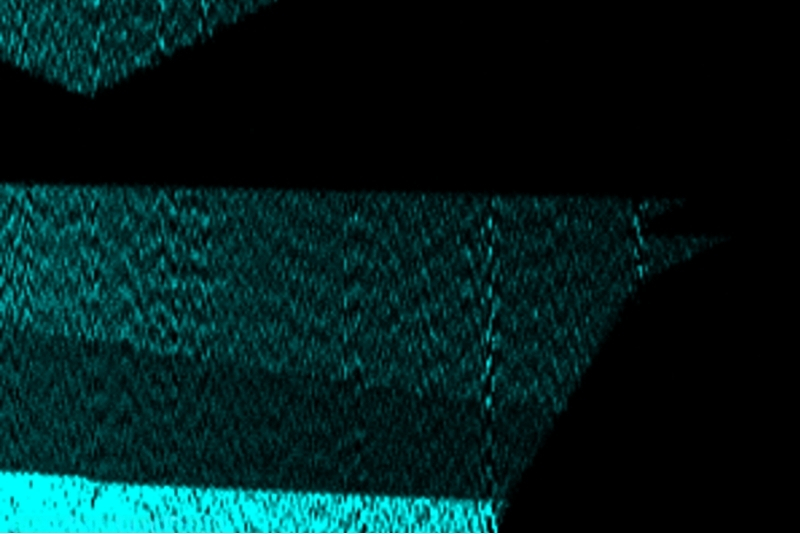
Second harmonic generation (SHG) imaging microscopy is a nonlinear optical imaging technique that uses SHG as an intrinsic contrast mechanism to produce high-resolution images. SHG occurs in materials with non-centrosymmetric crystal structures. Because SHG does not involve electronic absorption, it is intrinsically label-free and highly specific to crystal symmetry. In materials science, SHG microscopy is widely used to probe crystal structure, layer orientation, grain boundaries, defects, and strain in semiconductors, thin films, and functional materials.
 Second-harmonic generation intensity image of a WSe₂ monolayer recorded with 1064 nm excitation on the MicroTime 100 photoluminescence microscope. The uniform near-zero lifetime across the image verifies the non-resonant, coherent nature of the SHG process.
 In second-harmonic generation (SHG) microscopy, a focused pulsed laser beam excites the sample, inducing a second-order nonlinear polarization in non-centrosymmetric regions of the material. This interaction generates photons at twice the optical frequency of the excitation light. The emitted SHG signal is collected through the microscope optics and spectrally separated from the fundamental excitation. By scanning the laser focus across the sample, a spatially resolved SHG intensity map is formed. The signal strength depends on crystal symmetry, orientation, and local electric field distribution, providing contrast based on structural rather than absorptive properties.
SHG microscopy data typically consist of intensity maps that represent the spatial distribution of the second-harmonic signal within a sample. Data analysis focuses on correlating SHG contrast with crystal symmetry, domain orientation, layer number, and structural heterogeneity. Polarization-resolved SHG measurements provide additional insight into crystallographic orientation and tensor properties. In materials research, SHG images are often compared with reflection or photoluminescence to distinguish structural from electronic or optical effects to achieve a comprehensive characterization of the material.
 SymphoTime 64 software interface for fluorescence lifetime imaging analysis.
SHG microscopy data can be analyzed using SymPhoTime 64 and snAPI, as well as QuCoa for advanced photon-counting data processing and visualization.
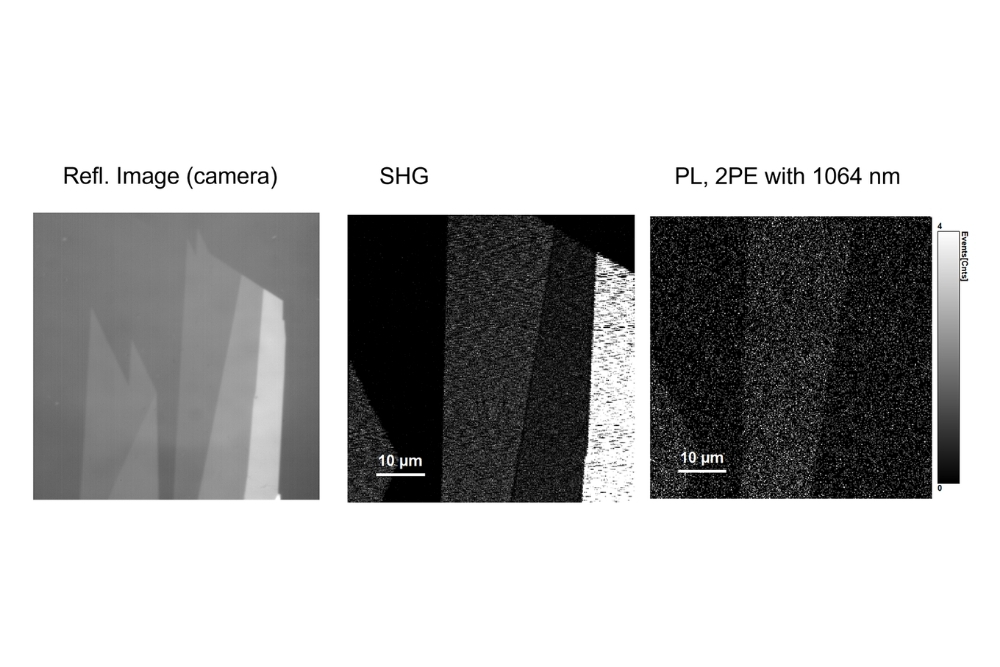 Comparison of reflection imaging and second-harmonic generation intensity imaging of a MoS₂ monolayer. While reflection reveals overall morphology, SHG selectively highlights non-centrosymmetric domains and crystallographic orientation, providing structural contrast not accessible with conventional optical microscopy.
 SHG microscopy offers a unique combination of label-free contrast, high spatial resolution, and intrinsic sensitivity to crystal symmetry. It enables direct visualization of non-centrosymmetric phases that remain invisible to conventional optical microscopy. In materials science, SHG microscopy is particularly valuable for studying 2D materials, semiconductors, nanomaterials, thin films, and new functional materials. The technique allows non-destructive mapping of grain boundaries, defects, strain, and layer stacking while avoiding photobleaching and minimizing sample preparation.
Solira is a modular upright microscope for time-resolved photoluminescence measurements across semiconductors, nanomaterials, optoelectronic devices, and other advanced material systems.Reliable SHG microscopy requires a pulsed laser source with sufficient peak power to drive nonlinear optical processes, typically operating in the picosecond or femtosecond regime. A scanning or confocal microscope provides high spatial resolution and optical sectioning capability. Efficient spectral filtering is essential to isolate the second-harmonic signal from the fundamental excitation light, while photon-counting detectors enhance sensitivity for weak SHG signals. Stable beam alignment, polarization control, and precise scanning electronics are critical for reproducible and quantitative SHG imaging in materials research.

Second-harmonic generation imaging of monolayer MoS₂ and WSe₂ on PDMS was performed using the MicroTime 100 confocal microscope with 1064 nm picosecond excitation. SHG, reflection, and time-resolved photoluminescence data were acquired from the same region, enabling correlative structural and optical characterization of two-dimensional materials.

A time-resolved technique that maps charge carrier lifetimes and recombination dynamics. While SHG microscopy probes crystal symmetry, TRPL imaging reveals electronic properties, providing complementary insight into defects, strain, and material quality.