Different Emissive Pathways, Different Clocks
Light emission after optical excitation does not follow a single clock. Depending on the sample and underlying photophysical processes, emission dynamics can extend from picoseconds and nanoseconds to microseconds, milliseconds, or even longer. Prompt fluorescence is generally found at the fast end of this range, while delayed fluorescence, phosphorescence, and long-lived states in materials can persist much longer. These timescales can overlap, however, so the measured lifetime alone does not uniquely identify the underlying mechanism.
The excitation and observation scheme must therefore change with the dynamics. For a nanosecond decay, a picosecond pulse approximates an instantaneous excitation event. Time-correlated single photon counting (TCSPC) can then relate each detected photon to the laser synchronization signal and reconstruct the decay. The repetition period must provide a sufficiently long observation window for the relevant emission dynamics.
Long-lived emission poses a different challenge. At a high repetition rate, a new excitation pulse may arrive while the population created by previous pulses is still decaying. Reducing the repetition rate provides a longer interval between excitation events. Alternatively, the sample can be excited during a defined time window using a burst of picosecond pulses or gated CW excitation, followed by a dark interval in which the delayed emission is recorded. In burst mode, the individual excitation pulses remain picosecond pulses, while the overall excitation window can extend to much longer timescales.
Prima in Published Research
Three peer-reviewed studies show how PicoQuant’s stand-alone picosecond laser Prima has been used at the fast end of this range in different experimental settings.
In a Nature Communications study, Pan et al. (2026)1 investigated room-temperature valley-selective emission from MoSe₂ monolayers coupled to chiral silicon metasurfaces. For photon-spin-resolved time-resolved photoluminescence (TRPL), they used a fiber-coupled Prima at 640 nm with a 100 ps pulse width and a 20 MHz repetition rate. The emitted photons were detected with a single-photon avalanche diode and time-tagged relative to the laser trigger using a PicoHarp 300 TCSPC module.

The experiment resolved sub-nanosecond decay dynamics and differences between the two circular polarization channels. At 294 K, the reported lifetime for the monolayer on the metasurface was 0.189 ns, compared with 0.398 ns on glass. Combined with steady-state measurements and modeling, the TRPL data supported the interpretation of a valley-selective Purcell enhancement induced by the chiral q-BIC mode. Based on an assumed ratio of nonradiative to radiative decay taken from the literature, the authors estimated an approximately 13-fold increase in radiative decay rate on the metasurface. The experiment and its implications for chiral light-matter interactions are discussed in more detail in a dedicated blog article.
The second example comes from fluorescence lifetime imaging microscopy (FLIM). Hwang et al., Scientific Reports (2025)2, used a customized high-speed FLIM system to separate immunofluorescence from tissue autofluorescence. The setup included Prima picosecond excitation at 450, 520 and 640 nm, operated at 25 MHz, alongside a separate 405 nm nanosecond laser. Instead of TCSPC, this system used the analog mean-delay (AMD) method for high-speed lifetime measurements, combined with GPU-accelerated phasor processing.

Lifetime contrast enabled immunofluorescence to be separated from overlapping tissue autofluorescence in the phasor domain, and the authors validated the method across several tissue types and antibody-fluorophore combinations. This study demonstrates how three Prima excitation wavelengths can be integrated into a high-speed, multiplexed FLIM workflow.
A third materials-science example comes from Wang et al., Science Advances (2025)³, who investigated exciton relocalization and plasmon-enhanced emission in quasi-2D Ruddlesden–Popper perovskites integrated with aluminum surface-lattice-resonance (SLR) cavities. For the time-resolved optical characterization, the authors report a PicoHarp 300 TCSPC system with 50 ps temporal resolution and a Prima pulsed excitation source operating at 450 nm, 5 MHz, and 130 ps pulse width. At 5 MHz, successive excitation pulses are separated by 200 ns, adding a distinctly different timing configuration to the 20 and 25 MHz examples above.

The reported TRPL results showed that adding 18-Crown-6 increased the photoluminescence lifetime of the perovskite film, consistent with improved phase distribution and reduced nonradiative recombination. When the crown-assisted perovskite was coupled to the SLR cavity, the fitted decay lifetime decreased from 724 to 18 ps, consistent with a Purcell-enhanced emission rate. Measurements across different cavity periods further connected the decay rate with the coupling between the amplified-spontaneous-emission band and the cavity mode. The lasing experiments themselves used a separate 400 nm, 100 fs source at 1 kHz. The study therefore provides an independent example of Prima used in time-resolved materials characterization at 5 MHz, rather than as the pump source for the reported lasing.
Flexible Excitation Across Timescales
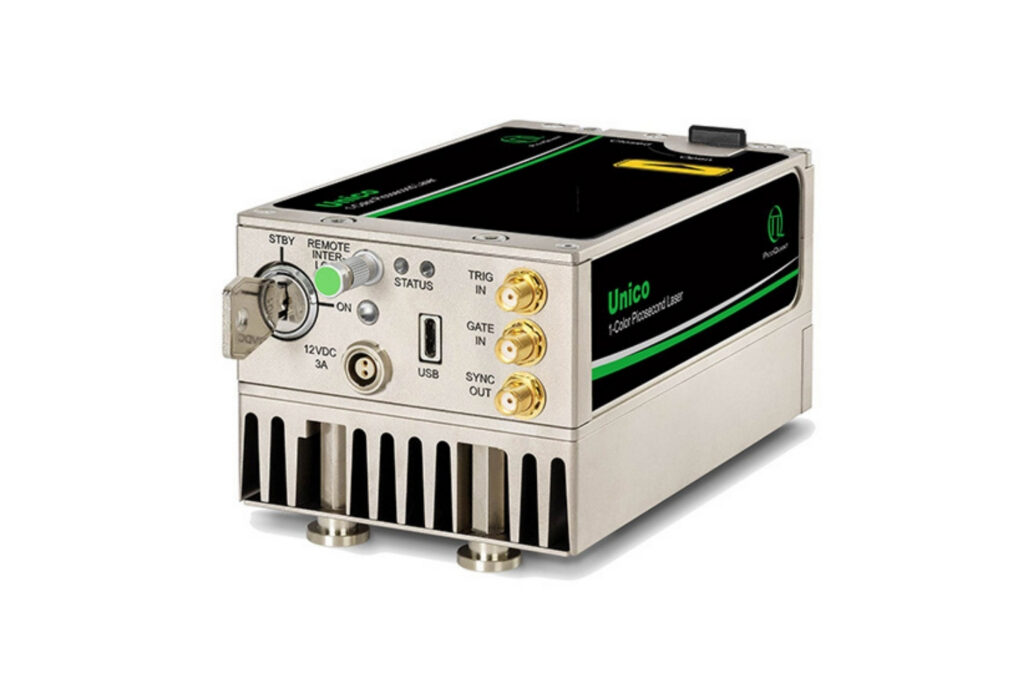
The studies above show what precisely timed picosecond excitation enables in TRPL and FLIM. Prima and Unico extend this concept beyond a fixed pulse sequence by allowing the excitation timing to be adapted to the dynamics of the sample. Short picosecond pulses provide a defined starting point for TCSPC, fluorescence lifetime measurements, and fast TRPL. Lower repetition rates provide more time between excitation events, while gated excitation can create defined excitation and dark intervals for observing slower luminescence processes. Depending on the dynamics of interest, pulsed, burst, CW, and fast-switched CW operation provide different excitation strategies of structuring this excitation window. Learn more about choosing the right excitation strategy for photonic materials.
Prima offers internal repetition rates from 1 kHz to 200 MHz, together with external triggering from single shot to 200 MHz. Its gating function provides rise and fall times below 3 ns and adjustable ON and OFF times from below 10 ns to 1 ms. Using the gating function, sequences of picosecond pulses can be confined to defined excitation windows and followed by dark intervals for observing the subsequent emission. Fast-switched CW excitation provides an alternative excitation scheme for longer-lived processes. For long-lived luminescence, the sample can therefore be excited over a defined period before the excitation is switched off and the subsequent decay is observed.

The choice between Prima and Unico can be guided by the spectral requirements of the experiment. Unico brings this excitation flexibility to setups requiring a single wavelength, while Prima offers configurations with up to three wavelengths. Available Prima wavelengths include 375, 405, 450, 485, 515, and 640 nm. This makes Prima particularly useful when an experiment benefits from multiple excitation wavelengths within one laser platform, as illustrated by the multicolor FLIM example above, while Unico provides a focused single-wavelength solution.
Beyond the Published Examples
The published studies discussed here demonstrate Prima in picosecond-excitation TRPL and FLIM. The documented timing modes of Prima and Unico also support excitation schemes for processes that extend beyond the interval between individual excitation pulses. Potential applications include delayed fluorescence, phosphorescence, and other long-lived emission processes.
These longer-timescale applications follow from the available operating modes; they were not demonstrated in the publications discussed above. The accessible lifetime range in practice depends on the complete measurement chain, including absorption wavelength, excitation dose, expected lifetime, detector response, background, timing electronics, and required dynamic range.
1 Reference: F. Pan, X. Li, A. C. Johnson, S. Dhuey, A. Saunders, M. Hu, J. P. Dixon, S. Dagli, S. Lau, T. Weng, C. Chen, J. Zeng, R. Apte, T. F. Heinz, F. Liu, Z. Deng & J. A. Dionne. Room-temperature valley-selective emission in Si-MoSe₂ heterostructures enabled by high-quality-factor chiroptical cavities. Nature Communications 17, 20 (2026).
2 Reference: W. Hwang, T. McPartland, S. Jeong & C. L. Evans. A robust method for autofluorescence-free immunofluorescence using high-speed fluorescence lifetime imaging microscopy. Scientific Reports 15, 5503 (2025).
3 Reference: Wang YY, Lee XH, Chen CH, Yuan L, Lai YT, Peng TY, Chen JW, Chueh CC, Lu YJ. Plasmon-enhanced exciton relocalization in quasi-2D perovskites for low-threshold room-temperature plasmonic lasing. Sci Adv. (2025).
Match the Source to the Experiment
Does your emission decay before the next pulse, or does your experiment require a longer excitation and observation cycle? Share your sample’s absorption range, expected lifetime, and detection method with our application specialists. We will help you identify a suitable Prima or Unico configuration.