Two Routes to Photon Number Resolution
Photon Number Resolution (PNR) extends the capabilities of standard single-photon detectors by providing information not only on whether photons were detected, but also on how many photons contributed to a detection event. With superconducting nanowire single-photon detectors (SNSPDs), PNR can be achieved by either intrinsic or multiplexed approaches.
Intrinsic PNR extracts photon-number information directly from the electrical response of a single detector element. Differences in the pulse shape, such as the slew rate or time-over-threshold (ToT), allow photon-number-related event classes to be distinguished without modifying the optical path.
Multiplexed PNR, in contrast, distributes photons across multiple detection modes. This can be realized by splitting the photons into temporal modes using optical delay lines or into spatial modes using multiple detector elements. Spatially multiplexed SNSPDs are commonly implemented using interleaved nanowires that share the same active area. The resulting signals can either be combined into a single readout, where photon-number information is extracted from the pulse amplitude or ToT, or an independent readout, allowing the photon number to be inferred from the number of simultaneously responding detector elements. Each implementation provides different information. Combined readout exploits amplitude variations of the summed electrical pulse, whereas independent readout directly identifies which detector elements responded. Intrinsic PNR complements both approaches by resolving multi-photon events occurring within a single detector element. In this article, we combine independently read-out spatial multiplexing with intrinsic PNR.
Combining Multiplexed and Intrinsic PNR
To demonstrate how independently read-out multiplexed and intrinsic PNR complement each other, we measured four channels of an interleaved SNSPD from Single Quantum. Four superconducting nanowires are interleaved within the same active area, providing a nearly uniform probability that an incident photon is absorbed by any detector element. Each nanowire is connected to an independent electrical readout, enabling multiplexed PNR by counting how many detector elements respond during each excitation pulse.
The detector was illuminated with an attenuated pulsed laser at approximately 48 MHz, ensuring that only a few photons reached the detector during each excitation pulse. Each detector output was connected to a separate input of HydraHarp 500 to determine the click multiplicity on a pulse-by-pulse basis. In addition, one detector output was split electrically and recorded on two timing inputs, allowing the rising and falling edges of each electrical pulse to be analyzed for intrinsic PNR.

These two parallel data streams provide complementary information: the four detector outputs reveal the spatial click multiplicity, while the dual-edge timing analysis probes the pulse shape of individual detection events.
Resolving Spatial Click Multiplicity
The first analysis uses all four outputs of the interleaved SNSPD. As the detection peaks occur at slightly different delays relative to the excitation sync, an individual adaptive timing gate is defined for each channel using Herald manipualtors in UniHarp. Only events within these channel-specific gates are assigned to the corresponding laser pulse.

The gated events were grouped pulse by pulse according to their sync index in an offline Python analysis. For each excitation pulse, the click multiplicity k was defined as the number of detector channels containing at least one gated event, resulting in a distribution ranging from k=0 to k=4. To evaluate the measurement, the experimental results are compared with an independent-channel model, which assumes that each detector output behaves as an independent binary detector with its experimentally determined click probability. Based on these individual probabilities, the expected click multiplicity distribution is calculated using a Poisson-binomial model, without introducing any additional fitting parameters. The close agreement between the measured and predicted click-multiplicity distributions is consistent with approximately independent detector outputs and supports multiplexed click-number-resolving operation.

Identifying Multiple Photons within One Input
Spatial multiplexing determines how many time tagger inputs register a detection event during each excitation pulse. However, it cannot distinguish whether a signal recorded on a single input originated from one photon or from multiple photons absorbed within the same detector element.
To extract this additional information, one detector output was split electrically and connected to two inputs of HydraHarp 500, allowing the rising and falling edges of each electrical pulse to be recorded independently. From these timestamps, both the pulse arrival time and the ToT were calculated for every detection event.
At the employed repetition rate of 48 MHz, incomplete detector recovery introduces correlations between successive detection events. As discussed in our previous blog article on PNR at High Count Rates, these recovery effects can systematically shift both the arrival time and ToT, causing the photon-number-related populations to broaden or overlap.
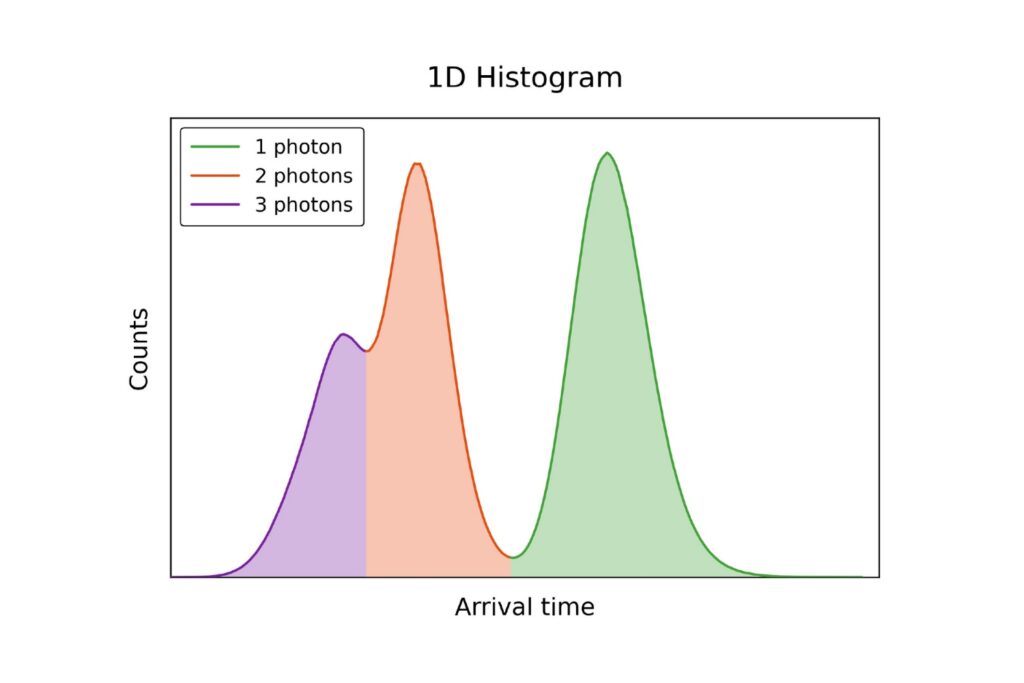
Before correction, the one- and two-photon event classes are therefore only partially separated. Applying the recovery-time correction implemented via the PNR manipulator in UniHarp compensates for these distortions and produces two clearly distinguishable populations, enabling reliable photon-number-sensitive event classification. The one- and two-photon events can be filtered as demonstrated in our previous blog article on Photon Number Arrival-Time Gating using the Herald manipulator. The corrected data yield a two-photon to one-photon event ratio of approximately (10±1)%.


It should be noted that a similar analysis can also be performed using Coincidence manipulators in UniHarp which works sufficiently for lower click multiplicities. In the Python wrapper snAPI there is a dedicated Coincidences manipulator designed for efficiently handling many coincidence operations at once.
Complementary Photon-Number Information
Under attenuated coherent illumination, the detected photon numbers follow Poisson statistics. The intrinsic PNR analysis yields a two-photon to one-photon event ratio of 0.10±0.01. This is consistent with the Poisson ratio inferred from the binary click probability of the same output in the multiplexed analysis, providing a consistency check between the two analyses.
The two methods nevertheless probe different event classes. Multiplexed PNR identifies photons detected by different detector elements during the same excitation pulse. Intrinsic PNR adds sensitivity to multi-photon events occurring within a single detector element, which would otherwise appear as only one click.
Towards More Complete Event Classification
The experiment shows how spatial click information and electrical pulse-shape analysis can be combined within one time-tagging measurement. The multi-channel architecture of HydraHarp 500 records the required timing information, while UniHarp or snAPI provide the corresponding analysis tools. Two-dimensional histograms support the identification and classification of intrinsic PNR populations, while the Herald and Coincidence manipulators enable pulse-by-pulse analysis of multiplexed detection events.
This combined approach extends the useful photon-number range of an interleaved SNSPD without requiring every incident photon to reach a different detector element. It offers a practical route towards richer event classification in quantum optics, quantum communication, and other photon-number-sensitive measurements.

Explore how HydraHarp 500 and PicoHarp 330 enable high-resolution time tagging workflows for advanced SNSPD-based photon number analysis.