Joshua Rapp on Choosing Prima for Doppler SPL
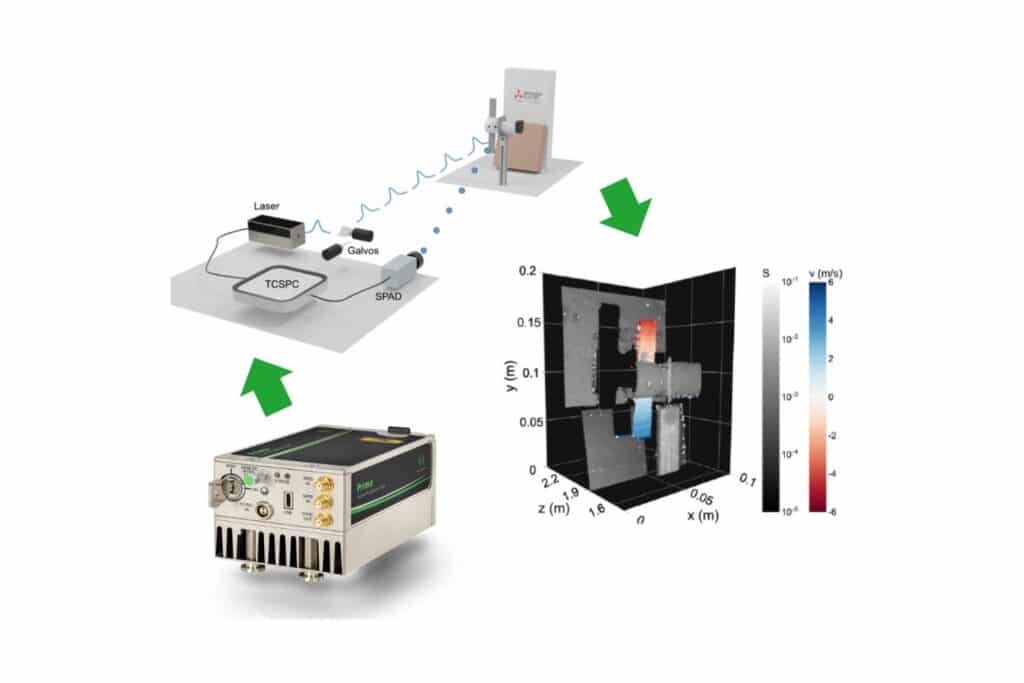
A recent study by researchers at Mitsubishi Electric Research Laboratories (MERL) shows that it can. Using a technique called Doppler Single-Photon Lidar (SPL), they were able to simultaneously estimate distance and radial velocity with remarkable precision. Their setup worked even at high frame rates and in extremely low signal conditions, opening up new possibilities for motion-aware 3D imaging.
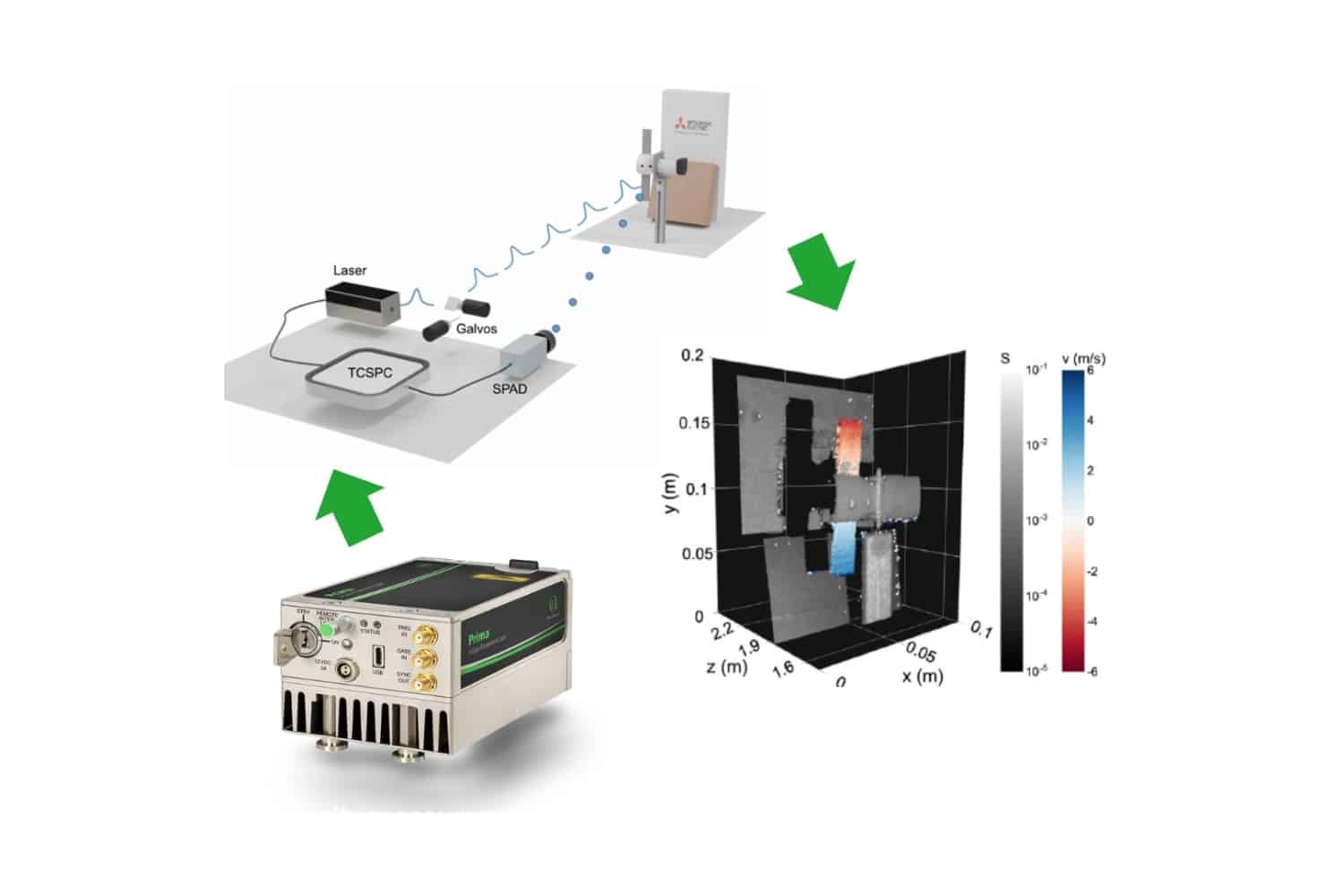
Behind this success was a careful choice of hardware. The team needed a laser source that could meet both the precision requirements and the flexibility needed for demanding SPL experiments. That’s why they chose Prima.
Joshua Rapp, Principal Research Scientist at Mitsubishi Electric Research Laboratories and one of the authors of the recent study on Doppler single-photon lidar says:
“We originally chose the Prima laser because it had one of the highest repetition rates for pulsed lasers that we could find.”
Although their published experiment used a 40 MHz pulse rate, the team selected Prima with long-term goals in mind.
“We did not take advantage of that capability in this paper […] but we have ongoing work that uses pulse rates up to 200 MHz. Having more pulses per second allows us to detect more photons, which improves our estimates.”
Another key factor? Wavelength versatility. Prima offers six available wavelengths (375, 405, 450, 488, 515, and 640 nm). Users can select any three, which provides maximum flexibility for adapting to different detectors, samples, or application needs.
“Another reason we bought the Prima is because of the laser wavelengths available, which allows us to choose the wavelength that best suits the problem we are working on. For this paper, we chose the blue laser because the SPAD detector has the narrowest temporal response at shorter wavelengths. However, we could have also used the green or red, where the detector has higher efficiency.”

The study itself demonstrates a proof-of-principle for velocity estimation using pulsed lidar – a milestone in SPL research. But its broader relevance goes beyond the lab:
“In a more practical application setting, we probably would need to work in the infrared. But the flexibility of the Prima allows us to develop a good prototype system at reasonable cost.”
MERL’s work illustrates how research-grade flexibility in a laser system like Prima can support both fundamental science and applied innovation – especially in emerging fields like photon-efficient, motion-aware lidar.
Discover how the Prima pulsed laser supports advanced photon-counting and lidar experiments.
1 Reference: Ruangrawee Kitichotkul, Joshua Rapp, Yanting Ma, and Hassan Mansour. Simultaneous range and velocity measurement with Doppler single-photon lidar. Optica 12, 604-613 (2025). https://doi.org/10.1364/OPTICA.555984