Key Highlights
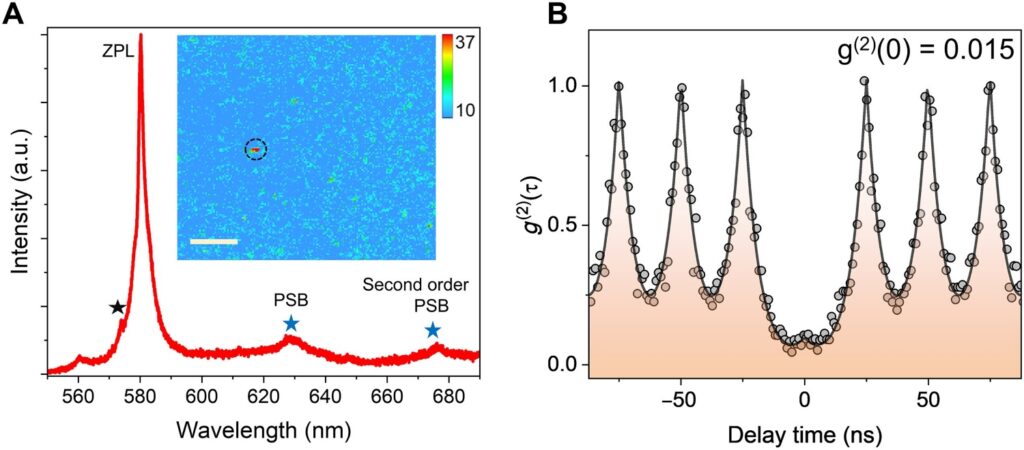
- Carbon-doped h-BN thin films show near-ideal room-temperature single-photon emission with g2(0) = 0.015 without background correction and high photostability.
- A coupled micro-PL workflow links spectral identity, excited-state lifetime, and photon-correlation data from the same confocal observation volume.
- Confocal PL raster scanning, TRPL lifetime readout, and HBT correlation measurements provide a coherent verification framework for quantitative single-emitter characterization.
Why Single-Photon Purity Is a Measurement Challenge
A narrow emission line is not proof of single-photon behavior. Single-photon purity is defined by photon statistics, most directly by the second-order autocorrelation function g2(τ). Reaching very low g2(0) values at room temperature is challenging because small background contributions, imperfect spectral filtering, and timing artifacts can bias the result. Credible verification therefore requires correlated measurements where spectrum, lifetime, and g2(τ) are recorded for the same emitter under stable alignment and well-controlled detection conditions.
Carbon-Doped h-BN Achieves Near-Ideal Single-Photon Purity
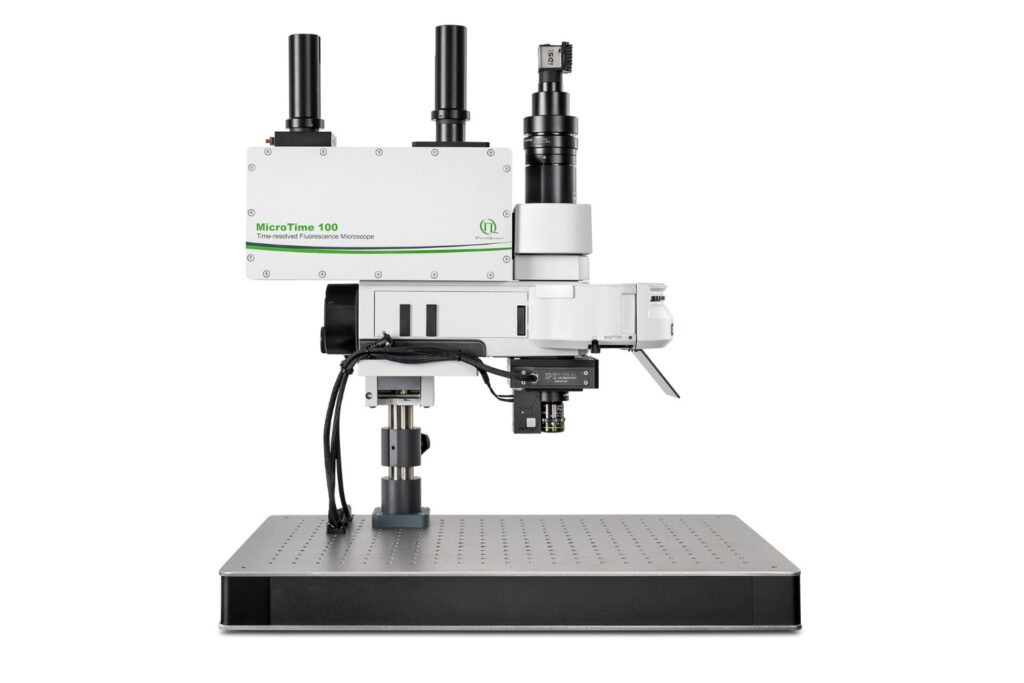
Chatterjee et al. Sci. Adv. (2025)1, report room-temperature single-photon emission from carbon-doped hexagonal boron nitride (h-BN) thin films with exceptionally low multi-photon probability. Using a PicoQuant MicroTime 100 confocal microscope for confocal PL raster scanning, the emission was switched via a flip mirror either to a FluoTime 300 spectrometer or to two avalanche photodiodes in a Hanbury Brown and Twiss configuration for g2(τ) measurements. With pulsed 515 nm excitation at 40 MHz, they measured an antibunching dip of g2(0) = 0.015 ± 0.002 without background correction, corresponding to ~98.5% single-photon purity.
Time-resolved photoluminescence (TRPL) measurements were performed with a PicoQuant FluoTime 300 photoluminescence spectrometer and yielded a single-exponential excited-state lifetime of 5.4 ns, consistent with a well-defined radiative transition. Beyond purity and lifetime, the emitters combine high practicality metrics: a narrow zero-phonon line at 580.3 nm and a Debye–Waller factor of 45%, indicating a large fraction of photons emitted into the ZPL rather than phonon sidebands. The authors also report high brightness with saturation emission rates approaching 4.66 × 10^5 counts per second and strong photostability, with no detectable spectral wandering during extended continuous measurements.
Integrated Spectral and Correlation Measurements in a Micro-PL Architecture
What makes the dataset compelling is not a single metric, but the ability to connect spectral identity, decay kinetics, and photon statistics within one confocal workflow. In the MicroTime 100 setup, the same confocal collection path was used to interrogate individual emitters, while a flip mirror allowed the emission to be switched between time-resolved spectroscopy on the FluoTime 300 and photon-correlation detection on an HBT detector pair.
This measurement logic is essentially micro-photoluminescence in the strict sense: spatially selective excitation and collection define a micrometer-scale observation volume, and the emitted photons are analyzed in complementary domains. Spectral readout establishes the zero-phonon line and phonon sidebands and sets the filtering window. Time-resolved detection yields the excited-state lifetime under the same optical alignment. Correlation measurements then quantify antibunching with minimal ambiguity about which spectral components contribute to g2(0).
By keeping excitation, confocal alignment, and spectral selection consistent while switching only the downstream analysis path, the approach reduces the risk of background-driven artifacts and makes purity claims comparable across emitters and samples.
Instrumentation Used in This Study by PicoQuant
Micro-Photoluminescence Upgrade
The Micro-Photoluminescence Upgrade is designed to couple a scanning microscope with a spectrometer so that spatial, spectral, and temporal information can be accessed in a coordinated workflow. In this study, that coupling principle is reflected by routing the same confocal emission either to the FluoTime 300 spectrometer or to correlation detection, keeping the measurement context consistent while changing only the downstream analysis.
FluoTime 300
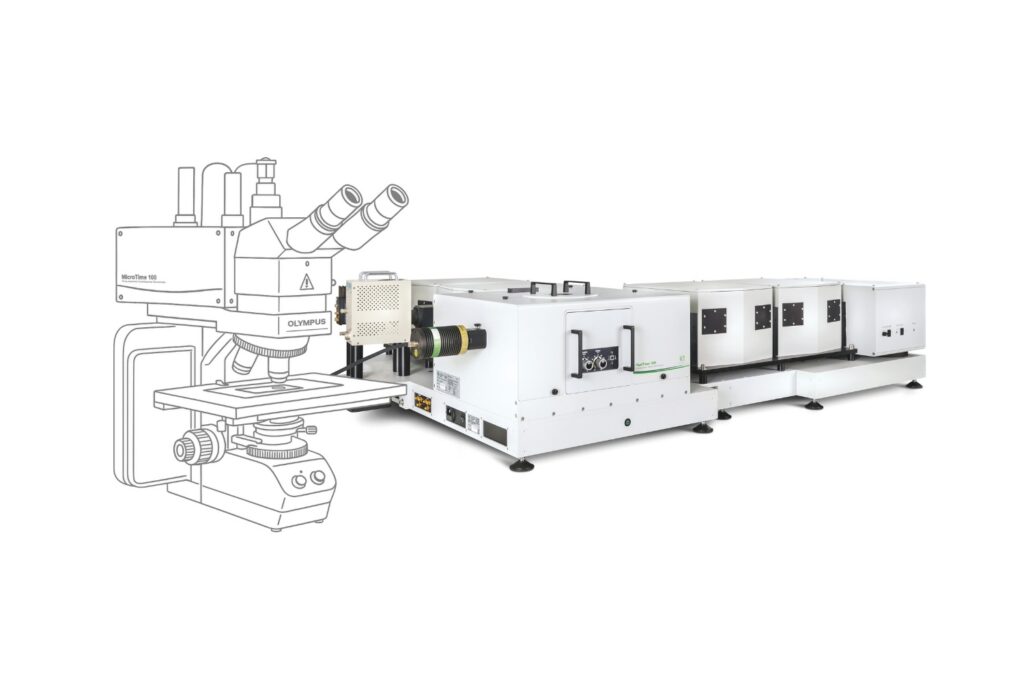
FluoTime 300 served as the spectroscopic anchor for time-resolved photoluminescence (TRPL), providing the lifetime readout needed to complement photon-correlation measurements. Its role aligns with the platform’s purpose as a high-end photoluminescence spectrometer for sensitive steady-state and time-resolved spectroscopy across broad spectral and temporal ranges.

MicroTime 100
MicroTime 100 provided the confocal microscope framework for addressing single emitters with spatial selectivity and stable alignment, enabling PL raster scanning and correlation experiments within the same optical geometry. This matches its positioning as an upright, modular time-resolved photoluminescence microscope for confocal, time-resolved measurements on demanding samples.
A New Flagship for Materials Science Microscopy
Meet Solira, our new time-resolved photoluminescence microscope designed for sensitive and flexible characterization across nanomaterials, semiconductors, LEDs, solar cells, and quantum systems. Combining TRPL imaging, carrier diffusion imaging, anisotropy imaging, and spectrally resolved measurements within one configurable platform, Solira adapts to diverse materials, sample geometries, and experimental requirements while maintaining high sensitivity and picosecond timing precision.

Enabling Quantitative Single-Emitter Research
As room-temperature emitters approach near-ideal photon statistics, the bottleneck shifts from finding bright defects to verifying purity with methodological rigor. At g2(0) levels around 0.015, even small background contributions or inconsistent spectral windows can bias the conclusion. The workflow in this study links spectrum, lifetime, and g2(τ) within one confocal context, enabling defensible comparisons across emitters and samples and supporting targeted optimization of material growth and defect engineering.
1 Reference: Arka Chatterjee, Abhijit Biswas, Addis S. Fuhr, Tanguy Terlier, Bobby G. Sumpter, Pilickel M. Ajayan, Igor Aharonovich, and Shengxi Huang. Room-temperature high-purity single-photon emission from carbon-doped boron nitride thin films. Sci. Adv.11,eadv2899(2025). DOI: 10.1126/sciadv.adv2899