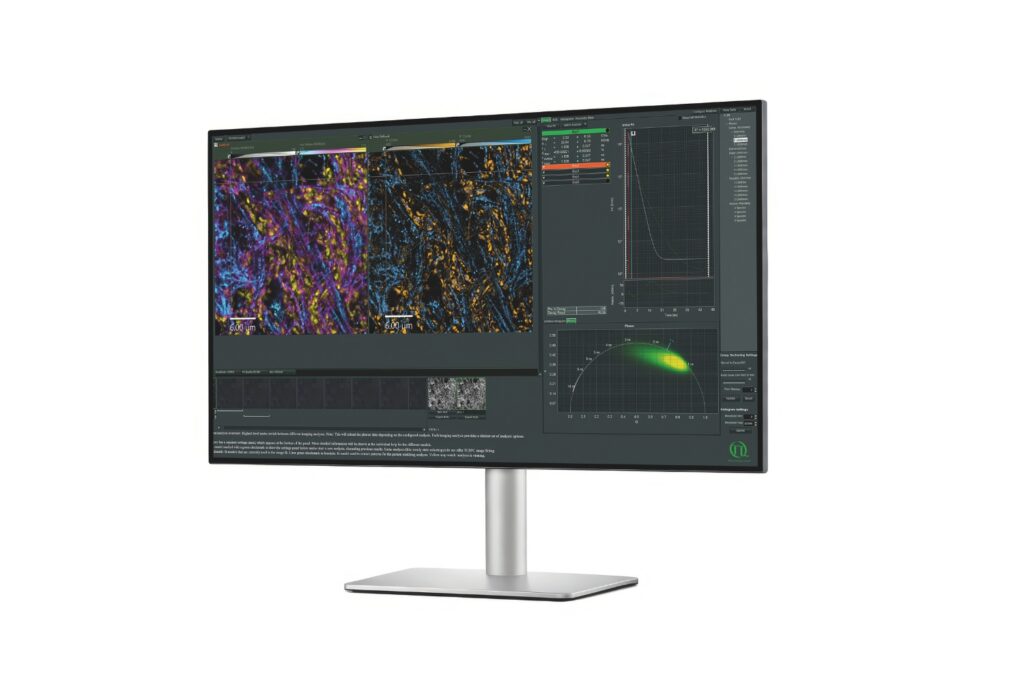
Complete confocal fluorescence microscope that empowers researchers to advance quantitative functional imaging from individual molecules to cells and tissues.

Modular, customizable, time-resolved confocal microscope with single-molecule sensitivity for life and materials science.

Compact FLIM and FCS upgrade kit that adds advanced functional imaging and correlation analysis to existing laser scanning microscopes.

Designed for flexible, sensitive, and precise steady-state and time-resolved spectroscopy across the UV to NIR range and time scales from picoseconds to milliseconds.

Modular lifetime spectrometer designed for flexible fluorescence and photoluminescence measurements in both materials and life science research.

Add spectral and time-resolved photoluminescence to your setup through flexible microscope–spectrometer coupling options.

Get the most out of superconducting nanowire detectors in large-scale quantum communication and computing experiments requiring precise multichannel timing.

Boost your time-resolved experiments with a flexible, high-precision time tagging and TCSPC unit for materials science and quantum sensing.

Scale your photonic quantum computing and detector characterization setups while maintaining performance, flexibility, and high data throughput.

Compact 3-color picosecond laser delivering flexible ns to ms excitation with cost-effective multicolor performance and straightforward operation.

Smart picosecond laser diode heads covering UV-A to NIR, providing the right combination of power, pulse width, and diode type for any time-resolved technique.

VisUV provides clean short pulses and stable timing across key UV and visible wavelengths, including deep UV lines as well as 488 nm and 532 nm.

Enhance your single-photon counting experiments with wide dynamic range and excellent timing precision in the UV and visible even at the highest count rates.

Capture even the weakest signals over large areas with maximum dynamic range and enhanced low-light sensitivity in a compact detector design.

Unlock spatially resolved single-photon detection with a 23-pixel SPAD array, combining low dark counts and precise time tagging for advanced experiments.

Advanced FLIM analysis software for fast, accurate interpretation of lifetime imaging data.

Intuitive, free software solution for real-time, high-precision photon data acquisition, visualization, and initial data analysis.

Advanced software for time-resolved fluorescence acquisition and analysis.

An imaging technique that uses fluorescence lifetimes to generate image contrast.

Investigating how proteins dynamically explore multiple conformational states that control biological function.

Investigating how biomolecules separate into dynamic liquid phases to organize cellular space and regulate biological function.

A time-resolved technique that measures photoluminescence lifetimes to reveal excited-state dynamics in materials.

Studying exciton dynamics, charge carrier processes, and structural properties through optical and time-resolved characterization methods.

Investigating charge-carrier lifetimes and recombination dynamics to enable precise optical characterization of material quality and device performance.

A quantum optical signature revealed by time-resolved photon correlation analysis to identify single-photon emission in materials and nanostructures.

The transmission of information using individual photons, using quantum effects to ensure absolute security.

Quantifying photons per detection event enables direct access to photon-number statistics, providing insight into quantum and statistical properties of light.

An optical technique that analyzes light emission under electrical excitation to reveal electronic properties of electroluminescent materials.

Monitoring environmental signals and trace compounds to understand dynamic changes in natural and engineered environments.

A photon timing technique that measures single-photon arrival times to resolve ultrafast dynamics in fluorescence, materials research, and quantum optics.
Comparison of confocal imaging and NovaISM analysis using GATTA-SIM 160 nm nanorulers shows sharper structures and improved separation of fine features.NovaISM is a powerful ISM and FLIM analysis software seamlessly integrated with the Luminosa microscope and fully optimized for the PDA-23 SPAD array detector. By combining pixel reassignment, computational sectioning, and advanced deconvolution, NovaISM delivers up to 1.7× higher resolution than conventional confocal imaging. Its fast, intuitive workflow reveals fine structural and functional details that standard approaches often miss, enabling researchers to extract sharper, deeper insights from every experiment. When used together with NovaFLIM software, it forms a uniquely powerful imaging and analysis environment that elevates confocal microscopy to an entirely new level.
Top: ISM-FLIM species separation in U2OS cells labeled for mitochondria (Tom20) and microtubules (α-Tubulin). Left shows separation after ISM, right after ISM, computational sectioning, and deconvolution. Bottom: Intensity profiles along tubulin filaments illustrate the progressive improvement in resolution and contrast across each processing step.NovaISM lets you follow every improvement step-by-step, from confocal-like input images to high-resolution, high-contrast ISM results. Starting from the summed signal of all 23 SPAD pixels, pixel-reassignment already boosts resolution by ~30%. Computational sectioning then removes out-of-focus contributions, dramatically increasing contrast in thicker samples. A final deconvolution step enhances structural clarity by an additional ~30%, revealing details that remain hidden in conventional confocal microscopy.
Luminosa confocal microscope combined with NovaISM enables advanced ISM-FLIM imaging and analysis workflows.In combination with the Luminosa confocal microscope and NovaFLIM, NovaISM enables advanced ISM-FLIM workflows including pixel-reassigned imaging, computational sectioning, and resolution-enhanced lifetime analysis within a unified imaging environment.
The computational sectioning is based on an unmixing of the intensity distribution over the PDA-23 detector array. This process allows for rejection of light coming from out-of-focus planes which in thicker samples can be problematic as it limits the contrast, produces artifacts in the deconvolution process and interferes in the lifetime –species determination. With computational sectioning offered by NovaISM all these problems are resolved.

Intensity-weighted ISM-FLIM image. Colorscale indicates the fast lifetime contrast ranging from blue (shorter lifetimes) to red (longer lifetimes) sample: neuronal hippocampal culture, labeling of mitochondrial marker TOM20 with Cy2 (lifetime 1.3 ns) and synamptic vesicles marker SYPT1 with OregonGreen (lifetime 3.5 ns). Samples prepared by Dr. Eman Abbas, Rizzoli lab, UMG Goettingen.

In NovaISM computational sectioning is performed simultaneously with lifetime species separation allowing for determineing in –focus and out-of-focus contributions independently for each lifetime species. For further analysis then only the infocus part can be used. Upper side: SYPT1, lower side: TOM20, left side: out-of-focus, right side: in-focus.

Deconvolution is then performed only on the in-focus part. In this way we solve the problems arising from out-of-focus light when deconvolution algorithms are applied in thick samples. The end result is an image with high resolution, extremely high contrast and simultaneous marker multiplexing based on lifetimes. SYPT1 in cyan, TOM20 in yellow.

A simple schematic of the principle of computational sectioning. The distribution of light on the PDA-23 detector is fitted with 2 Gaussian of different widths. The in-focus part correspond to the narrow Gaussian and the out-of-focus part to the broader Gaussian. Parameters are estimated automatically by the software while the user can always fine tune if needed.
NovaISM provides powerful tools for enhancing resolution, streamlining workflows, and enabling flexible ISM-FLIM data analysis within confocal microscopy.


Access in-depth application notes and scientific posters with detailed methods, measurement data, and real-world use cases.
Poster on advanced FLIM analysis in NovaFLIM and NovaISM, enabling GPU-accelerated fitting, phasor plots and ISM-FLIM for higher resolution
Please fill out the form below to receive the requested file. After submitting your details, the file will be sent to you by email.
* Required
| Licence type | License available for either 1, 2, or 4 years |
| Data formats | Available for *.spqr files and *.ptu files acquired with the PDA-23 SPAD Array Detector in Luminosa microscope |
| Minimal | Recommended | |
| Operating system | Win10 64-bit | Win10 / Win11 64-bit |
| CPU | Intel Core i3-8100 or AMD Ryzen 3 1300X | Intel Core i7-13700 or AMD Ryzen 7 5700X |
| RAM | 8 GB | 32 GB |
| GPU | AMD Radeon RX550/550 Series or Nvidia GeForce GT 1030 | AMD Radeon RX 6700 XT or Nvidia GeForce RTX 3060 |
| Screen resolution | QHD (2560 × 1440) | 4K (3840 × 2160) |
Luminosa | NovaFLIM | NovaISM | NovaFLIM+NovaISM | |
| InstaFLIM | ||||
| Phasor plot for marker multiplexing | ||||
| Multi-frame analysis | ||||
| Batch analysis of series measurements (time-lapse,z-stacks, tiling, …) | ||||
| Advanced ROI handling, multi-ROIs, import of external ROIs | ||||
| Parameter plots of fitted parameters over multiple ROIs | ||||
| Representation of the image information as user defined 1D and 2D histograms of fitted parameters | ||||
| ROI selection via parameter histograms | ||||
| User configured analyses allowing for FLIM, FLIM-FRET, steady-state FRET and anisotropy imaging | ||||
| Extended export options of graphs and images | ||||
| Image Scanning Microscopy-FLIM (Resolution enhancement via a pixel reassigned image available in combination with PDA-23 Add-on) | ||||
| Re-assignement vectors calculation from image | ||||
| Resolution enhancement Deconvolution for ISM-FLIM (enhanced FLIM contrast via the rejection of contribution from out-of.plane light; Available in combi with PDA-23 Add-on) | ||||
| Computational Sectioning in combination with lifetime-species seperation (enhanced FLIM contrast via the rejection of contribution from out-of.plane light; Available in combi with PDA-23 Add-on) |
Combine compatible components to build a complete setup tailored to your experimental requirements and measurement workflows.
Please fill out the form below to request more information. You may also use it to inquire about pricing, availability, technical specifications, or discuss your specific application. Our sales team will be happy to review your request and get in touch with you. If additional information is needed to process your inquiry, we will let you know.
* Required
Please fill out the form below to request more information about our products and services. You may also use it to ask for pricing, availability, technical specifications, or any other details relevant to your inquiry. Our team will be happy to review your request and get in touch with you. If additional information is needed to process your inquiry, we will let you know.
* Required
Please fill out the form below to request more information and prices about our product. Our team will be happy to review your request and get in touch with you. If additional information is needed to process your inquiry, we will let you know.
* Required