Photon Counting Detectors
High-performance SPAD, PMT and hybrid detectors for reliable photon counting across materials science, life science, quantum optics, and metrology.


Simplify your materials characterization with one flexible TRPL microscope enabling multiple methods for precise and efficient analysis.

Complete confocal fluorescence microscope that empowers researchers to advance quantitative functional imaging from individual molecules to cells and tissues.

Compact FLIM and FCS upgrade kit that adds advanced functional imaging and correlation analysis to existing laser scanning microscopes.

Designed for flexible, sensitive, and precise steady-state and time-resolved spectroscopy across the UV to NIR range and time scales from picoseconds to milliseconds.

Modular lifetime spectrometer designed for flexible fluorescence and photoluminescence measurements in both materials and life science research.

Add spectral and time-resolved photoluminescence to your setup through flexible microscope–spectrometer coupling options.

Get the most out of superconducting nanowire detectors in large-scale quantum communication and computing experiments requiring precise multichannel timing.

Boost your time-resolved experiments with a flexible, high-precision time tagging and TCSPC unit for materials science and quantum sensing.

Scale your photonic quantum computing and detector characterization setups while maintaining performance, flexibility, and high data throughput.

Compact 3-color picosecond laser delivering flexible ns to ms excitation with cost-effective multicolor performance and straightforward operation.

Smart picosecond laser diode heads covering UV-A to NIR, providing the right combination of power, pulse width, and diode type for any time-resolved technique.

VisUV provides clean short pulses and stable timing across key UV and visible wavelengths, including deep UV lines as well as 488 nm and 532 nm.

Enhance your single-photon counting experiments with wide dynamic range and excellent timing precision in the UV and visible even at the highest count rates.

Capture even the weakest signals over large areas with maximum dynamic range and enhanced low-light sensitivity in a compact detector design.

Unlock spatially resolved single-photon detection with a 23-pixel SPAD array, combining low dark counts and precise time tagging for advanced experiments.

Advanced FLIM analysis software for fast, accurate interpretation of lifetime imaging data.

Intuitive, free software solution for real-time, high-precision photon data acquisition, visualization, and initial data analysis.

Advanced software for time-resolved fluorescence acquisition and analysis.

An imaging technique that uses fluorescence lifetimes to generate image contrast.

Investigating how proteins dynamically explore multiple conformational states that control biological function.

Investigating how biomolecules separate into dynamic liquid phases to organize cellular space and regulate biological function.

A time-resolved technique that measures photoluminescence lifetimes to reveal excited-state dynamics in materials.

Studying exciton dynamics, charge carrier processes, and structural properties through optical and time-resolved characterization methods.

Investigating charge-carrier lifetimes and recombination dynamics to enable precise optical characterization of material quality and device performance.

A quantum optical signature revealed by time-resolved photon correlation analysis to identify single-photon emission in materials and nanostructures.

The transmission of information using individual photons, using quantum effects to ensure absolute security.

Quantifying photons per detection event enables direct access to photon-number statistics, providing insight into quantum and statistical properties of light.

An optical technique that analyzes light emission under electrical excitation to reveal electronic properties of electroluminescent materials.

Monitoring environmental signals and trace compounds to understand dynamic changes in natural and engineered environments.

A photon timing technique that measures single-photon arrival times to resolve ultrafast dynamics in fluorescence, materials research, and quantum optics.

Singlet oxygen is a short-lived, highly reactive excited state of molecular oxygen formed through energy transfer from photoexcited materials. Its generation and decay provide sensitive probes of excited-state dynamics, energy transfer efficiency, and reactive oxygen species formation in photocatalytic and photoactive systems.

The weak near-infrared luminescence of singlet oxygen around 1270 nm requires highly efficient excitation schemes. Burst-mode excitation using the 3-Color Stand-Alone Picosecond Laser Prima enhances signal generation, while time-resolved spectroscopy enables reliable detection of emission spectra and decay dynamics despite low detector sensitivity in this spectral range.

Steady-state and time-resolved emission spectra of singlet oxygen produced by H₂TTP were recorded in water and acetone with the High-End Photoluminescence Spectrometer FluoTime 300. Despite spectral overlap and quenching effects in aqueous environments, phosphorescence lifetimes extracted from tail fitting closely matched reported literature

Singlet oxygen emission generated by ZnPc in acetone was detected using the Upright Time-Resolved Photoluminescence Microscope MicroTime 100 combined with the High-End Photoluminescence Spectrometer FluoTime 300. Even from a confined excitation volume, weak phosphorescence signals remained clearly resolvable, demonstrating high sensitivity for spatially restricted measurements.
CO₂ photoreduction explores how photocatalytic materials convert carbon dioxide into energy-rich chemical products under light excitation. The focus lies on charge separation, interfacial electron transfer, and the stabilization of reaction intermediates that determine efficiency and selectivity.

Time-resolved fluorescence measurements using the modular confocal microscope MicroTime 200 revealed accelerated charge transfer in a hybrid photocatalyst based on ultrathin metal-organic layers and graphene oxide. Shortened RuPS fluorescence lifetimes directly confirmed more efficient electron delivery compared to conventional bulk catalysts.
Photocatalytic hydrogen generation investigates how semiconductor materials convert light energy into chemical energy by driving water splitting reactions. From a materials science perspective, the focus lies on charge separation, interfacial charge transfer, and recombination processes that govern hydrogen evolution efficiency.

Time-resolved photoluminescence measurements using the High-End Photoluminescence Spectrometer FluoTime 300 revealed how platinum single atoms and nanoparticles influence recombination pathways in TiO₂ nanosheets. PL quenching at 521 nm and unchanged decay dynamics after Pt removal indicate that only a small number of surface sites dominate photocatalytic hydrogen generation.
Environmental purification by photocatalysis focuses on how light-driven materials enable the degradation of organic pollutants in water and air. From a materials science perspective, efficiency is governed by light absorption, charge separation, and interfacial charge transfer processes that suppress recombination and promote reactive pathways.
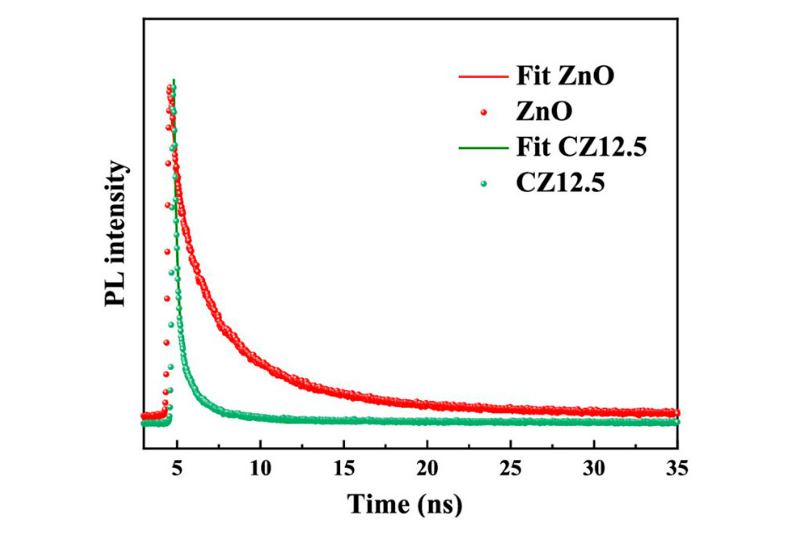
TRPL spectroscopy using the High-End Photoluminescence Spectrometer FluoTime 300 revealed reduced charge recombination in CQDs/ZnO composite photocatalysts compared to pure ZnO nanoparticles. Shortened photoluminescence lifetimes indicate more efficient charge separation and electron transport enabled by upconversion-assisted excitation and interfacial charge transfer.

Time-resolved photoluminescence measurements demonstrated accelerated charge transfer in Au–CdS yolk–shell nanocrystals compared to pure CdS. Faster decay dynamics and additional nonradiative pathways confirm efficient interfacial charge separation relevant for photocatalytic pollutant degradation.
Upconversion materials enable photochemical polymerization by converting low-energy excitation into higher-energy emission that can initiate reactions inaccessible under direct illumination. In materials science, the focus lies on upconversion mechanisms, energy transfer efficiency, and how material structure controls excitation thresholds and reaction initiation.

Steady-state and time-resolved luminescence measurements using the High-End Photoluminescence Spectrometer FluoTime 300 revealed the emission pathways and excited-state dynamics of NaYF₄:Yb/Er upconversion nanoparticles. Burst-mode excitation enables efficient population of long-lived states, allowing reliable lifetime analysis and identification of the emitting electronic levels relevant for photochemical activation.

Time-resolved fluorescence measurements reveal triplet–triplet annihilation upconversion in a porphyrin–perylene system followed by nonradiative energy transfer to a ruthenium complex. Fluorescence lifetime shortening enables quantitative determination of transfer efficiencies and quenching rates relevant for NIR-triggered photoactivation.
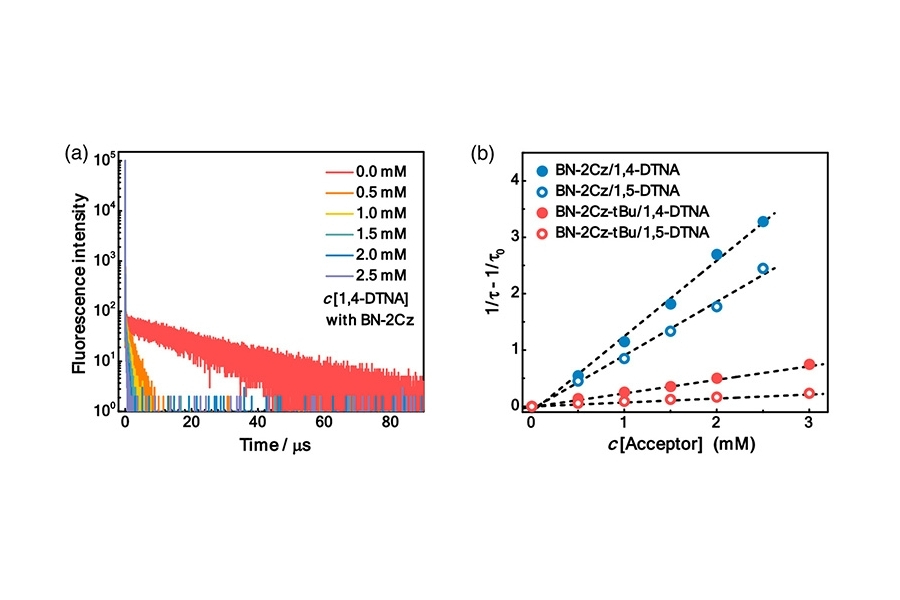
Time-resolved photoluminescence measurements reveal the characteristic ns and µs decay components of TADF sensitizers and quantify triplet involvement through oxygen quenching of the delayed fluorescence. Lifetime analysis enables extraction of intersystem crossing and bimolecular quenching rates, supporting optimization of sensitizer–acceptor energy transfer for green-to-UV upconversion.