Key Highlights
- Time-resolved photoluminescence provides direct access to charge carrier dynamics in nanomaterials.
- Radiative and nonradiative recombination pathways can be quantitatively separated using TCSPC-based measurements.
- Surface modification, plasmon coupling, and hybrid nanostructuring strongly influence excited-state lifetimes.
- Confocal time-resolved microscopy enables spatially resolved nanomaterial characterization at the single-structure level.
Time-Resolved Optical Analysis of Nanoscale Dynamics
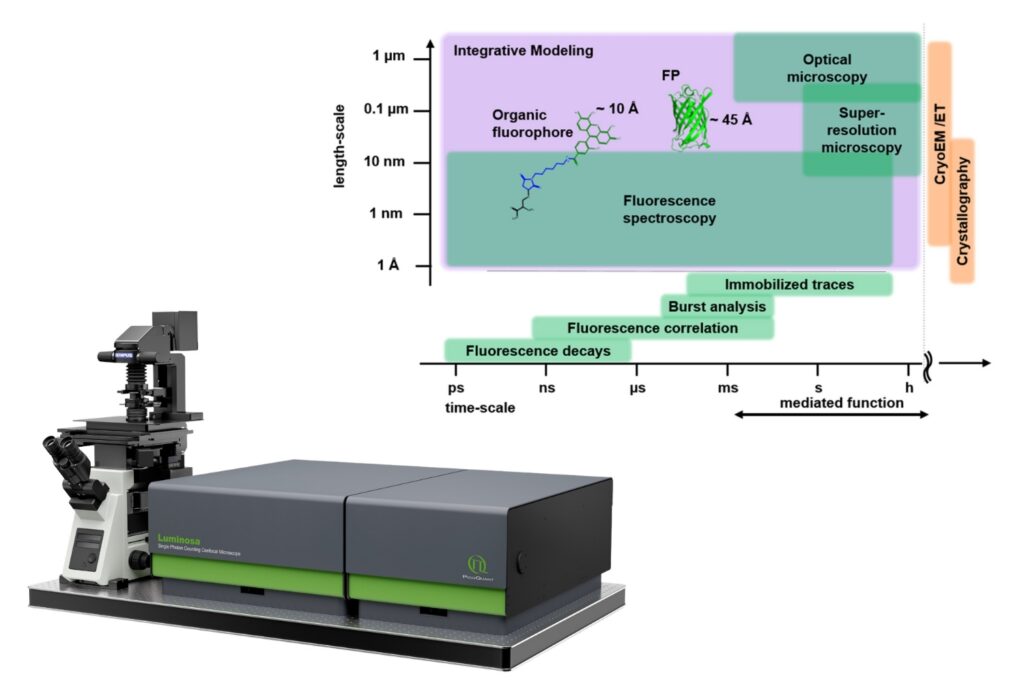
Nanomaterials research is driven by the question of how nanoscale structure controls optical behavior. In semiconductor nanomaterials and nanostructured materials, charge carrier dynamics often determine performance more strongly than steady-state emission intensity. Radiative recombination, surface trapping, plasmon coupling, and stimulated emission occur on nanosecond and sub-nanosecond timescales. These processes cannot be resolved by steady-state spectroscopy alone. Time-resolved photoluminescence (TRPL), implemented in confocal microscope platforms and TCSPC-based spectrometers, has therefore become a central tool in the optical characterization of nanomaterials.
Studies on carbon dot systems and hybrid nanostructures illustrate how time-resolved methods provide mechanistic insight into excited-state dynamics across different material architectures.
The Scientific Challenge
Optical characterization of nanomaterials must address several recurring questions:
- How fast do charge carriers relax after excitation?
- Which fraction of recombination is radiative versus nonradiative?
- How do interfaces, surface states, and plasmonic coupling modify decay pathways?
- How does excitation density affect carrier lifetimes in hybrid systems?
In nanomaterial characterization, steady-state photoluminescence provides spectral information, but it does not reveal the kinetic origin of emission efficiency. Time-resolved photoluminescence nanomaterials studies are required to quantify relaxation rates and separate intrinsic material effects from environmental or structural influences.
Three selected publications demonstrate how TRPL enables this level of analysis of nanomaterials.
Recent Studies Addressing This Challenge
Plasmon-Coupled Carbon Dot Complexes
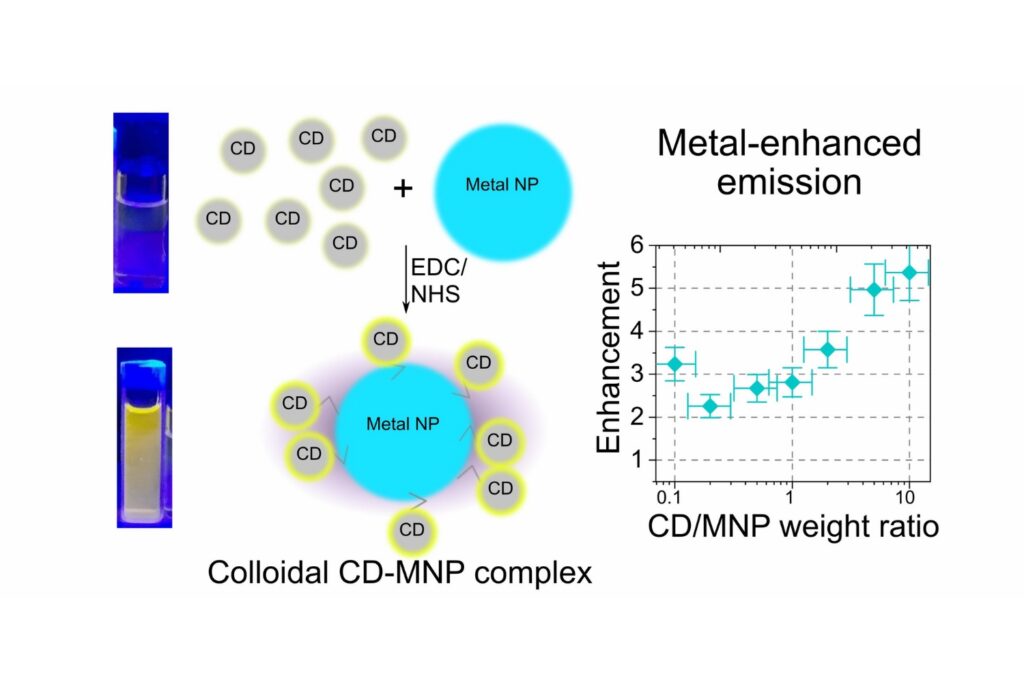
A study by Arefina et al., Nanomaterials (2023)1, investigated covalently bonded complexes of carbon dots and plasmonic metal nanoparticles.
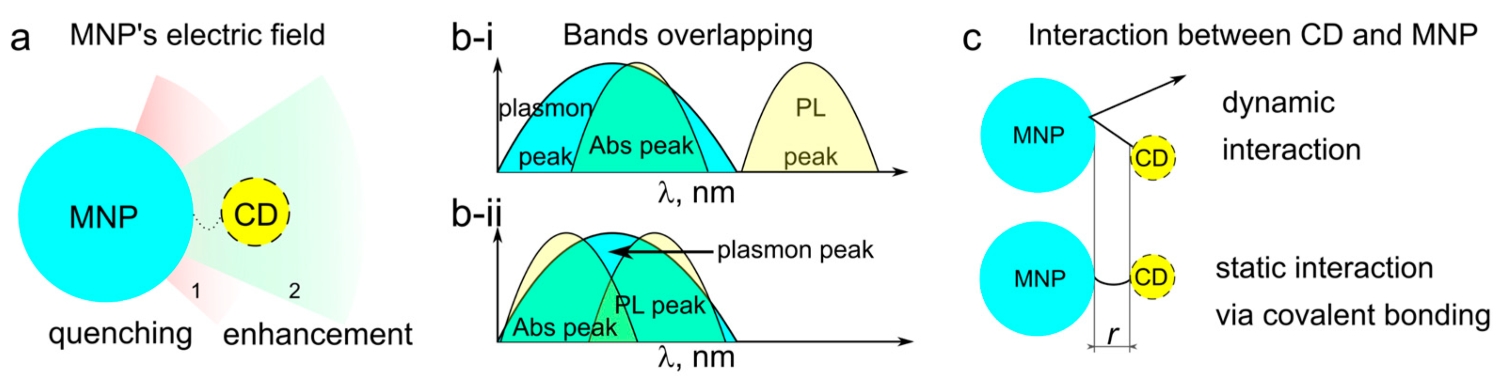
The authors analyzed how spectral overlap and interparticle distance influence emission behavior. Using time-resolved photoluminescence measurements on a MicroTime 100 microscope, they quantified:
- Changes in photoluminescence lifetime
- Variations in radiative and nonradiative recombination rates
- Plasmon-induced modifications of decay dynamics
The measurements revealed a reduction in lifetime accompanied by an increase in photoluminescence quantum yield for optimized architectures. By calculating modified radiative (Γₘ) and nonradiative (kₘ) rates, the study distinguished between plasmon-enhanced radiative recombination and plasmon-induced quenching.
This work demonstrates how charge carrier dynamics in nanomaterials can be engineered through nanoscale coupling and verified through quantitative time-resolved measurements.
Near-Infrared Emission via Surface Engineering
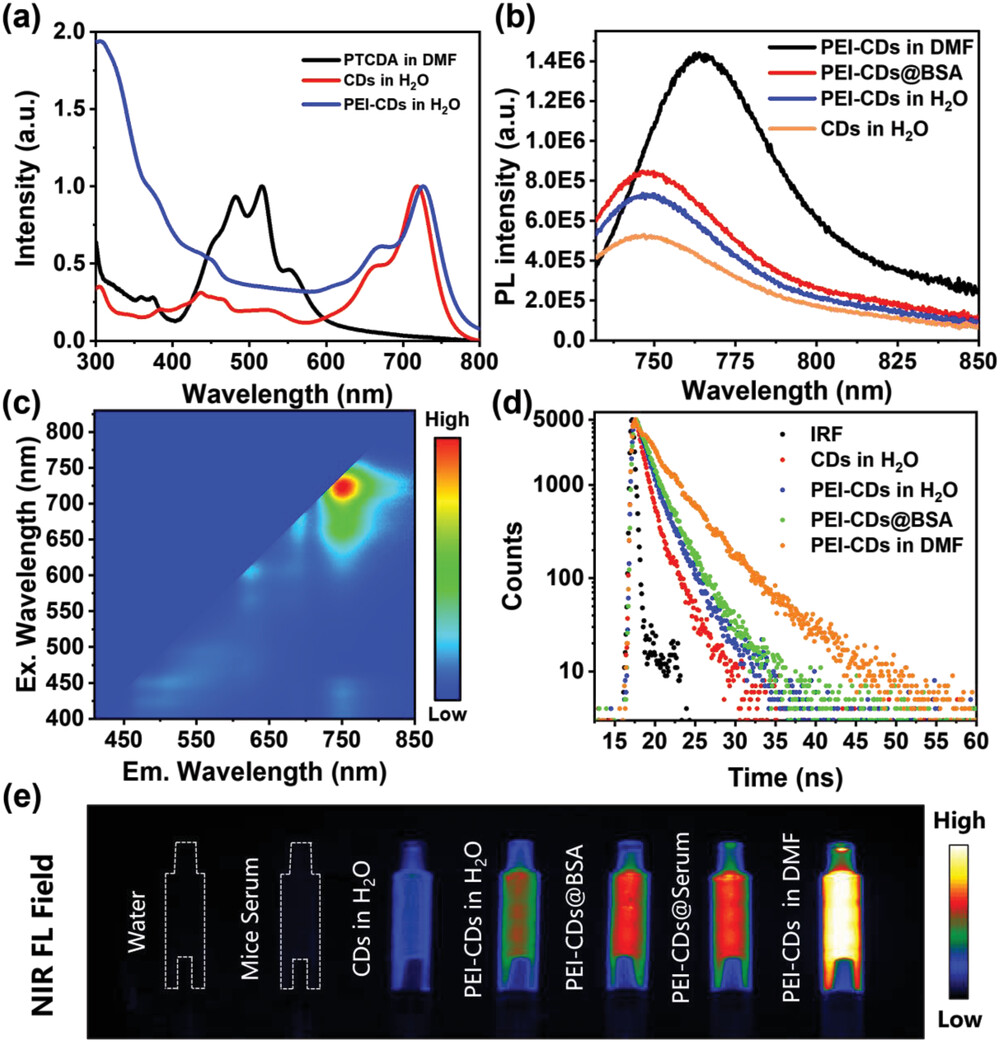
In a second study, Liu et al., Advanced Science (2022), examined surface-modified carbon dots with strong near-infrared absorption and emission (Advanced Science, 2022)
Here, polyethyleneimine functionalization altered surface states and reduced nonradiative losses in aqueous media. Time-resolved photoluminescence measurements on a MicroTime 200 platform showed:
- Increased excited-state lifetimes after functionalization
- Suppression of nonradiative energy dissipation
- Stabilization of emissive states in complex environments
Rather than focusing on spectral shifts alone, the study used lifetime analysis to directly quantify how chemical surface modification influences carrier relaxation pathways.
For nanomaterials research, this example illustrates how optical characterization of nanomaterials must combine chemical control with time-resolved kinetic analysis to understand structure–property relationships.
Power-Dependent Carrier Dynamics in Carbon Dot–Graphene Hybrids
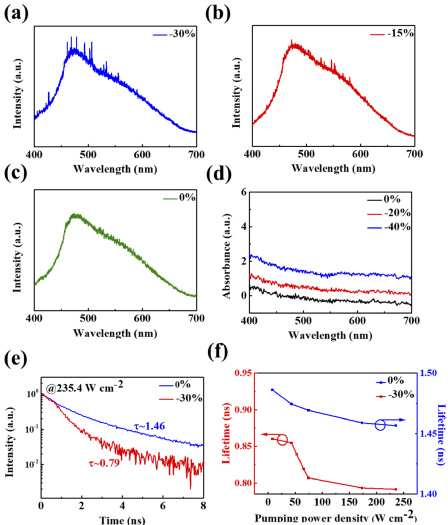
A third study by Lu et al., Opt. Express (2022)2, reported cavity-free white laser emission in carbon dot–graphene hybrid structures.
In this study, time-resolved measurements used picosecond pulsed excitation controlled by a PicoQuant PDL 800-B diode laser driver (374 nm, 55 ps, 1 MHz) to investigate excitation-density-dependent dynamics. Time-resolved photoluminescence (TRPL) decays revealed:
- Shortening of carrier lifetimes with increasing pump power
- Evidence of stimulated emission processes
- Distinct relaxation behavior between deformed and undeformed device architectures
The observed lifetime reduction under high excitation densities indicates that carrier dynamics in nanostructured hybrid systems are strongly excitation dependent. In such cases, TRPL provides direct access to dynamic transitions between spontaneous and stimulated emission regimes.
Shared Measurement Requirements
Across these three nanomaterials research studies, several common technical requirements emerge:
- High temporal resolution: Nanosecond and sub-nanosecond decay components must be resolved accurately.
- Single-photon sensitivity: Weak emission from nanoscale emitters requires photon-counting detection.
- Quantitative decay analysis: Multi-exponential fitting and rate extraction are necessary to separate radiative and nonradiative pathways.
- Confocal spatial resolution: Structural heterogeneity in nanostructured materials requires localized measurements.
- Flexible excitation control: Repetition rate and pulse width influence excitation density and dynamic behavior.
Time-resolved photoluminescence nanomaterials experiments therefore rely on TCSPC-based systems capable of combining spectral, spatial, and temporal information within a single measurement framework.
Instrumentation Used in These Studies by PicoQuant
MicroTime 200
Used in the near-infrared carbon dot study, the MicroTime 200 platform supported:
- High-sensitivity single-photon detection
- Flexible excitation source integration
- Lifetime measurements in aqueous and complex media
- Quantitative decay analysis across different environments
This configuration allowed direct comparison of excited-state lifetimes before and after surface functionalization. Its modular confocal architecture supports adaptation of excitation and detection pathways to different spectral ranges and signal intensities. High timing precision combined with single-molecule sensitivity enables reliable lifetime quantification even for weakly emitting nanoscale systems.

MicroTime 100
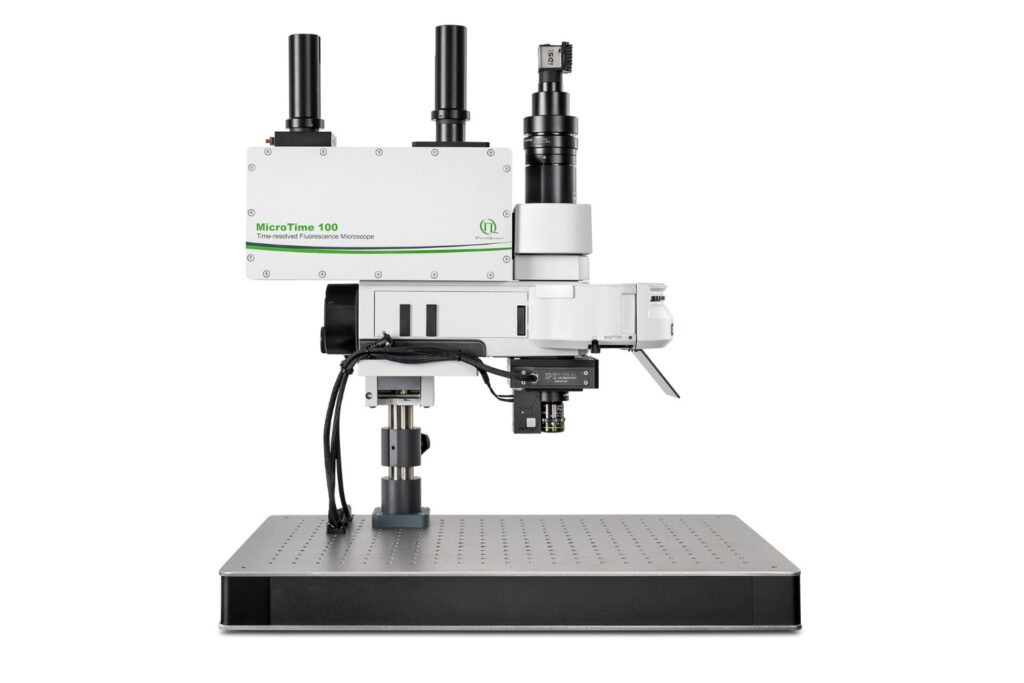
Used in the plasmon-coupled carbon dot study, the MicroTime 100 confocal fluorescence lifetime microscope provided:
- Time-correlated single photon counting (TCSPC) detection
- Confocal spatial resolution for nanoscale structures
- Nanosecond lifetime resolution
- Spectrally resolved emission collection
The system enabled extraction of modified radiative and nonradiative rates in CD–metal nanoparticle complexes. Its upright microscope geometry facilitates measurements on structured or non-transparent material samples, which are common in nanomaterial characterization. Precise timing electronics allow quantitative separation of overlapping decay components across picosecond to nanosecond timescales.
A New Flagship for Materials Science Microscopy
Meet Solira, our new time-resolved photoluminescence microscope designed for sensitive and flexible characterization across semiconductors, nanomaterials, LEDs, solar cells, and quantum systems. Combining TRPL imaging, carrier diffusion imaging, anisotropy imaging, and spectrally resolved measurements within one configurable platform, Solira adapts to diverse materials, sample geometries, and experimental requirements while maintaining high sensitivity and picosecond timing precision.

Conclusion
Nanomaterials research increasingly depends on quantitative optical characterization to understand charge carrier dynamics in nanomaterials. Surface chemistry, plasmon coupling, and hybrid nanostructuring all modify excited-state relaxation pathways. These effects become visible only when temporal resolution is combined with spectral and spatial information.
Time-resolved photoluminescence nanomaterials studies therefore provide more than lifetime values. They enable rate extraction, identification of nonradiative loss channels, and evaluation of excitation-density-dependent processes.
The three studies discussed here illustrate how TCSPC-based confocal platforms contribute to mechanistic insight across different nanostructured materials and hybrid architectures.
Explore the Microscope Systems Used in these Studies:
1 Reference: Irina A. Arefina, Danil A. Kurshanov, Anna A. Vedernikova, Denis V. Danilov, Aleksandra V. Koroleva, Evgeniy V. Zhizhin, Aleksandr A. Sergeev, Anatoly V. Fedorov, Elena V. Ushakova, and Andrey L. Rogach. Carbon Dot Emission Enhancement in Covalent Complexes with Plasmonic Metal Nanoparticles. Nanomaterials 2023, 13, 223. https://doi.org/10.3390/nano13020223
2 Reference: Yupeng Liu, Josh Haipeng Lei, Gang Wang, Zhiming Zhang, Jun Wu, Bohan Zhang, Huiqi Zhang, Enshan Liu, Liming Wang, Tzu-Ming Liu, Guichuan Xing, Defang Ouyang, Chu-Xia Deng, Zikang Tang, Songnan Qu. Toward Strong Near-Infrared Absorption/Emission from Carbon Dots in Aqueous Media through Solvothermal Fusion of Large Conjugated Perylene Derivatives with Post-Surface Engineering. Adv. Sci.2022, 9, 2202283. https://doi.org/10.1002/advs.202202283