Key Highlights
- 10–100× faster FLIM acquisition enables volumetric imaging of live multicellular systems with frame times down to 100 ms
- Parallel time-resolved detection replaces sequential scanning, increasing count rates to hundreds of MHz while maintaining quantitative lifetime accuracy
- Detection and timing architectures define performance limits, shifting FLIM beyond conventional confocal constraints toward high-speed, low-phototoxic imaging
High-speed FLIM for Live Multicellular Systems
Fluorescence lifetime imaging microscopy is widely used to extract functional information from biological systems. Yet in live imaging, FLIM quickly reaches a practical limit. Acquisition speed, photon budget, and phototoxicity are tightly coupled, and improving one typically degrades the others.
This constraint becomes critical in multicellular systems such as organoids, where dynamic processes unfold in three dimensions.
Why Conventional FLIM Becomes the Bottleneck
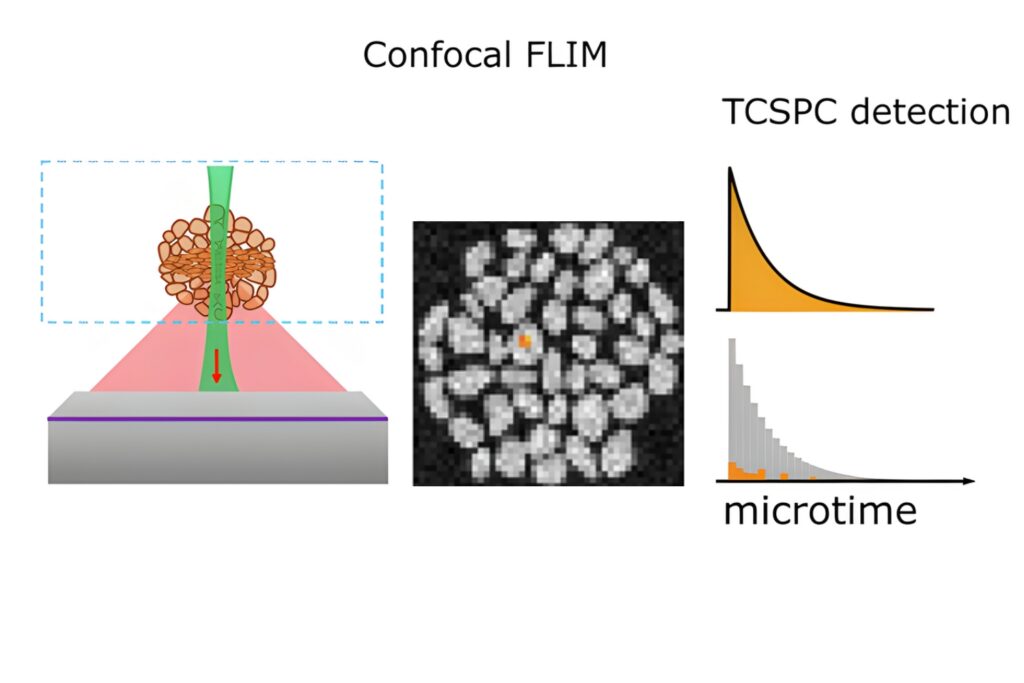
In confocal implementations, FLIM relies on point-by-point acquisition and time-correlated single photon counting. This architecture provides quantitative lifetime information, but at limited photon count rates and relatively long acquisition times.
In the study by Dunsing-Eichenauer et al., Communications Biology (2025)1, conventional TCSPC systems operated in the MHz regime and required acquisition times ranging from seconds to minutes for a single frame. For live samples, this directly translates into phototoxic stress or insufficient temporal resolution.
Parallelization Changes FLIM Performance
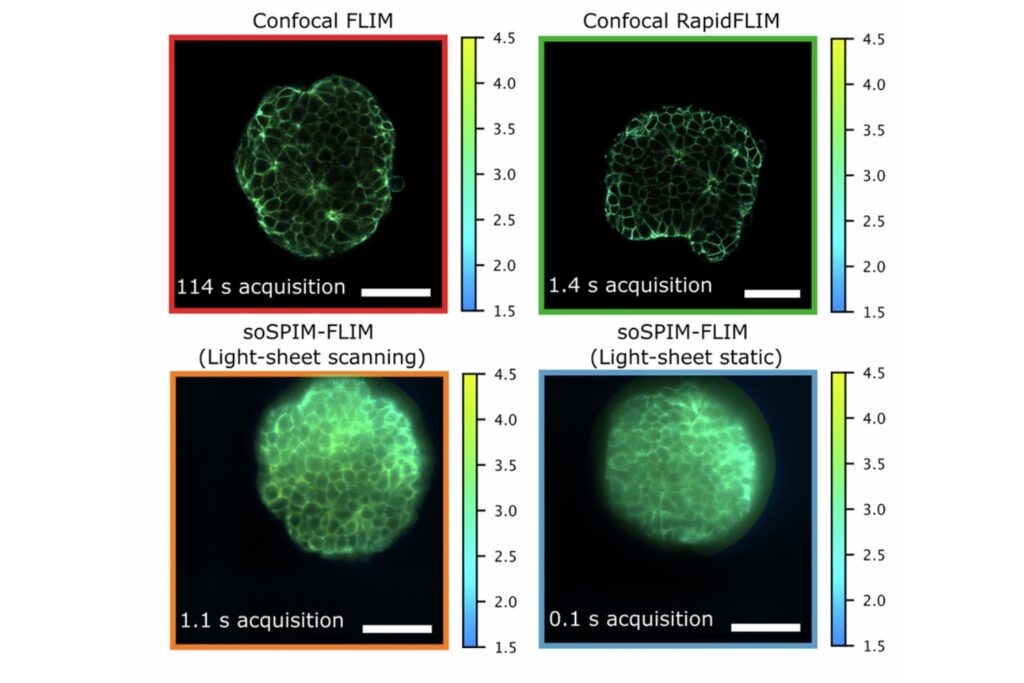
The authors addressed this limitation by combining single-objective light-sheet illumination with time-resolved detection using a SPAD array. Instead of sequential pixel acquisition, photons are recorded in parallel across the field of view. This shift in detection architecture leads to a fundamental change in performance:
- up to 10–100× faster FLIM acquisition
- frame times down to 100 ms
- significantly reduced excitation power densities
- overall count rates reaching hundreds of MHz
Importantly, lifetime values remained in excellent agreement with confocal references, confirming that speed does not come at the expense of quantitative accuracy.
Detection and Timing Define the New Limits
The key insight of this study is not limited to light-sheet microscopy. It highlights a broader transition in FLIM. Performance is no longer primarily limited by optical resolution or scanning mechanics. Instead, it is defined by:
- how efficiently photons are detected
- how precisely arrival times are measured
- how well excitation and detection are synchronized
High-speed FLIM therefore depends on tightly controlled pulsed excitation and timing architectures. These requirements extend across modalities, from confocal TCSPC systems to emerging wide-field and volumetric approaches.
Instrumentation Used in This Study by PicoQuant
LSM Upgrade Kit with PMA Hybrid Detectors
- TCSPC-based lifetime acquisition for confocal microscopes
- high sensitivity hybrid photon detection
- quantitative lifetime readout under controlled count rates

MicroTime 200 Confocal Microscope
- rapidFLIM implementation for high-throughput FLIM imaging
- photon counting rates up to tens of MHz
- used as a confocal reference for quantitative benchmarking

VisUV Picosecond High Power UV Laser
- high-power picosecond excitation at 488 nm
- low-jitter synchronization for time-resolved detection
- pulse widths below 100 ps for precise lifetime measurements
- enabling high-speed gated FLIM acquisition

What This Means for FLIM Workflows
This work shows that scaling FLIM to volumetric and live imaging applications requires more than incremental improvements. It requires a shift in measurement architecture. Parallel detection, high count rate capability, and precise timing control redefine what is experimentally accessible.
For researchers, the implication is clear. Quantitative FLIM at high speed is no longer limited by concept, but by how excitation, detection, and timing are implemented.
Explore instrumentation solutions for high-speed and volumetric FLIM >
1Reference: Valentin Dunsing-Eichenauer, Johan Hummert, Claire Chardès, Thomas Schönau, Léo Guignard, Rémi Galland, Gianluca Grenci, Max Tillmann, Felix Koberling, Corinna Nock, Jean-Baptise Sibarita, Virgile Viasnoff, Ivan Michel Antolovic, Rainer Erdmann, and Pierre-François Lenne. Fast volumetric fluorescence lifetime imaging of multicellular systems using single-objective light-sheet microscopy. Communications Biology 8, 1785 (2025). https://doi.org/10.1038/s42003-025-09221-2